What Is BaZi? A Guide to the Four Pillars of Destiny
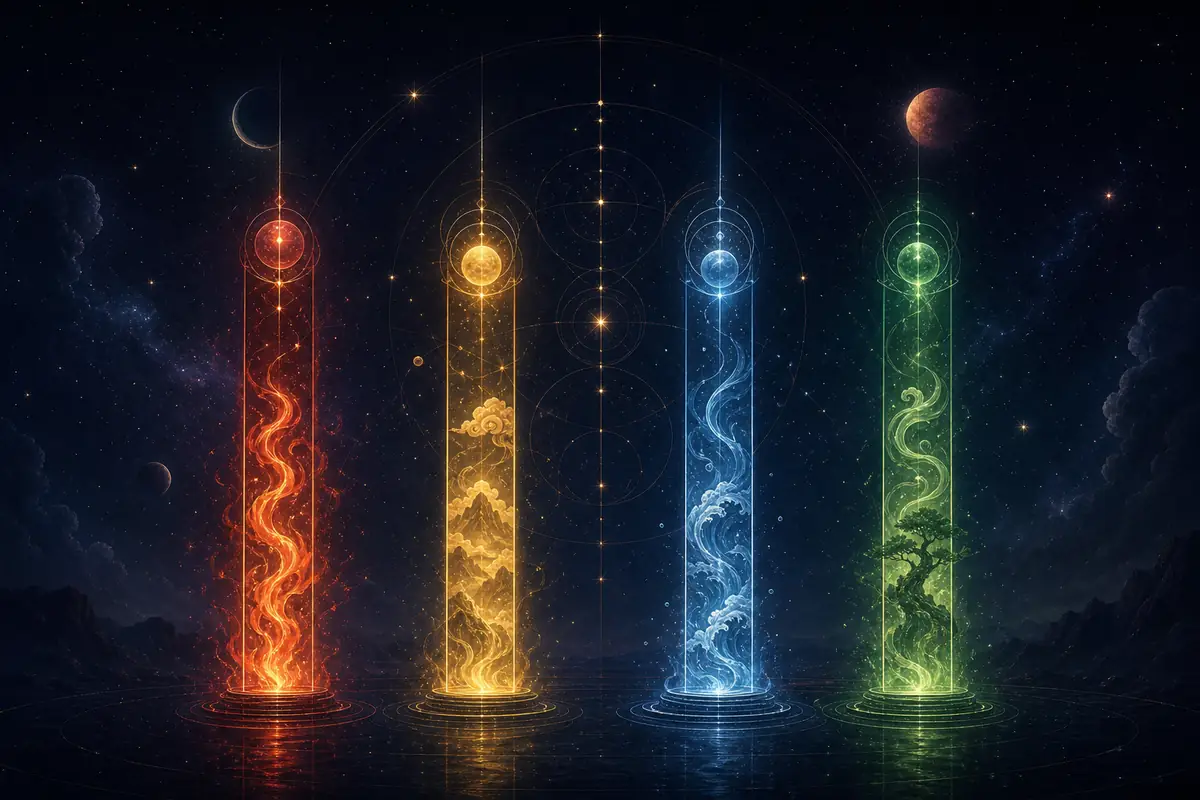
Most people encounter Chinese astrology through a single question: “What is your animal sign?” You say “I'm a Dragon” or “I'm a Rabbit,” and that is usually the end of it. But the full Chinese astrological tradition runs far deeper than a year-based animal cycle. At its heart is BaZi — also called the Four Pillars of Destiny — a system that encodes your exact birth moment into a detailed map of elemental forces, personality, and life timing. If you have ever felt that your Chinese zodiac sign barely scratches the surface, a BaZi reading is where the real depth begins.
Ready to explore your own chart? Open your BaZi chart or create an account to get started.
What Is BaZi? The Eight Characters Explained
The word BaZi (八字) literally means “eight characters.” Those eight characters come from four pairs — one pair for each pillar — and each pair consists of a heavenly stem on top and an earthly branch below. The heavenly stems represent the ten elemental forces that flow through time; the earthly branches correspond to the twelve animals of the Chinese calendar cycle. Together they produce a grid that describes not just who you are, but the elemental climate you were born into.
What makes BaZi sophisticated is that it treats those eight characters as a dynamic system. No element exists in isolation: Wood feeds Fire, Fire creates Earth, Earth holds Metal, Metal produces Water, and Water nourishes Wood again. The productive and controlling cycles between elements — and how they play out across your four pillars — form the foundation of every Four Pillars of Destiny interpretation.
The Four Pillars: Year, Month, Day, Hour
Each of the four pillars carries a distinct meaning:
- Year Pillar — represents your ancestral background, the family you were born into, and the social environment of your early years. This is also the pillar that carries your Chinese zodiac animal, which is why it is the one most people know.
- Month Pillar — describes your parents, your career potential, and the dominant themes of your youth and working life. Because the solar month in BaZi is determined by the sun's position rather than the lunar calendar, the Month Pillar can differ from what you might expect.
- Day Pillar — the most personal of the four. The upper character of this pillar is your day master — the single most important symbol in your entire chart, representing your core self. The lower character often describes your spouse or closest partner.
- Hour Pillar — governs your children, your inner aspirations, and the themes of your later years. Because birth time can be uncertain, a professional practitioner will often verify the Hour Pillar by cross-referencing life events.
Together, these four pillars give a chart that is unique to your exact birth moment — not just your birth year. Two people born in the same year but at different times in different months will have strikingly different BaZi charts even though they share the same Chinese zodiac animal. That is the fundamental gap between a casual year-sign lookup and a genuine Four Pillars of Destiny reading.
The Day Master: Your Core Self
Of all the elements in a BaZi chart, the day master is the most important. It is the heavenly stem sitting at the top of your Day Pillar, and it represents you — your temperament, your natural strengths, and the elemental energy you express most naturally in the world.
There are ten possible day masters, each a combination of one of the five elements in either its Yang or Yin form:
- Yang Wood (Jia) — the towering tree: ambitious, principled, and growth- oriented, with a tendency toward stubbornness.
- Yin Wood (Yi) — the creeping vine: flexible, elegant, and quietly persistent.
- Yang Fire (Bing) — the blazing sun: radiant, generous, and commanding, but prone to overextension.
- Yin Fire (Ding) — the candle flame: warm, nurturing, focused, and illuminating in close relationships.
- Yang Earth (Wu) — the mountain: stable, reliable, and broad-minded, but sometimes slow to adapt.
- Yin Earth (Ji) — the fertile soil: practical, detail-oriented, and quietly supportive.
- Yang Metal (Geng) — the sword: decisive, disciplined, and direct, with a sharp sense of justice.
- Yin Metal (Xin) — the jewel: refined, perceptive, and quality-conscious.
- Yang Water (Ren) — the ocean: resourceful, adaptable, and intellectually wide-ranging.
- Yin Water (Gui) — the rain: intuitive, sensitive, and deeply imaginative.
Once a practitioner knows your day master, they assess whether it is strong or weak relative to the other elements in your chart. A strong day master thrives when its element is not further reinforced — it needs outlets. A weak day master benefits from support. This balance determines which elements are “favorable” for you and which create friction, shaping guidance on everything from career direction to relationship compatibility.
BaZi vs the Chinese Zodiac: A Crucial Distinction
The Chinese zodiac is a twelve-year cycle in which each year is governed by one of twelve animals — Rat, Ox, Tiger, Rabbit, Dragon, Snake, Horse, Goat, Monkey, Rooster, Dog, and Pig. It is beautifully poetic and culturally rich, but it assigns the same sign to everyone born in the same year. In a world of 8 billion people, that means hundreds of millions share “your” animal.
BaZi resolves this limitation by incorporating all four time pillars. Your Year Pillar carries the zodiac animal, yes — but your Month, Day, and Hour Pillars layer in the specific elemental forces active at your birth month, your birth day, and the two-hour window of your birth. The result is a chart that is genuinely unique to you, capable of distinguishing the character and life path of twins born thirty minutes apart.
The Chinese zodiac gives you your clan. BaZi gives you your fingerprint.
This is why serious Chinese astrologers use BaZi — not the zodiac year sign — for in-depth readings on career, relationships, health, and timing. The zodiac is a starting point; the Four Pillars of Destiny is the full map.
Five Elements and Elemental Balance
Every character in your BaZi chart belongs to one of the five elements. An experienced practitioner counts how each element appears — directly as a stem or branch, and hidden within the earthly branches as “hidden stems” — to determine your chart's elemental profile. A chart with three Wood stems and no Metal, for instance, tells a very different story from one where all five elements appear in rough balance.
Elemental balance shapes nearly every conclusion in a reading:
- Career. Your most productive element types — Output, Wealth, Power — indicate natural professional directions.
- Relationships. The Spouse Palace in the Day Pillar and the presence of specific elemental relationships signal compatibility and relational patterns.
- Health. In classical theory, each element corresponds to organ systems: Wood to the liver, Fire to the heart, Earth to the spleen, Metal to the lungs, Water to the kidneys.
- Timing. When a favorable or challenging element arrives through a luck pillar or annual influence, the corresponding life area is activated.
Luck Pillars: The Timing Engine of BaZi
A natal BaZi chart is static — it describes the elemental conditions of your birth. But life unfolds in time, and that is where luck pillars (da yun, or major luck cycles) come in. Each luck pillar spans approximately ten years and introduces a new heavenly stem and earthly branch into your life's elemental climate. Together, luck pillars map the broad chapters of your life.
The age at which your first luck pillar begins — and the specific pillar sequence — is calculated from the Month Pillar and your gender or Yin/Yang polarity. Once that start age is known, your entire life can be mapped in decade-long seasons: periods when your day master is supported and things flow, alternating with periods of challenge and consolidation when the elemental climate works against your natural strengths.
Overlaying annual stems and branches on top of the current luck pillar adds monthly and yearly granularity. This layered timing system is what allows a skilled BaZi practitioner to answer questions like: “When is a good time to start a business?” or “Why has the past two years felt so difficult?” Want to explore your own luck cycles? See your Life Cycles timeline.
What a Serious BaZi Reading Reveals
A thorough Four Pillars of Destiny reading goes far beyond a personality sketch. Depending on the questions you bring, a BaZi practitioner — or a well-trained BaZi AI — can explore:
- Innate strengths and blind spots — which elemental types energise you and which drain you, and how that maps to work styles and relationship dynamics.
- Career direction — whether your chart favours self-employment, leadership, specialist expertise, or creative fields, based on the strength of your Output and Wealth stars.
- Relationship patterns — how your Spouse Palace character interacts with incoming elemental influences, and what partnership dynamics your chart suggests.
- Current life chapter — which luck pillar you are in now, what elemental theme it carries, and how it interacts with your natal chart to explain current circumstances.
- Timing for major decisions — which years or months carry the elemental support to launch, invest, relocate, or commit.
This is why practitioners describe BaZi not as fortune-telling but as “knowing the weather” — you still choose what to do, but you can dress appropriately for the climate.
How an AI BaZi Reading Works
Classical BaZi requires calculating stems, branches, hidden stems, ten-year luck pillars, and the relationships between them — a process that traditionally takes years to learn and hours to apply. Astrologer AI compresses that calculation to seconds.
When you enter your birth date, time, and place, the Chinese astrology module computes your complete four pillars, identifies your day master, calculates elemental balance across all pillars including hidden stems, and plots your full luck pillar sequence. The AI then interprets those results in plain language — explaining what your day master says about your character, which elements are favorable for you, and what your current luck pillar means for the themes active in your life right now.
Crucially, it is conversational. You can ask “Why does my chart suggest caution in partnerships?” or “What does my current luck pillar say about career changes?” and receive an answer grounded in your actual chart — not a generic template. That back-and-forth is what makes an AI BaZi reading different from a printed report: the interpretation stays in dialogue with your specific questions.
Because Astrologer AI unifies multiple systems, you can also compare your BaZi reading with your Western natal chart, your Vedic dashas, or your numerology profile in the same session — letting different traditions illuminate the same life question from different angles.
Ready to read your Four Pillars of Destiny? Open your BaZi chart or create your account to begin.
Frequently Asked Questions
What is BaZi?
BaZi (also written Ba Zi or 八字, meaning 'eight characters') is a Chinese astrological system that converts your birth year, month, day, and hour into four pairs of heavenly stems and earthly branches. Those eight characters map the interplay of Yin and Yang across the five elements — Wood, Fire, Earth, Metal, and Water — to reveal personality, strengths, challenges, and the timing of major life chapters.
What are the Four Pillars of Destiny?
The Four Pillars of Destiny is the English name for BaZi. The four pillars are the Year Pillar (your family and ancestry), the Month Pillar (your parents, career, and early life), the Day Pillar (your self and your closest relationships), and the Hour Pillar (your children, aspirations, and later years). Each pillar holds two characters — a heavenly stem on top and an earthly branch below — giving eight characters in total.
What is a day master in BaZi?
The day master is the heavenly stem of your Day Pillar — it represents your core self in BaZi. There are ten possible day masters, each corresponding to one of five elements in either its Yin or Yang polarity (for example, Yang Wood or Yin Fire). The day master is the lens through which the rest of your chart is read: a strong day master thrives when supported, while a weak one benefits from different elemental combinations.
What is the difference between BaZi and the Chinese zodiac?
The Chinese zodiac (Sheng Xiao) assigns one of twelve animal signs based solely on your birth year — everyone born in 1990 is a Horse, for instance. BaZi uses all four time pillars (year, month, day, and hour) and analyses the full interaction of ten heavenly stems and twelve earthly branches across five elements. A BaZi chart is therefore unique to your exact birth moment, while the Chinese zodiac year sign is shared by hundreds of millions of people.
What are luck pillars in BaZi?
Luck pillars (da yun, or major luck cycles) are ten-year periods that activate different parts of your BaZi chart in sequence. Each pillar brings a new heavenly stem and earthly branch into contact with your natal chart, shifting which elements are strong or weak in your life. Astrologers use luck pillars alongside annual and monthly influences to time important decisions around career, relationships, and finances.
How does an AI BaZi reading work?
An AI BaZi reading starts by computing your exact four pillars from your date, time, and place of birth. The system identifies your day master, evaluates elemental balance, and maps your current luck pillar and annual stem-branch. A language model then interprets those calculations in plain language and lets you ask follow-up questions about career, relationships, health, or timing — turning a complex classical chart into a two-way conversation.