Vedic vs Western Astrology: Sidereal, Tropical, and What Actually Differs
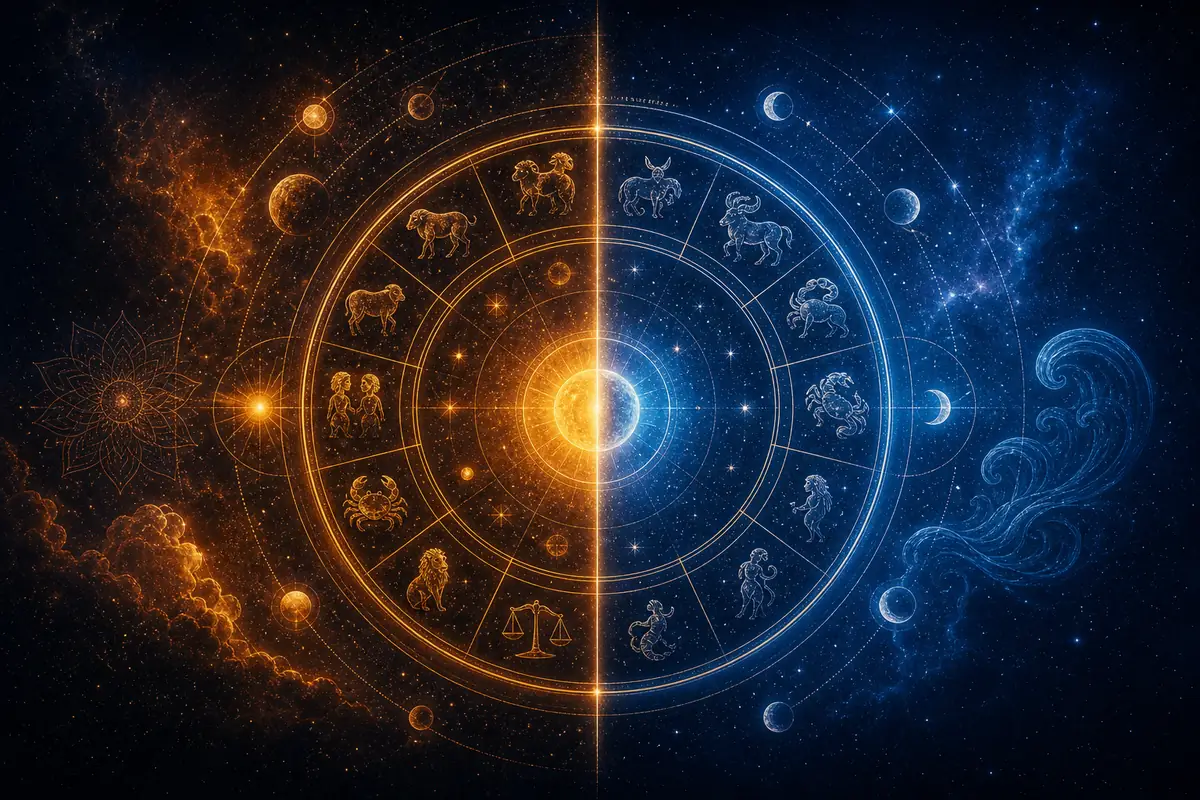
If you have ever looked up your chart in a Vedic app and noticed that your Sun sign, Moon sign, or rising sign shifted — sometimes by a whole sign — you have already run into the central puzzle of Vedic vs Western astrology. Both traditions read the sky at the moment of your birth, yet they can describe you in noticeably different terms. Understanding why clarifies both systems, and helps you decide how to use them together rather than choosing one and dismissing the other.
Astrologer AI supports both Vedic astrology and Western astrology from a single birth profile, so you can compare them side by side in one conversation. Create your profile and see exactly where your planets fall in each system.
The Root Difference: Tropical vs Sidereal Zodiac
Every other difference between Vedic and Western astrology flows from one foundational choice: which zodiac do you use?
Western astrology uses the tropical zodiac. The tropical zodiac is pegged to the seasons. Zero degrees Aries always coincides with the spring equinox in the Northern Hemisphere — the moment the Sun crosses the celestial equator heading north. The signs are equal 30-degree slices of the ecliptic measured from that seasonal anchor point. The actual constellations are irrelevant; what matters is the Earth's relationship to the Sun.
Vedic astrology uses the sidereal zodiac. The sidereal zodiac is pegged to the fixed stars. Zero degrees Aries is aligned (more or less) with the actual star cluster the ancient Babylonian and Indian astronomers used as a reference. The signs track where the constellations truly are in the sky, not where the seasons say they should be.
Why the Two Zodiacs Diverge: Precession and the Ayanamsa
Earth's axis wobbles slowly, like a spinning top that is gradually tilting. This wobble, called the precession of the equinoxes, means the spring equinox point drifts backward through the sidereal sky at roughly 50 arc-seconds per year — a full 360-degree cycle every ~26,000 years. When Western astrology's Hellenistic foundations were being laid around 200 BCE, the two zodiacs were almost perfectly aligned. They have been drifting apart ever since.
Today, the gap between the tropical and sidereal zodiacs — called the ayanamsa — is approximately 23 to 24 degrees, depending on which ayanamsa calculation a Vedic astrologer uses (Lahiri is the most common in India; Fagan-Bradley is popular in Western sidereal astrology). Since each sign spans 30 degrees, a 23–24 degree offset means that most planets will fall in a different sign in your Vedic chart than in your Western chart. A Sun at 10° Taurus (tropical) lands at roughly 16–17° Aries (sidereal).
The ayanamsa is not an error in either system — it is a deliberate philosophical choice about what the zodiac measures: seasonal cycles versus stellar positions.
Why Your Sign Can Differ Between Systems
The most common surprise for newcomers to Vedic astrology is discovering that their Vedic sign is different from the one they have identified with for years. Here is what actually happens:
- Sun sign. If your Sun is in the first half of any Western sign (say, 1°–24° of that sign), it almost certainly shifts back one full sign in your Vedic chart. If your Sun is in the last few degrees of a sign, it may stay in the same sign across both systems, but this is less common.
- Moon sign. The Moon moves roughly one degree every two hours, so even a small shift can place it in a different sign. In Vedic astrology the Moon sign (called the Rashi) is weighted at least as heavily as the Sun sign, often more so.
- Rising sign (Ascendant). The Ascendant changes sign roughly every two hours. The sidereal shift can move it into the previous sign, which then repositions every house in your chart.
- All other planets. Mercury, Venus, Mars, Jupiter, Saturn, and the classical Vedic points (Rahu and Ketu, the lunar nodes) all shift back by roughly the same ayanamsa amount.
None of this means one system is “wrong.” It means the two systems are measuring different things with the same planets, and the interpretation tradition built around each zodiac has evolved to work with that zodiac's logic.
Timing: Dashas (Vedic) vs Transits (Western)
Beyond the zodiac, the biggest practical difference between Vedic and Western astrology is how each system handles time and prediction.
The Dasha System in Vedic Astrology
Vedic astrology's most celebrated predictive tool is the dasha system. The most widely used variant, Vimshottari dasha, assigns each of the nine classical planets a fixed rulership period — the Moon rules 10 years, the Sun 6 years, Saturn 19 years, and so on, totaling 120 years for a full cycle. Your starting dasha is determined by the Moon's position in one of 27 lunar mansions (nakshatras) at birth.
Within each major dasha, there are sub-periods (antardashas) and sub-sub-periods (pratyantardashas) that refine the timing to months and weeks. When a practitioner says “you are in your Saturn dasha,” they mean a 19-year chapter colored by Saturnine themes — discipline, limitation, long-term building — is currently active. This system gives Jyotish a reputation for remarkably specific life-chapter predictions.
Transits and Progressions in Western Astrology
Western astrology relies primarily on transits — the ongoing movement of planets through the sky as they form angles (aspects) to the planets in your natal chart. A Saturn transit to your natal Sun, for example, typically brings a period of testing and consolidation. Secondary progressions, solar arc directions, and solar returns add further layers of timing.
Transits are dynamic and continuous; the sky is always moving, so there is always something active. Dashas are more like chapters — long, thematic arcs that provide a background color against which transits operate. Many contemporary astrologers who study both systems overlay dasha periods with transits to get a richer picture.
Other Key Structural Differences
House Systems
Western astrology uses several competing house systems (Placidus is the most common, followed by Koch, Equal, and Whole Sign). Vedic astrology predominantly uses Whole Sign houses, where the rising sign occupies the entire first house, the next sign the second house, and so on. This can shift planets from one house to another when comparing the two traditions.
The Outer Planets
Classical Vedic astrology works with seven planets visible to the naked eye — Sun, Moon, Mercury, Venus, Mars, Jupiter, Saturn — plus Rahu and Ketu (the lunar nodes). Uranus, Neptune, and Pluto, discovered in the modern era, are incorporated into Western astrology as major outer-planet archetypes but play little or no role in traditional Jyotish. This is one reason the two systems can feel philosophically different: Western astrology has absorbed modern psychological symbolism via Uranus, Neptune, and Pluto, while Vedic astrology has preserved an older, fate-oriented framework.
Divisional Charts (Vargas)
Vedic astrology uses a sophisticated system of divisional charts called vargas. The Navamsa (D9 chart, dividing each sign into nine parts) is used for marriage and spiritual potential. The Dashamsa (D10) focuses on career. There are 16 standard divisional charts and more in advanced practice. Western astrology has no direct equivalent, though harmonic charts are a partial analogue.
What Each System Is Best At
Rather than debating which system is “more accurate,” it is more useful to recognize what each does well:
- Western astrology excels at psychological portrait work — mapping character, inner conflicts, relationship dynamics, and the symbolic story of a life. Modern Western astrology has deeply integrated Jungian and humanistic psychology, making it a powerful tool for self-understanding. Aspects and outer-planet transits are especially rich for tracking inner development.
- Vedic astrology excels at predictive specificity and karmic framing. The dasha system, nakshatras, and divisional charts give practitioners tools for timing life events — marriages, career shifts, health cycles — with a level of precision that practitioners of Western astrology often envy. Jyotish also has a strong tradition of remedial measures (upayas), such as gemstones and mantras, to mitigate challenging planetary periods.
Using both together — as Astrologer AI makes easy — means you get the psychological depth of Western interpretation and the timing precision of Vedic dashas, all from one birth profile.
Which System Should You Start With?
There is no universally correct answer, but here are practical starting points:
- Start with Western if you are new to astrology, want a psychological framework, or are primarily interested in character and relationships. The tropical zodiac signs and modern planet archetypes (including Uranus, Neptune, and Pluto) are well documented in English and widely taught.
- Start with Vedic if you are interested in timing and prediction, are drawn to Indian philosophical traditions, or find that the sidereal placements resonate more with your experience. The Moon sign and rising sign carry tremendous weight in Jyotish — many practitioners feel the Vedic chart describes their “inner self” with striking accuracy.
- Use both if you want the fullest picture. Most experienced practitioners find the two systems complementary rather than contradictory. Your Western Sun sign and your Vedic Moon sign can both be valid descriptions of different facets of who you are.
Explore your Vedic chart or your Western chart in Astrologer AI, or ask the AI to compare both directly. Create your profile to see both systems side by side from a single birth entry.
Vedic and Western Astrology in Astrologer AI
Astrologer AI was built specifically so you do not have to choose. Both Vedic astrology and Western astrology are calculated from the same birth profile — date, time, and place — so the switch between them is instant. You can ask questions like “Where does my Moon fall in each system and what does that mean?” or “I am in my Saturn dasha — what do the Western transits say about this period?” and receive one coherent, personalized answer.
The AI also explains the mechanics as you go, so whether you are encountering the sidereal vs tropical zodiac debate for the first time or already familiar with dashas and vargas, you will find an appropriate level of depth. This is the advantage of a conversational approach: the system meets you where you are rather than defaulting to a fixed report format.
Both systems have been practiced for thousands of years and continue to offer genuine insight to millions of people worldwide. The difference between Vedic and Western astrology is not a reason to pick a winner — it is an invitation to see your life through two complementary lenses at once.
Frequently Asked Questions
What is the difference between Vedic and Western astrology?
The core difference between Vedic and Western astrology is the zodiac they use. Western astrology uses the tropical zodiac, anchored to the seasons (the Sun enters Aries at the spring equinox). Vedic astrology uses the sidereal zodiac, anchored to the fixed stars. Due to the slow wobble of Earth's axis called precession, the two zodiacs have drifted about 24 degrees apart — so most planets and your Sun sign will fall in a different sign depending on which system you use. Beyond the zodiac, Vedic astrology places greater emphasis on the Moon sign and rising sign, uses a different house system (whole sign houses by default), and has a unique timing system called dashas, while Western astrology relies more on transits and progressions for timing.
What is the difference between the sidereal and tropical zodiac?
The tropical zodiac divides the sky relative to the Earth-Sun relationship: 0° Aries always marks the spring equinox, regardless of where the stars actually are. The sidereal zodiac divides the sky relative to the background stars, so 0° Aries stays aligned with the fixed star cluster the ancients used as a reference. Because Earth's axis wobbles over a roughly 26,000-year cycle (precession of the equinoxes), the two systems drift apart at about 50 arc-seconds per year. Today that gap, called the ayanamsa, is roughly 23–24 degrees. Practically, this means a planet at 10° Taurus in the tropical system appears at about 16–17° Aries in the sidereal system.
Why is my Vedic sign different from my Western sign?
Your Vedic sign differs from your Western sign because Vedic astrology uses the sidereal zodiac, which is currently about 23–24 degrees behind the tropical zodiac used in Western astrology. If your Sun is near the beginning of a sign in Western astrology, it will almost always fall in the previous sign in your Vedic chart. People born in the middle of a sign may stay in the same sign in both systems, but this is less common. The Moon and rising sign are also recalculated, which can shift your Vedic profile noticeably relative to your Western one.
Which is more accurate, Vedic or Western astrology?
Neither system is objectively more accurate — they are different frameworks built on different philosophies. Western astrology, rooted in Hellenistic and later Renaissance traditions, is strong for psychological insight, character mapping, and relationship dynamics via aspects and modern planets. Vedic astrology (Jyotish), rooted in the Sanskrit texts called Vedangas, is often praised for its predictive precision, especially through the dasha timing system, and its emphasis on karma and life purpose. Many practitioners study both. The most useful approach is to explore what resonates with you, using both lenses side by side rather than treating them as rivals.
What are dashas in Vedic astrology?
Dashas are planetary periods unique to Vedic astrology. The most widely used system, Vimshottari dasha, assigns each planet a specific number of years that it 'rules' in sequence — the full cycle spans 120 years. The planet ruling your dasha at any given time colors the themes, opportunities, and challenges of that life chapter. Sub-periods (antardasha) and sub-sub-periods refine the timing further. Dashas are one of the most distinctive and powerful features of Jyotish, giving it a reputation for precise timing that differs from Western astrology's transit-based approach.