Mars Conjunction Saturn: Aspect Meaning & Interpretation
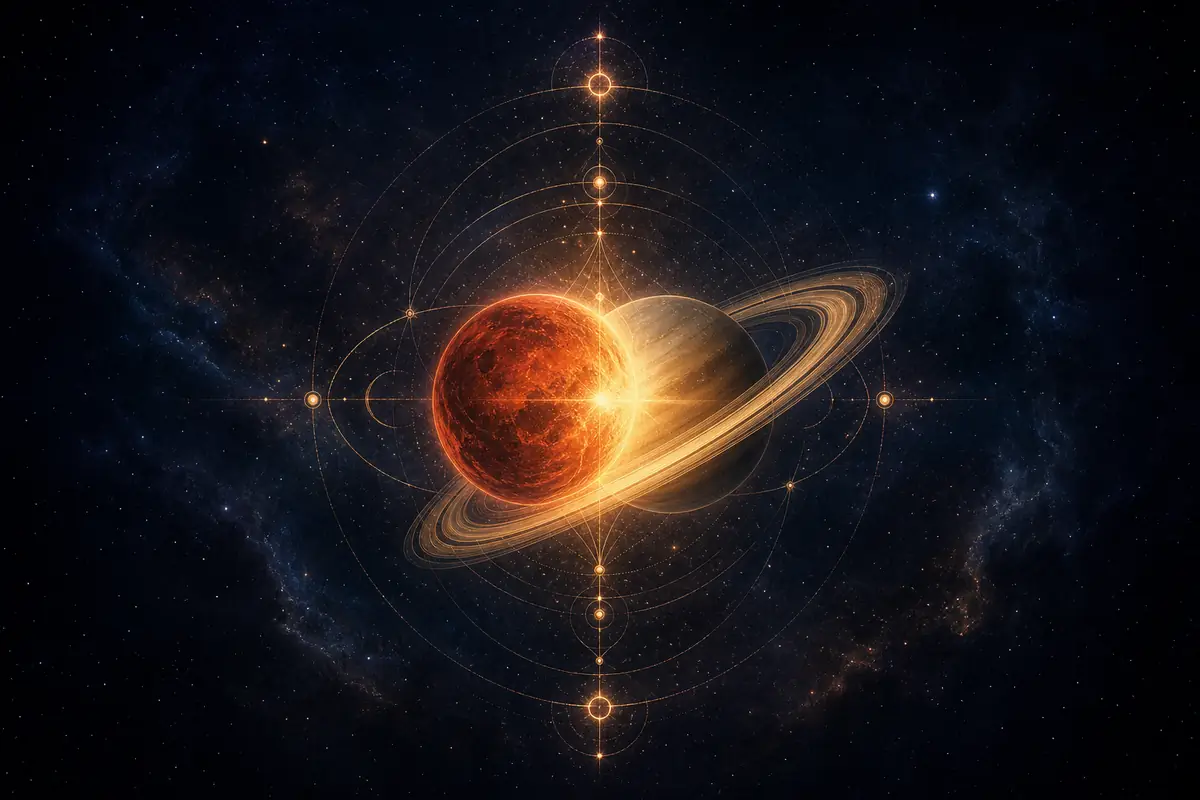
Two planets that traditional astrology treats as difficult share one spot in a Mars–Saturn conjunction. Mars, the lesser malefic of the night sect, is the planet of heat, appetite and the urge to move; Saturn, the greater malefic of the day sect, is the planet of limits, time and the weight of responsibility. Joined at 0°, the accelerator and the brake operate as a single function, and neither can easily act without the other registering it. One way to read this is as drive that has learned to ration itself, or as restraint that never fully stops pushing. The pairing describes effort under pressure, and the questions it raises are about timing and cost more than about whether to act at all.
The accelerator and the brake in one place
A conjunction merges two planets rather than setting them in conversation, so Mars and Saturn do not trade turns. They colour each other continuously. Mars wants to act now; Saturn asks what the cost will be and how long it must last. The result can be read as deliberate force: energy released in measured amounts, aimed at something that has been thought through.
A person with this pairing may feel an impulse and a refusal arrive at the same moment, so that anger is swallowed or delayed, or ambition sets a very high bar before it will begin. Sign and house give the merger a setting: the sign shows the manner, from blunt in fire to methodical in earth, and the house shows the arena where effort and caution are both most visible. A tighter orb fuses the two functions more completely.
Two malefics, no benefic to soften them
In the Hellenistic scheme, Mars is the lesser malefic and Saturn the greater, and one belongs to the night while the other belongs to the day. Meeting in a conjunction, they sit in one place with no benefic planet in the pair. That does not make the aspect a verdict of hardship; it means neither body brings the generosity that Jupiter or Venus would, so the combination is read as austere.
Malefic is a technical term for planets that tradition links with difficulty. Skills such as patience, courage and discipline can grow from a pairing like this, though the aspect does not guarantee them and they depend on how the person uses the energy.
The Mars–Saturn conjunction places the two malefics in a single point, so the chart's drive and its discipline are the same thing rather than two parts at odds.
How rare is this pairing?
About 3.2% of charts have a Mars–Saturn conjunction, using a 6° orb. That is among the lowest conjunction shares in the pair table, so it is an uncommon aspect. The two planets meet in the sky about every 2.0 years. The figure is a count of charts and says nothing about strength; what matters in a given chart is how close the two bodies are, where they sit and which other planets touch them.
Stamina, patience and a controlled temper
The conjunction can be linked with qualities that reward time and care. Scenes that fit the pattern include:
- Endurance that suits long projects and slow training
- Careful, methodical handling of tools, plans or money
- A temper kept on a short leash, shown rarely and with purpose
- A strong reluctance to start something that cannot be finished well
Courage that waits for a plan
Mars is the planet of nerve and Saturn the planet of preparation, so a conjunction can describe someone whose bravery is not impulsive. The person may hold back in a crisis only until the ground has been surveyed, and then act with a steadiness that others find reassuring. One way to see it is courage that has been rehearsed.
The cost is hesitation. If Saturn's demand for a flawless plan wins out, a good moment can pass while the plan is still being checked. A conjunction gives no outside referee, so the person has to decide for themselves when preparation has become delay.
When restraint turns into frustration
The shadow side of the pairing is pressure with no outlet. Mars wants to act, Saturn withholds permission, and the unspent heat can show up as irritation, bodily tension or a sense of being blocked. One way to see it is that the aspect needs a regular channel, and work that requires sustained physical or mental effort gives both planets something to do, since it asks for force and discipline at once.
Slow craft as an outlet
Activities where progress is visible and gradual suit a pairing that distrusts shortcuts: training with measurable stages, building or repairing things by hand, or any discipline with clear milestones. A hard task planned in stages gives Saturn the structure it seeks and gives Mars a steady stream of small wins.
How aspects tie a birth chart together — read the guide →
Get your personal AI birth chart reading — create a free account →
Frequently Asked Questions
Does having no benefic in the pair make this conjunction harmful?
Not by itself. Mars and Saturn are the two traditional malefics, so nothing in the pair adds Jupiter's or Venus's generosity, and the combination reads as austere. That describes a serious, effortful tone rather than a bad outcome, and the rest of the chart can add warmth or ease.
Is the Mars–Saturn conjunction really that uncommon?
Using a 6° orb, about 3.2% of charts carry it, which is among the lowest conjunction shares in the pair table. The two planets meet about every 2.0 years, and the share counts charts, not strength.
How does the conjunction differ from the Mars–Saturn square?
A conjunction merges the two planets into one function at 0°, so drive and restraint arrive together. A square at 90° sets them against each other, so the friction is felt as a push and a check in turn. Both are traditional hard combinations, but the conjunction is more concentrated.
What tends to ease the pressure of this conjunction?
Steady, physical or craft-based work can help, because it gives Mars something to do and gives Saturn a structure to respect. Clear goals, enough rest and early conversation about frustration can all stop the pressure from building into a block.