North Node in Cancer: Your Growth Direction
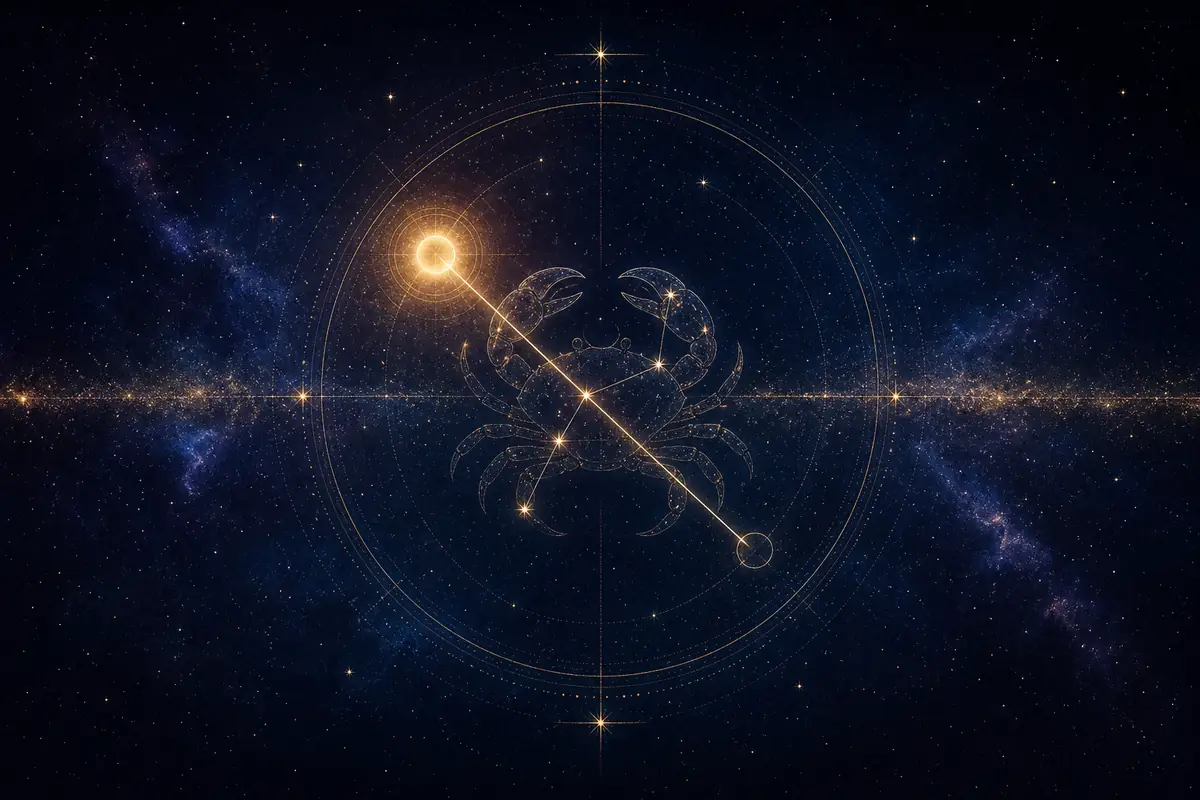
The lunar nodes mark two points, not two bodies — the places where the Moon's orbit crosses the Sun's apparent path, always exactly opposite one another. North node in Cancer fixes south node in Capricorn; it is one axis, not two separate placements. Capricorn is the end you already run fluently: achievement, duty, standing on your own record. Cancer is the direction the chart is asking you to grow toward, and everything below follows from that one fact.
Not a body, so not a dignity
Domicile, exaltation, detriment, fall, peregrine — the entire language of essential dignity describes how an actual planet sits in a sign it owns, is honoured in, or holds no formal standing in. The nodes were never eligible for that system, because they are not planets to begin with; they are the intersection of two orbital planes, recalculated for each chart. No rulership, no exaltation, not even peregrine, a term that presumes a body capable of holding dignity in the first place. North node in Cancer carries none of it — only the Cancer–Capricorn axis it forms with its south node.
Capricorn, and the competence mistaken for a personality
Building a record, being visibly responsible, letting achievement stand in for whatever softer thing was actually needed — south node in Capricorn does this well, and the competence is real, which is precisely why it is so hard to set down. What gets quietly lost underneath the doing is the identity that isn't attached to it: being cared for without having produced anything first starts to feel unearned, almost embarrassing, rather than simply allowed.
Being looked after is not a step backward
Growth toward Cancer is not an argument against responsibility. It is permission to let feeling and belonging count as legitimate on their own terms, without a title or a finished task attached to them first. Cancer doesn't ask you to stop being capable. It asks whether you can be held by someone without first having earned it that week, and whether comfort offered without conditions can be received rather than quietly deflected. That reception is the genuinely unfamiliar skill here, not the capability — you already have plenty of that.
- Measuring your worth by output, versus letting worth exist without a receipt attached.
- Managing a family the way you'd manage a team, versus simply belonging to one.
- Deflecting comfort until it has been earned, versus letting it be given first.
- Treating vulnerability as a liability, versus treating it as information.
- Confusing being needed with being loved.
Two cardinal signs, two different ways of going first
Cancer and Capricorn are both cardinal signs, so this axis was never about whether you initiate — both ends do. Capricorn initiates upward, toward a structure, a title, a public record that others can verify. Cancer initiates inward, toward a home, a bond, a feeling that doesn't need external verification to be real. Growing toward Cancer doesn't make you less of a starter; it changes what you're building toward when you start.
A circuit of eighteen point six years, entered again at 37
The node spends roughly 18 months in each sign, moving backwards through the zodiac unlike every planet, and completes a full circuit in about 18.6 years. The nodal return that follows falls at approximately ages 18–19, 37 and 55 — and the return near 37 lands squarely inside the years achievement and duty are often at their loudest, which is exactly when this axis tends to reopen the older question of whether the record was ever the point, or only ever the cover story for it.
North node in Capricorn faces the opposite direction
The same axis, read from its other end, belongs to someone with north node in Capricorn — their growth runs away from the safety of family and the familiar, toward public responsibility and standing on the record. That page and this one describe one axis from two directions, and neither end is the finished or superior version of the other.
This axis carries no dignity to weigh, only a direction — Cancer asking to be cared for where Capricorn has spent a lifetime earning the right to be.
What is a birth chart? Read the full guide →
Get your personal AI birth chart reading — create a free account →
Frequently Asked Questions
The Moon rules Cancer, and these are lunar nodes — does that combination count for something?
No. Despite the name, the lunar nodes aren't Moon-ruled bodies — they're the points where the Moon's orbit crosses the Sun's apparent path, and Cancer's rulership by the Moon doesn't transfer any dignity to them. North node in Cancer has none — only the Cancer–Capricorn axis it forms with its south node.
Why does comfort need to be earned first with a Capricorn south node?
Because south node in Capricorn has spent a lifetime treating achievement as the price of belonging, so care that isn't preceded by producing something can feel unearned rather than simply available. The growth work is letting feeling and belonging count on their own terms.
Why does the Cancer–Capricorn question tend to sharpen again around age 37?
The node completes its backward circuit in about 18.6 years, with returns to this axis landing near ages 18–19, 37 and 55. The return near 37 often coincides with peak career and duty years, which is usually when the older question — whether the record was ever the point — comes back loudest.
Capricorn and Cancer both initiate — where does the resemblance end?
It ends at what each is building toward. Capricorn initiates upward, toward a structure or title others can verify. Cancer initiates inward, toward a bond or feeling that doesn't need outside verification to be real. Growing toward Cancer doesn't make you less of a starter — it changes what you're starting toward.