Jupiter in Capricorn: Growth, Luck & Belief
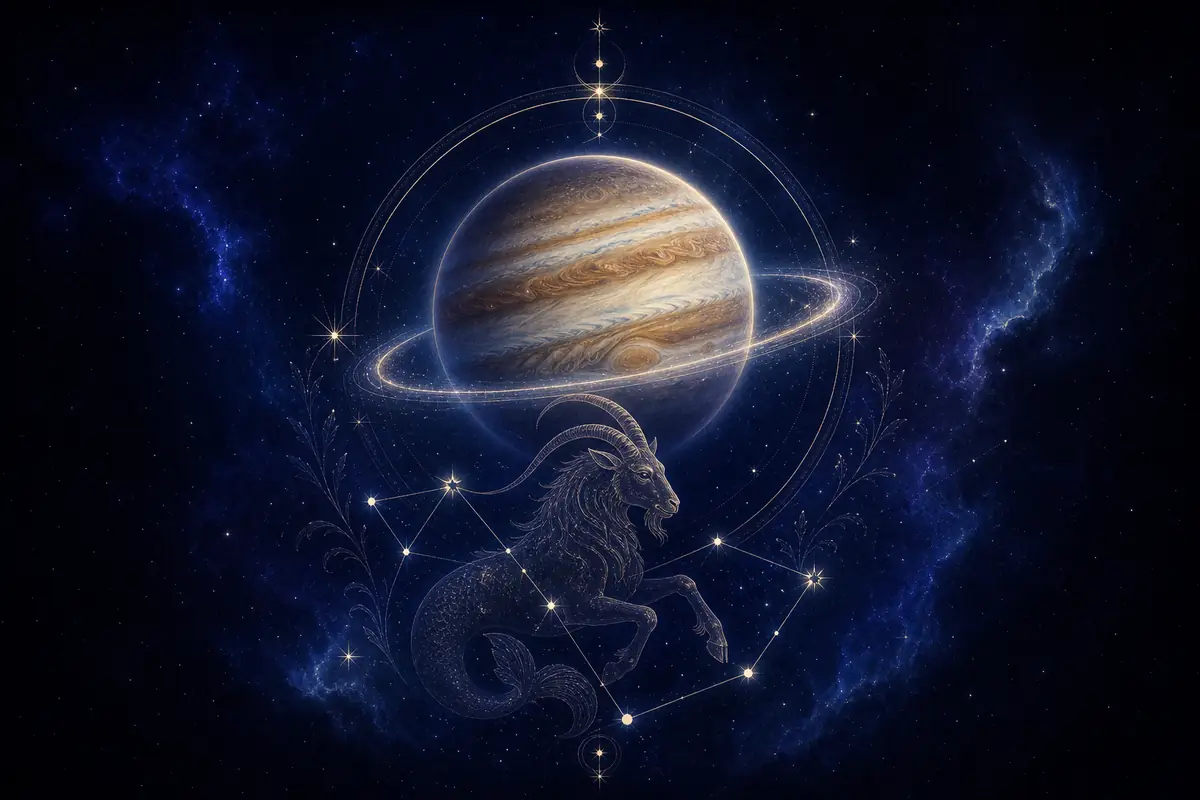
Fall is the sign directly opposite a planet's exaltation, and Jupiter's exaltation is Cancer, exact at 15° — so Capricorn is where the planet of expansion meets the sign built to test whether anything is actually worth keeping. Because Jupiter moves through a sign for about a year, this placement is shared across a whole birth cohort rather than marking one person out; what varies is not whether you have it but what you do with growth that has to earn its place before it is allowed to stay. Fall has a reputation as one of astrology's disappointing placements. Capricorn is the strongest case against that reputation.
Fall lands on the exact degree of Jupiter's Cancer exaltation
Every planet has a sign where it is honoured above its usual station, and the sign directly opposite that one is its fall. Jupiter is exalted at 15° Cancer, so its fall sits at the same degree of Capricorn. Fall is a distinct dignity category, different from detriment, describing a structural mismatch between a planet's natural mode and the sign it occupies — not a personal failing, and not simply 'weak'. Here the mismatch is exact: Cancer feeds and shelters what Jupiter wants to expand; Capricorn tests it against a standard before letting it through.
Why one of astrology's least popular placements is its most defensible
Jupiter's ordinary fault is excess — belief that outruns evidence, generosity that outruns means, growth that never pauses to check whether it is worth having. Capricorn is Saturn's own sign, built around sequence and the discipline to say not yet. Put the two together and Jupiter's expansiveness has to survive an actual gatekeeper rather than simply gathering more. The result is not less growth; it is growth that gets tested, so what remains afterward tends to hold up under weight in a way that untested Jupiter often does not.
A generation apprenticed to delay
Jupiter spends roughly a year in each sign and about twelve years crossing the whole zodiac, so a Capricorn Jupiter belongs to an entire birth-year cohort rather than to any single chart. It functions closer to a mood a generation absorbed early — belief tempered by consequence — than to an individual trait, and it resurfaces on Jupiter's roughly twelve-year return cycle, at ages near 12, 24 and 36, as a recognisable pattern rather than a one-off fact of birth.
Cardinal earth means nothing grows before it is approved
Capricorn is cardinal, the modality that initiates, paired with earth's insistence on something durable and provable. Growth here does not wait for permission from outside circumstances — it starts by building the structure capable of holding whatever expands within it. That is a different order of operations from Cancer's cardinal water, which starts by making an emotional home first: Capricorn builds the container, then fills it, rather than filling before there is anywhere for the growth to live.
Three rulers, three earth signs, no relief from the audit
The first decan, 0–10°, is ruled by Saturn through Capricorn itself — the most concentrated version of the fall, discipline meeting expansion directly. The second, 10–20°, comes under Venus through Taurus, adding patience and a preference for growth you can actually hold. The third, 20–30°, comes under Mercury through Virgo, where expansion gets checked against detail before it is trusted. All three decan rulers pass through earth signs here, so there is no stretch of the sign where the standard relaxes.
The particular ways the gate says not yet
- Opportunities get delayed by a review process that rarely gets waived.
- Optimism arrives with a discount already applied before anyone else applies one.
- Credit for growth already earned can go unclaimed out of habit.
- Enthusiasm from other people reads as insufficiently tested.
- Ambition and permission-seeking end up pointed at each other.
Cancer never has to earn what Capricorn does
Cancer is where Jupiter is the honoured guest, expanding through what is fed and sheltered, given room before it has to prove anything. Capricorn is the opposite arrangement on the same axis: nothing is given room until it has proven itself first. The two signs describe the same planet from either side of a single line — one welcoming growth in advance, the other admitting it only afterward — and neither is the full story without the other.
Fall is not a verdict on a person's worth. It describes a structural test the sign applies before growth is allowed to stay — and growth that passes that test rarely needs to be tested again.
What is a birth chart? Read the full guide →
Get your personal AI birth chart reading — create a free account →
Frequently Asked Questions
Why does Capricorn count as Jupiter's fall rather than simply its weak spot?
Fall is a distinct dignity category: the sign directly opposite a planet's exaltation. Jupiter is exalted at 15° Cancer, so its fall sits at the same degree of Capricorn. That describes a structural mismatch between the planet's natural mode and the sign, not a vague weakness or a personal failing.
Why does growth that survives Capricorn tend to last?
Jupiter's ordinary fault is excess — belief or generosity that outruns what is actually there. Capricorn, Saturn's own sign, makes that expansiveness pass an actual gatekeeper before it counts. The result is not less growth, but growth that has been tested, so what remains tends to hold up under weight.
Does a whole birth cohort share this delayed-reward pattern?
Yes. Jupiter spends about a year in each sign, so a Capricorn Jupiter belongs to everyone born in roughly the same twelve-month window. It reads more like a generational apprenticeship in delayed reward — belief tempered early by consequence — than like a trait unique to any one chart.
How does the Cancer–Capricorn axis explain why this placement feels like the harder twin?
Cancer is where Jupiter is exalted, expanding through what is fed and sheltered before it has to prove anything. Capricorn sits opposite on the same axis and reverses the arrangement: nothing is given room until it has already proven itself, which is what makes the fall feel earned rather than merely difficult.