Sun in Gemini: Meaning, Personality & Traits
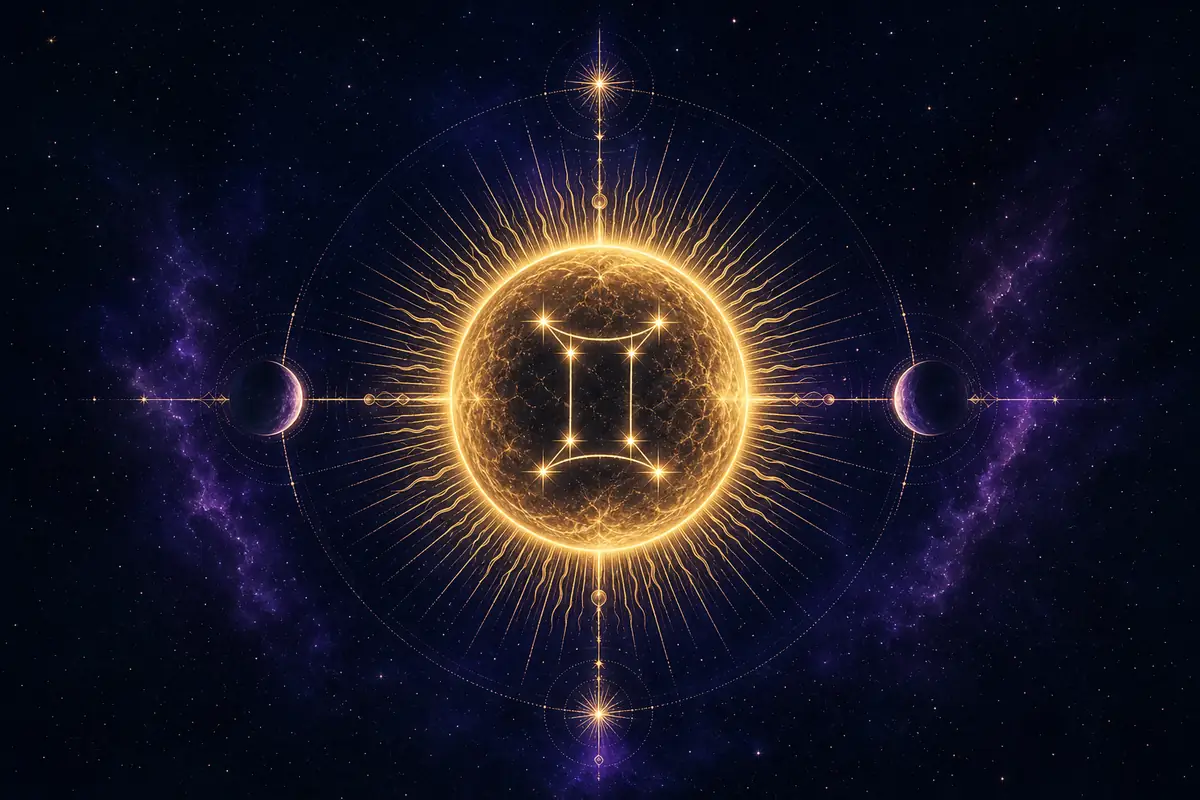
Every other sign in the zodiac is pictured as one figure, one animal, one symbol. Gemini alone is the Twins — two people, standing together, and there is no tidier way to say what a Sun sign here is built to do. Mutable air under Mercury's rule gives this placement an identity engineered to hold more than one version of itself at once, which means the question 'which one is the real you' is not a symptom of confusion. It is what the placement is structurally for.
The only zodiac symbol that is two people, not one
Every sign but this one is represented by a single figure — a ram, a bull, a crab, a lion. Gemini's glyph is the Twins, and that detail is not decorative. It signals a sign built around duality as a basic feature rather than as a complication layered on top of a single self. A Sun placed here is not one person occasionally showing two sides; the two sides are closer to co-authors, both genuinely present.
Why 'which one is the real you' is the wrong question
The question assumes a single true self is hiding behind the variation, waiting to be identified. Gemini's structure does not support that assumption. Both the version that is quick and sociable at a party and the version that goes quiet and analytical alone with a book are real, in the plain sense that neither is a performance covering for the other. The more useful question is not which one is authentic but which one the moment actually calls for, since this placement is built to answer that question quickly and without much internal debate.
Mutable air: identity that reconfigures rather than holds a shape
Mutability is the modality of the sign that closes each season, adapted to shift rather than to found or sustain, and air gives that shift a mental rather than emotional or physical character. Put together, this placement's sense of self is genuinely responsive to context in a way fixed or cardinal signs are not — it updates in real time based on who is in the room and what is being discussed, which reads as inconsistency only to someone expecting a fixed reference point this placement was never built to hold.
- Answers a question differently depending on who asked and when.
- Gets restless with any single label applied for too long.
- Learns a subject fastest by talking it through with someone else.
- Feels most like itself mid-conversation, not mid-solitude.
- Changes its mind openly and does not experience that as inconsistency.
Mercury deals in exchange, not in a fixed essence
Mercury rules Gemini, and Mercury's whole business is exchange — words, information, connections between things that would otherwise sit apart. A Sun run by Mercury takes its cue from that function: identity here is less a possession to defend than a set of connections actively being made, which is why this placement often locates itself through what it is currently talking about, reading, or comparing, rather than through a fixed set of traits held constant regardless of circumstance.
Even the Venus-toned decan can't make this Sun sign sit still
Gemini's decans run from Mercury's own ground into softer, then sterner, borrowed territory. The opening decan, 0°–10°, is Mercury through Gemini itself, exchange in its purest form. The middle decan, 10°–20°, is ruled by Venus through Libra, which should, in principle, calm the sign's restlessness with a wish to be liked and to keep the peace — and does soften it, without ever slowing it down. The final decan, 20°–30°, turns toward Saturn through Aquarius, adding a more detached, idea-driven seriousness to the sign's native quickness.
This placement is not scattered by accident; it is built to carry more than one thread at once. The skill worth building is not narrowing down to one thread, but choosing, on purpose, which thread gets the most attention.
Plurality isn't a dignity problem — Gemini carries none either way
The Sun holds no dignity in Gemini: it is peregrine, neither exalted, nor ruling, nor fallen here. That is worth stating plainly because plurality gets read as a flaw needing a dignity-style verdict, and it is not one. The placement's character comes from mutable air and Mercury's rulership, not from any formal standing the Sun itself holds in the sign.
What is a birth chart? Read the full guide →
Get your personal AI birth chart reading — create a free account →
Frequently Asked Questions
Why is Gemini's symbol two people?
The Twins are the only zodiac glyph representing two figures rather than one, signalling that duality is structural to the sign rather than an occasional complication. A Sun in Gemini genuinely carries more than one authentic mode, not a single self with an occasional mask.
Is Sun in Gemini a two-faced placement?
No — two-faced implies one version is false. Gemini's structure supports two, or more, equally real modes responding to context, which is different from insincerity. The placement adapts because mutable air is built to reconfigure, not to deceive.
Why does Sun in Gemini feel inconsistent?
Mutable air updates its expression based on context rather than holding one fixed shape, the way fixed or cardinal signs tend to. What reads as inconsistency from outside is, from the inside, a placement doing exactly what it is structurally built to do.
Does Gemini's Sun have any essential dignity?
No — the Sun is peregrine in Gemini, carrying no formal dignity status. The placement's character comes entirely from Mercury's rulership and mutable air, not from any dignity verdict on the Sun itself.