What Is a Birth Chart? Your Complete Guide to Natal Astrology
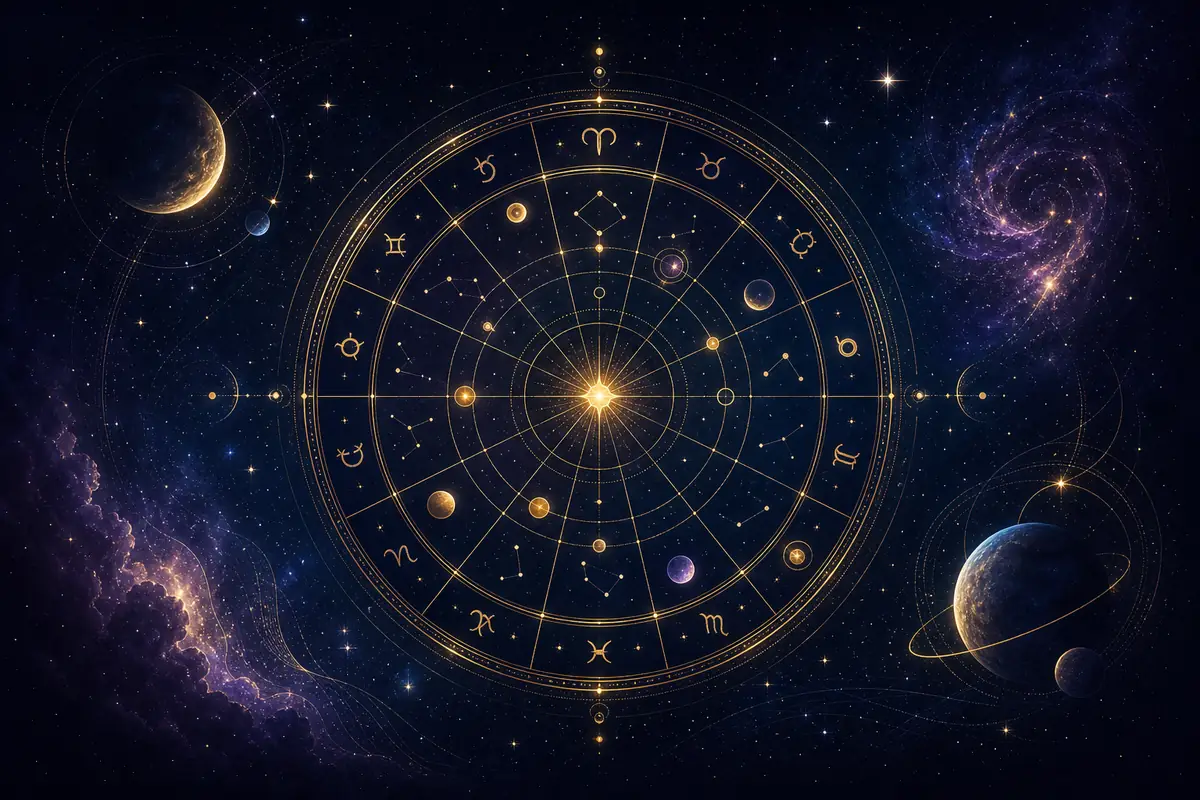
A birth chart — also called a natal chart or astrology by date of birth — is a snapshot of the sky frozen at the exact second you entered the world. Every planet, the Sun, and the Moon occupied a precise position along the ecliptic at that moment, and a birth chart maps all of them against the twelve zodiac signs and twelve houses that were active at your birthplace. That single map becomes the foundation of virtually every astrological technique: personality analysis, timing, relationships, and life-path guidance.
If you have ever wondered what is a birth chart beyond the casual “I am a Scorpio” shorthand, this guide walks through every layer of the wheel — what each planet means, what the houses represent, why the Ascendant and Midheaven matter, and how aspects tie the picture together. At the end you will see how an AI-powered natal chart reading on Astrologer AI can help you actually understand what you are looking at.
Ready to see your own chart? Create your account and generate your full birth chart in minutes.
The Three Layers of Every Natal Chart
Before you can read a birth chart, it helps to understand that the wheel contains three distinct but interlocking layers. Mastering each one separately makes the whole chart far less intimidating.
1. Planets — The What
In natal astrology the word “planet” covers the Sun, the Moon, Mercury, Venus, Mars, Jupiter, Saturn, Uranus, Neptune, and Pluto. Each one represents a domain of human experience:
- Sun — core identity, ego, life purpose, the conscious self.
- Moon — emotions, instincts, comfort needs, the inner world.
- Mercury — communication, thinking style, learning, and short travel.
- Venus — love, beauty, values, money, and what you attract.
- Mars — drive, ambition, sexuality, and how you take action.
- Jupiter — growth, luck, philosophy, expansion, and higher learning.
- Saturn — discipline, structure, responsibility, and long-term lessons.
- Uranus — innovation, rebellion, sudden change, and originality.
- Neptune — dreams, spirituality, illusion, creativity, and compassion.
- Pluto — transformation, power, death and rebirth, deep psychology.
The Sun and Moon are called the “luminaries” and carry the most personal weight. Saturn and beyond move slowly, so they describe generational themes as much as individual ones — but their house position and aspects still tell a personal story.
2. Zodiac Signs — The How
Each planet expresses itself through the sign it occupies. A sign colours the energy of a planet the way an accent colours a voice: the message is the same but the delivery is distinct. Mars in Aries charges forward; Mars in Libra negotiates first. Venus in Taurus seeks stability; Venus in Gemini seeks variety.
This is why Sun-sign astrology — reading only your Sun sign — captures just one of the ten planets in your chart. A complete natal chart places all ten planets in signs, producing a much richer and more accurate portrait. Two people born in the same week can have dramatically different charts if their Moon, Venus, and Ascendant fall in different signs.
3. Houses — The Where
The twelve houses divide the chart wheel into areas of life experience: identity, finances, communication, home, creativity, health, relationships, shared resources, philosophy, career, community, and the hidden self. A planet in the seventh house will express its energy through partnerships; the same planet in the tenth house will express it through public life and career.
House positions are calculated from your exact birth time and place. This is why two twins born minutes apart can have noticeably different charts — the houses shift quickly.
Why Exact Birth Time and Place Matter
Many people try to generate a birth chart with only a date. The result is always incomplete. Here is why birth time and birthplace are non-negotiable:
- The Ascendant changes every ~two hours. It rules your first house, your outward personality, and the order of all twelve house cusps. An incorrect Ascendant misplaces most of your planets into the wrong houses.
- The Midheaven (MC) is equally time-sensitive. The MC is the highest point in the sky at your birth and governs career, reputation, and public standing. It shifts along with the Ascendant.
- The Moon moves roughly one degree every two hours. If you are born near a sign boundary, even a few hours' uncertainty can mean your Moon is in a completely different sign.
- Place determines the local horizon. Two people born at the same time but in different cities will have different Ascendants and house cusps because the Earth rotates and the horizon changes with longitude and latitude.
If you do not know your birth time, check your birth certificate. Many countries, including the United States, United Kingdom, France, and most of Latin America, record it. If the record is unavailable, an astrologer can use a technique called chart rectification to estimate the time from known life events.
The Ascendant and Midheaven: The Chart's Structural Backbone
The Ascendant (Rising Sign)
The Ascendant, or rising sign, is the zodiac degree that was crossing the eastern horizon the moment you were born. It is the cusp of the first house and one of the most important points in the entire chart. Where the Sun describes your inner essence, the Ascendant describes how you meet the world — your instinctive approach, physical presence, and the first impression you make on strangers. A Leo Sun with a Capricorn Ascendant will appear far more reserved and serious than a Leo Sun with a Sagittarius Ascendant.
Because the Ascendant changes roughly every two hours, it is the primary reason birth time is essential for an accurate natal chart.
The Midheaven (MC)
The Midheaven (Medium Coeli, or MC) is the zodiac degree at the very top of the chart — the highest point the ecliptic reaches in the sky at your birth location. It rules the tenth house: career, vocation, public reputation, and how you are seen by society at large. Planets near the MC are often the most visible in a person's life and public work.
Aspects: How the Planets Talk to Each Other
A natal chart is not just a list of planet-in-sign-in-house combinations. The geometric angles between planets — called aspects — add another whole dimension. The major aspects are:
- Conjunction (0°) — planets merge their energies, amplifying both.
- Opposition (180°) — a push-pull tension between two life areas seeking balance.
- Trine (120°) — harmonious flow between planets of the same element; natural talent.
- Square (90°) — friction and challenge that drives growth and action.
- Sextile (60°) — opportunity and cooperative energy requiring a little effort to activate.
A chart with many trines and sextiles tends to show areas of ease and natural ability; squares and oppositions point to recurring tensions that ultimately build character. Neither is inherently “good” or “bad” — challenges often produce the most meaningful growth.
Sun-Sign Astrology vs. a Full Birth Chart
Your Sun sign is one data point in a chart that contains dozens. Reading only your Sun sign is like reading only the first chapter of a novel and claiming you know the whole story.
Two people born under the same Sun sign can have radically different lives if their Moon, Ascendant, and other planetary placements diverge — which they almost always do.
This is precisely why astrology by date of birth alone — without time and place — limits the depth of any reading. A full birth chart reading incorporates all ten planets, the Ascendant, the Midheaven, twelve houses, and every major aspect. That is where the real story lives.
How to Read a Birth Chart: A Practical Starting Point
If you are new to how to read a birth chart, start with these four anchor points before anything else:
- Sun sign — your core identity and conscious purpose. Where do you shine?
- Moon sign — your emotional needs and instinctive reactions. What makes you feel safe?
- Ascendant (rising sign) — your outward style and how others perceive you at first meeting.
- Stelliums — clusters of three or more planets in the same sign or house, indicating a concentration of energy in that life area.
Once those anchors are clear, explore the house placements of Venus (relationships), Saturn (life lessons), and the North Node (soul direction). These six points alone will give you a surprisingly coherent portrait before you dive into full aspect analysis.
How an AI Birth Chart Reading Helps You Understand Your Chart
Reading a natal chart thoroughly takes years of study. Traditional astrology software dumps raw data — a wheel full of glyphs and a table of degrees — and leaves interpretation to you. Static PDF reports give you a reading but cannot answer follow-up questions.
Astrologer AI takes a different approach. Enter your exact date, time, and place of birth, and the app computes your complete birth chart with astronomical precision. Then an AI trained in astrological tradition interprets it and answers your questions in plain language — conversationally, like a knowledgeable guide who has read your chart.
Want to know what your Saturn return means for your career? Ask. Curious why your relationship patterns keep repeating? Ask about your Venus and seventh house. Wondering how your Ascendant shapes how people see you? Ask that too. The AI holds your entire chart as context, so every answer is grounded in your actual placements rather than a generic archetype.
Beyond Western astrology, Astrologer AI also reads your chart through Vedic astrology and offers numerology readings from the same birth profile. One set of birth data, multiple lenses, all in a single conversation.
Ready to explore your natal chart? Create your account and get your full birth chart reading today.
Frequently Asked Questions
What is a birth chart?
A birth chart (also called a natal chart) is a map of the sky at the exact moment and location of your birth. It shows the positions of the Sun, Moon, and all major planets across the twelve houses and zodiac signs, and the angles between them (aspects). Astrologers use it to understand personality, life themes, strengths, and challenges.
What does a natal chart show?
A natal chart shows the zodiac sign each planet occupied at your birth, which of the twelve houses that planet falls in, and the geometric angles (aspects) it makes to other planets. Together these three layers — signs, houses, and aspects — describe your character, emotional patterns, relationship style, career inclinations, and the timing of major life phases.
Do I need my exact birth time for a birth chart?
Yes, your exact birth time matters significantly. The Ascendant (rising sign) changes every two hours, and the house cusps shift with every minute that passes. Without an accurate birth time your houses and Ascendant will be wrong, which affects a large part of the interpretation. If you don't know your birth time, check your birth certificate or hospital records — many countries record it there.
What is the Ascendant in astrology?
The Ascendant (or rising sign) is the zodiac sign that was rising on the eastern horizon at your exact moment of birth. It marks the cusp of the first house and acts as the lens through which you approach the world — your outward manner, physical appearance, and the way others first perceive you. It changes roughly every two hours, which is why birth time is essential for an accurate natal chart.