The Head Center in Human Design: Defined vs Undefined
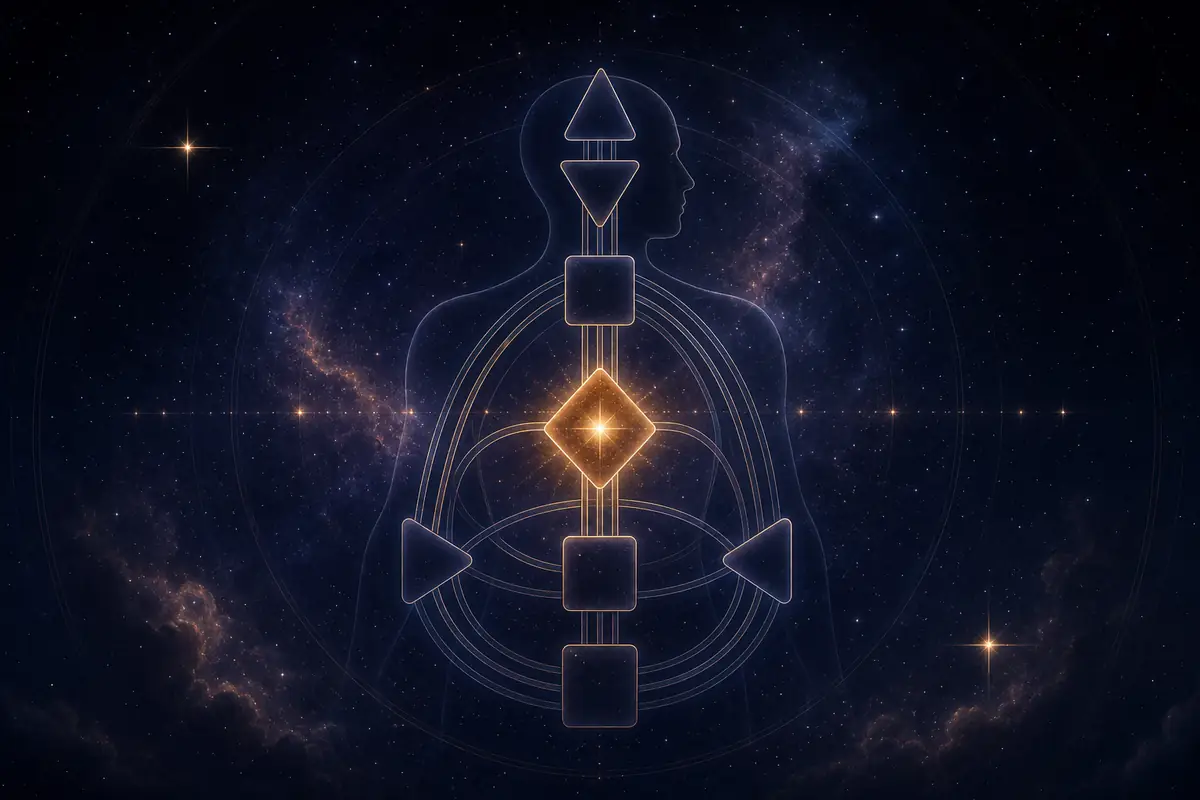
The Head Center sits at the very top of the bodygraph and holds just three gates — one of the smallest gate counts of any center in the chart. It has no capacity to think. It is one of only two centers in the entire system whose sole function is pressure rather than process, and that pressure travels in a single direction: straight down into the Ajna. What changes, defined or not, is whether the question that arrives is one you have carried your whole life or one you picked up from the room.
Three gates, and none of them think
Gates 64, 61, and 63 are the entire Head Center — Confusion, Mystery, and Doubt. None of the three does any conceptual work. Their job is to generate the felt urgency of a question before any actual thinking has happened. This is the defining fact of the center: it produces pressure, not content. The Head shares that pressure-only role with exactly one other center in the whole bodygraph, the Root, which pushes for physical completion the way the Head pushes for mental resolution.
A push that only goes one way
Every gate in the Head Center connects downward into the Ajna and nowhere else — there is no direct route from Head to Throat, no way for raw mental pressure to become speech or action without first passing through the mind's processing center. That structural fact is what separates the pressure to think from the act of thinking itself: the Head only ever supplies the former. If your Head Center is defined, the same three gates stay lit across your whole life, so the same handful of questions keeps resurfacing in familiar shapes — recognizable enough that people standing near you can feel the pressure building before you say a word.
- A defined Head repeats its questions rather than generating new ones — the same three or so themes for life.
- That pressure radiates outward; people with an undefined Head Center often feel it arriving before you speak.
- The pressure is not an assignment — it only has to move downward into the Ajna, not get solved on the spot.
- The recurring risk for a defined Head is mistaking a familiar question for an urgent one every time it resurfaces.
Catching a question that was never yours
With no gates active in the Head Center, an undefined Head has no fixed source of mental pressure of its own — instead it takes in whatever pressure is circulating nearby, and takes it in more intensely than the person who generated it. Stand near someone with a defined Head Center and their recurring questions can suddenly feel like the most urgent thing in the world to you, purely because you are amplifying rather than generating. This is one of the most disorienting forms of conditioning in the whole chart, precisely because mental pressure feels so personal even when it is entirely borrowed.
The not-self question for an undefined Head Center is: 'Am I trying to answer a question that was never mine?' Chronic urgency to resolve an idea you cannot even remember choosing is the signature of Head conditioning.
Letting the pressure move through instead of landing
Because the Head only pushes and never decides, working with it correctly means separating the sensation of pressure from any obligation to act on it. For a defined Head, that means noticing when a familiar question is being broadcast to everyone in the room rather than genuinely posed. For an undefined Head, it means recognizing that borrowed urgency does not require a borrowed answer — the pressure can simply pass on down into the Ajna and out again without you forcing a conclusion. Neither version of this center was built to resolve anything; that work belongs downstream.
- Before chasing an answer, ask whether the question is actually addressed to you or just passing through.
- Head pressure has no direct line to the Throat — it cannot become action until it has been processed elsewhere first.
- If your Head is defined, you can transmit a question without demanding everyone around you share its urgency.
- Mental pressure and decision-making are separate systems — pressure comes from the Head, decisions come from your Authority.
New to Human Design? Read the full guide →
Generate your free AI Human Design bodygraph →
Frequently Asked Questions
Why does the Head Center only have three gates?
The Head Center's job is narrow by design: generate mental pressure, not process it. Gates 64, 61, and 63 — Confusion, Mystery, and Doubt — are enough to do that. Conceptual work happens one center down, in the Ajna, which is why the Head stays small while the Ajna carries more gates and more structure.
Is the Head Center the same as the Ajna Center?
No. The Head only produces the pressure to think — it has no capacity to form an opinion, conclusion, or belief. The Ajna is the center that actually processes that pressure into concepts and certainty. Every Head gate connects downward into the Ajna; there is no route from Head pressure directly into speech or action.
What does an undefined Head Center feel like day to day?
Without fixed gates of its own, an undefined Head absorbs and amplifies whatever mental pressure is circulating nearby — especially from people with a defined Head Center. Questions can feel urgent and deeply personal even though you picked them up from the environment rather than generated them yourself.
Can the Head Center make decisions?
No — the Head Center is a pressure center, not a decision-making one. It cannot decide anything, defined or not. Decisions in Human Design run through your Strategy and Authority, which are entirely separate mechanisms from the mental pressure the Head generates.