Sun in Aries: Meaning, Personality & Traits
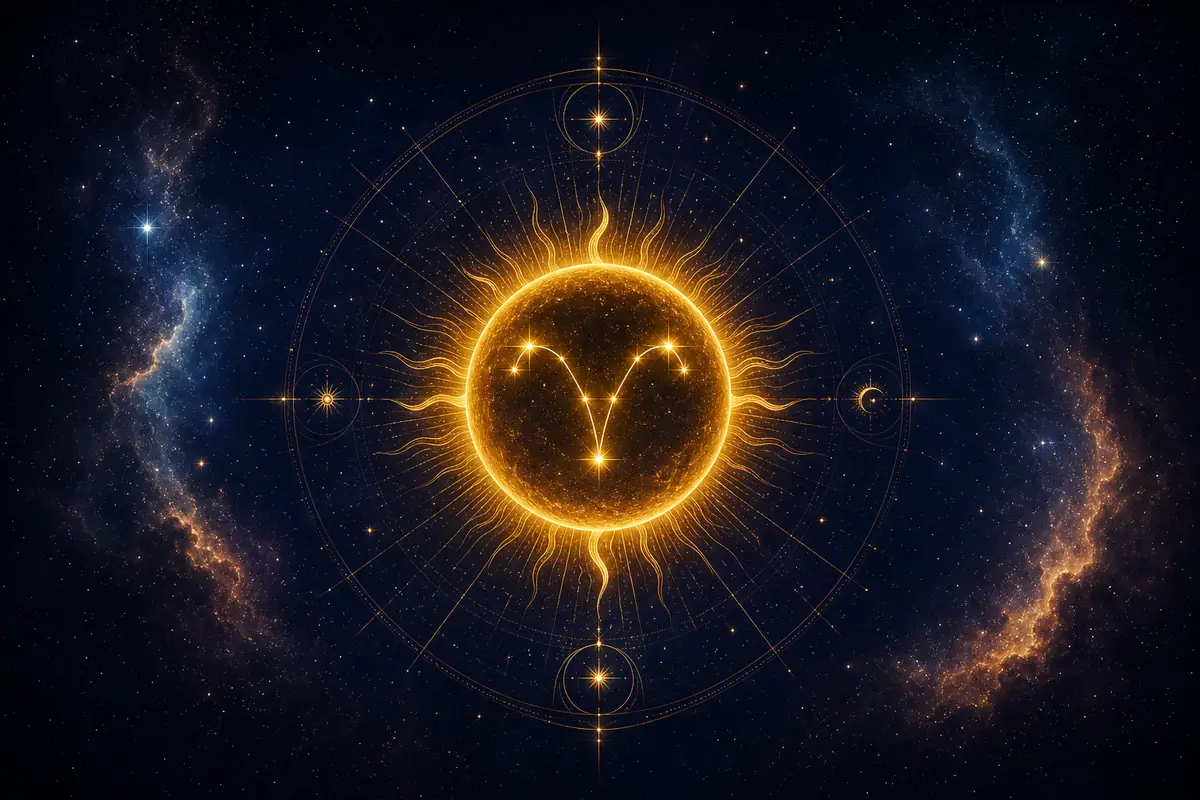
Every tropical zodiac calculation begins at the same instant: the moment the Sun crosses the celestial equator heading north, which astrologers call 0° Aries and everyone else calls the spring equinox. Aries is not just a fire sign the Sun happens to visit — it is the starting gun for the whole system, and the Sun is also exalted here, at 19°, an honoured position it holds nowhere else outside its own home in Leo. Both facts point the same direction: this is a Sun placement organised around beginning something, not around seeing it through.
0° Aries is the point the tropical zodiac counts from
The tropical zodiac is defined by the seasons, not by the constellations behind them, and its zero point is fixed at the instant the Sun reaches the equinox. That instant falls in Aries by definition — the sign does not follow the calendar, the calendar follows the sign. Practically, this means Sun in Aries is never a borrowed or secondary placement measured against something more central. It is the reference point everything else in the tropical system is dated from, which is a different kind of significance to simply being a strong sign.
Exalted at 19°: an honoured guest, not the owner of the house
Exaltation and domicile are not the same kind of strength, and Aries is a useful place to see the difference, because the Sun's domicile is one sign over, in Leo. In Leo the Sun owns the house outright — nothing needs translating. In Aries it is exalted, meaning it is raised above its ordinary station as a guest of honour in a house Mars actually owns. The result is a confidence that looks total but is powered by momentum rather than by settled ownership: it needs to keep moving to keep working.
Cardinal fire: measured by what you start, not what you finish
Aries is cardinal, the modality assigned to each season's opening sign, and cardinal energy exists to initiate rather than sustain. Paired with fire's need for direct, immediate expression, the result is an identity that proves itself at the beginning of things — the first idea, the first move, the decision made before the group has finished discussing it. Completion is not where this placement's self-worth is stored, which is exactly why closing things out or handing a project to someone else to finish can feel like losing the thread of who you are.
- Says yes to the new thing before weighing the old one it will replace.
- Reads hesitation in others as a problem to solve by moving first.
- Feels most like itself in the opening minutes of a project.
- Loses interest exactly when a task turns into maintenance.
- Recovers from setbacks fast because identity is not attached to any single outcome.
Mars runs the house the Sun is only exalted in
Mars rules Aries outright; the Sun's exaltation operates inside Mars's territory rather than replacing it. What that buys is directness — identity expressed through action first, reflection after, because that is how the sign's actual ruler behaves. What it does not buy is patience or an instinct for the slower consequences of a decision, neither of which is Mars's concern. A Sun placement built this way reads as certainty, but the certainty is about the next move, not the whole plan.
The exaltation degree sits in the decan borrowed from Leo
Aries divides into three ten-degree decans, and the exaltation degree, 19°, falls inside the middle one — the stretch from 10° to 20°, which is coloured by the Sun through Leo rather than by Aries's own ruler, Mars. That is a specific, non-arbitrary fact: the very degree at which this Sun sign reaches its highest dignity sits in the one decan borrowed from the Sun's own home sign. The opening decan, 0°–10°, is pure Mars through Aries; the closing decan, 20°–30°, turns toward Jupiter through Sagittarius, widening the aim outward as the sign hands off to Taurus.
The exaltation is real, but it describes a guest's welcome, not a resident's rights. This placement works best when it treats a strong opening as a beginning to hand off, not a whole story to finish alone.
What exaltation does not promise
Exaltation is often misread as 'the best possible Sun sign,' which flattens a more specific fact. Leo, the Sun's domicile, gives effortless authority because the house belongs to it. Aries gives brilliance under Mars's rules — dramatic, energising, and only as good as its follow-through, which the placement itself is not built to supply. Knowing which kind of strength you are working with changes what you ask of it: not more confidence, but people and structures that can hold what gets started.
What is a birth chart? Read the full guide →
Get your personal AI birth chart reading — create a free account →
Frequently Asked Questions
Why is the Sun exalted in Aries?
Aries opens the tropical zodiac at the spring equinox, and the Sun is given its second-strongest dignity there, exact at 19°, just short of its own rulership in Leo. Exaltation means honoured guest rather than owner: the placement is powerful but operates inside Mars's territory, not the Sun's own.
What is special about 0° Aries?
0° Aries is the reference point the entire tropical zodiac is measured from — the instant the Sun crosses the equator at the spring equinox. Every other degree in the system is dated relative to that moment, which is separate from, though related to, the Sun's exaltation later in the same sign.
Is Sun in Aries the same as being an Aries?
Yes — the Sun sign is the ordinary 'star sign' people mean by the word. Anyone born between 21 March and 19 April, roughly thirty days since the Sun never turns retrograde, has the Sun in Aries.
Does Sun in Aries mean you always finish what you start?
No, and the placement does not claim to. Cardinal fire is built to initiate; follow-through is a separate skill this placement has to build deliberately, usually by pairing with people or structures suited to sustaining what it starts.