Uttara Ashadha Nakshatra: Traits, Padas & Compatibility
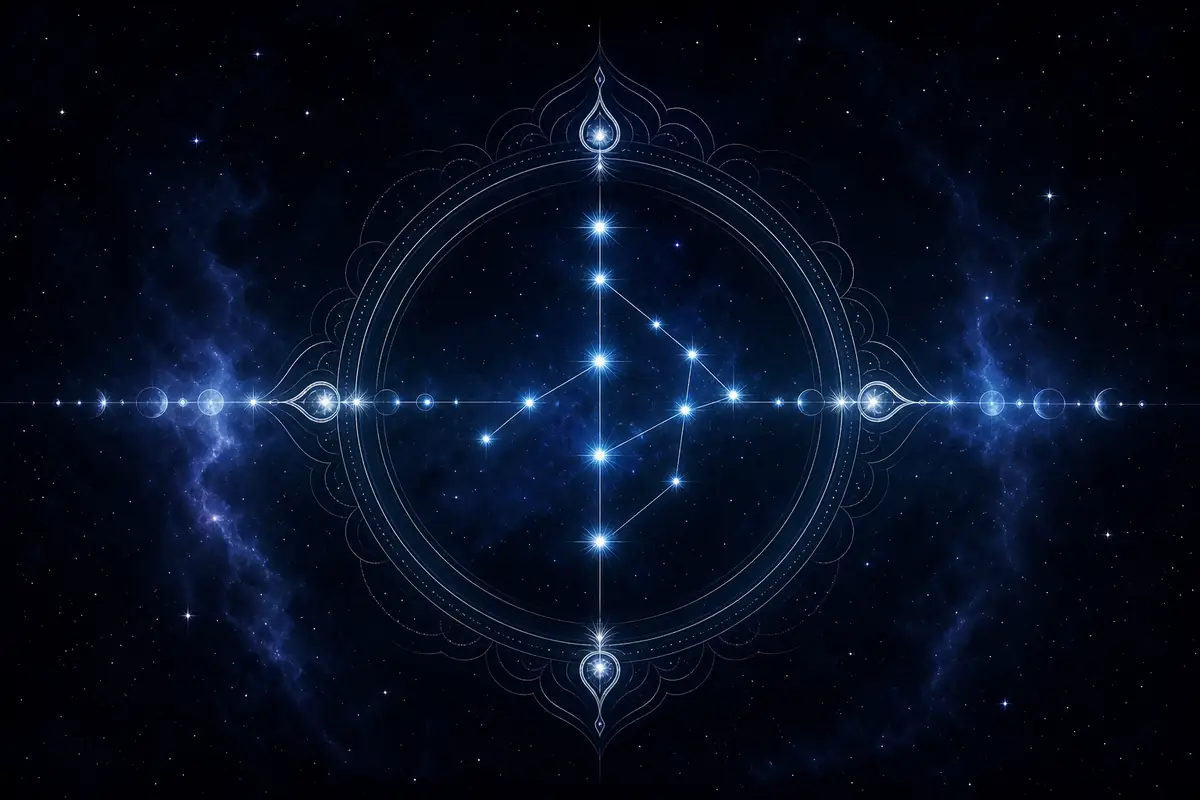
Uttara Ashadha Nakshatra, the twenty-first lunar mansion, is the nakshatra of the final, lasting victory. Where its sibling Purva Ashadha carries the early triumph, Uttara Ashadha represents the victory that endures — built not on brilliance but on sustained righteousness and the collective support of all the gods. Its presiding deities, the Vishvedevas, ensure that what it achieves has the blessing of the whole cosmos behind it.
The Vishvedevas: a committee, not a king
Uttara Ashadha spans 26°40' Sagittarius to 10°00' Capricorn (Makara) in the sidereal zodiac and is ruled by the Sun (Surya). Its presiding deities are the Vishvedevas, the universal gods, counted as ten — unusual among nakshatra deities in being a plurality rather than a single figure. That plurality is the meaning. Where another deity acts alone and decides alone, Uttara Ashadha's authority comes from assent: it holds only what everyone affected agrees to. Natives inherit the instinct. They will not move on a plan until it can be defended to every party in the room, which makes them slow, and which is why what they build so rarely gets overturned.
Apradhrishya shakti: the victory that needs no defending
The power assigned here is apradhrishya shakti — the power that cannot be challenged or defeated. It differs from the combative shaktis elsewhere in one specific way: it does not win contests, it makes contests pointless. A position built on principle, stated publicly, and held consistently for years becomes very hard to attack, because an attacker has no inconsistency to aim at. It is the slowest victory mechanism available and the one that needs least maintenance afterwards.
The elephant tusk and the planks of the bed
The symbols are an elephant tusk and the planks of a bed, and together they describe a relationship with weight. The tusk is not a weapon in the ordinary sense; it is what the animal uses to lift, carry, and clear a path through whatever is in the way. The planks are structural and invisible — nobody thanks the slats, and nobody sleeps without them. Uttara Ashadha does both jobs, in that order: clears the way, then becomes the thing everyone else rests on.
- Principled — committed to truth and fairness as working rules, not slogans.
- Patient — builds slowly, in structures meant to last decades.
- Widely trusted, across groups that do not trust each other.
- Goal-oriented, with quiet and relentless focus.
- Responsible — takes on duty willingly, often more than a fair share.
- Introspective, in the Capricorn manner: privately and without comment.
Abhijit, the twenty-eighth nakshatra hidden in the final pada
Uttara Ashadha holds something no other nakshatra does. Overlapping its last pada and the opening of Shravana lies Abhijit — the twenty-eighth nakshatra, left out of the standard twenty-seven-fold division but kept in muhurta, where its name means 'victorious' and its deity is Brahma. Timings chosen within Abhijit are treated as unusually protected against failure. That an extra, victorious interval sits precisely here, inside the nakshatra of unchallengeable victory, is not read as coincidence.
Uttara Ashadha's victory is not merely personal — it is the kind that uplifts everyone who witnessed the struggle.
What it costs to pick up everyone else's load
- Rigidity — principles that stop bending when circumstances demand it.
- Over-responsibility — absorbing others' burdens until the weight collapses them.
- Solitude, from Capricorn's reserve joined to the Sun's self-sufficiency.
- Self-righteousness — conviction sliding into judgement of different values.
- Slow emotional processing — action preferred to sitting with a feeling.
Institutions rather than start-ups: where this nakshatra builds
Uttara Ashadha does its best work inside things that already have a charter and are expected to outlive their staff: government, the judiciary, administration, the military, universities, standards bodies, long-horizon infrastructure. It makes exceptional institutional heads, judges, diplomats, and senior executives, and is conspicuously less suited to ventures needing a result this quarter. In relationships it is loyal and deeply responsible, but the reserve reads as coldness to anyone in a hurry. A partner who values quiet strength and waits out the dignified exterior gets extraordinary steadiness.
Padas that cross the Sagittarius–Capricorn boundary
- Pada 1 (26°40'–30°00' Sagittarius, Sagittarius Navamsa): the visionary pada, driven by universal principles and wisdom.
- Pada 2 (0°00'–3°20' Capricorn, Capricorn Navamsa): the most disciplined and practical, building lasting structures step by step.
- Pada 3 (3°20'–6°40' Capricorn, Aquarius Navamsa): reformist, applying the principles to collective upliftment.
- Pada 4 (6°40'–10°00' Capricorn, Pisces Navamsa): compassionate and self-sacrificing, often working out of sight — and the pada that overlaps Abhijit.
The mongoose that has no pair, and who matches anyway
Uttara Ashadha belongs to the Manushya (human) gana, and in the yoni system it is assigned the mongoose — the only animal in the scheme without a counterpart of the opposite sex. Traditional matching therefore never awards it a perfect yoni score with anyone, worth knowing before reading much into a middling compatibility table. In practice it pairs powerfully with Shravana, which shares Capricorn and adds receptive devotion to the principled drive. Purva Ashadha is its natural sibling, supplying momentum. Rohini and Mrigashira bring warmth that offsets the seriousness. Volatile or impulsive nakshatras unsettle its need for a partnership it can rely on without checking.
New to Vedic astrology? Read the full guide →
Get your free AI kundli reading — create an account →
Frequently Asked Questions
What is Abhijit Nakshatra, and how is it related to Uttara Ashadha?
Abhijit is the twenty-eighth nakshatra, omitted from the standard twenty-seven-fold zodiac but retained in muhurta. It overlaps the final pada of Uttara Ashadha and the opening of Shravana. Its name means 'victorious' and its deity is Brahma, and timings chosen within it are considered unusually well protected.
Why does Uttara Ashadha span two signs?
The twenty-seven nakshatras divide the zodiac into arcs of 13°20', which does not fit neatly into twelve 30° signs, so some nakshatras straddle a boundary. Uttara Ashadha runs from 26°40' Sagittarius to 10°00' Capricorn, which gives its natives Sagittarian philosophical scope working through Capricornian discipline.
Who are the Vishvedevas?
The Vishvedevas are the universal gods, a collective usually counted as ten, invoked together rather than individually. As nakshatra deities they make Uttara Ashadha's authority consensual: it rests on what a whole group will endorse, which is why natives move slowly and why their decisions tend to survive scrutiny.
Why is Uttara Ashadha's mongoose yoni difficult in matching?
In the yoni koota system every nakshatra is assigned an animal, and pairs are scored by how those animals get on. The mongoose belongs to Uttara Ashadha alone and has no counterpart, so the nakshatra can never score a perfect yoni match. It is a structural quirk of the scheme, not a verdict on the relationship.