Human Design Gate 20: The Now — Meaning & Theme
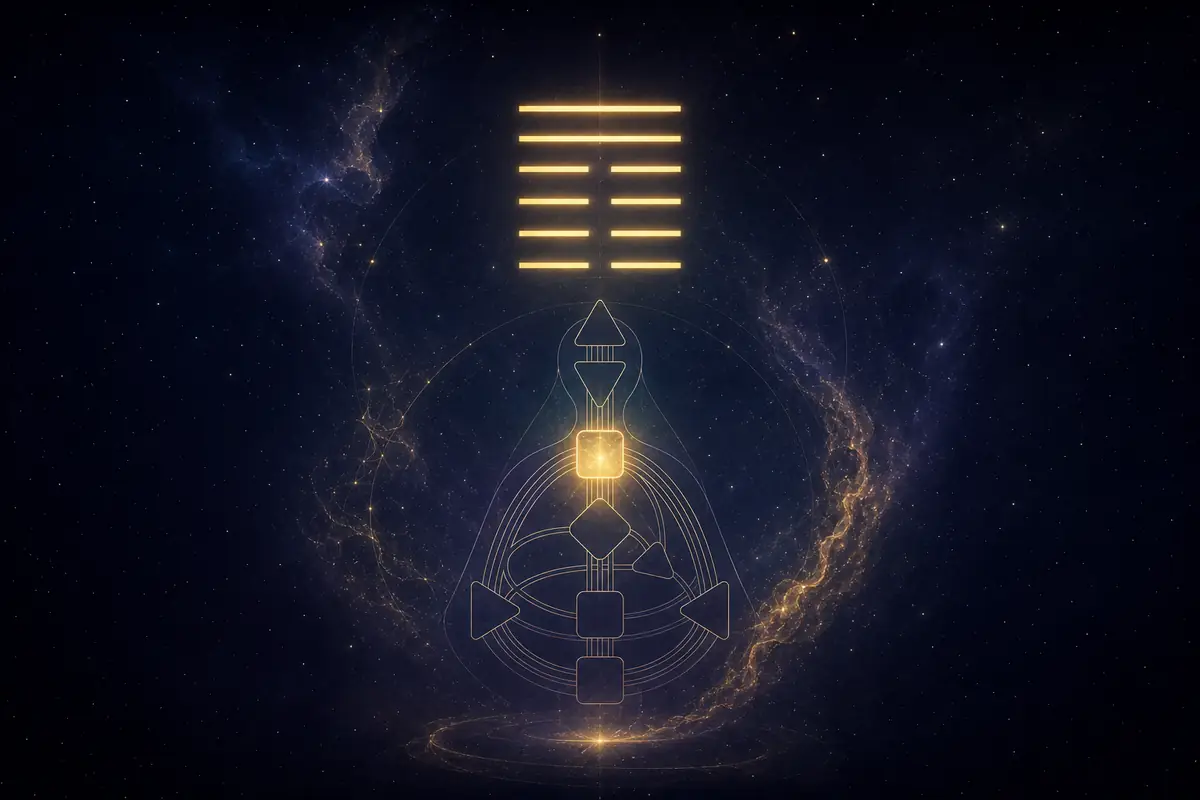
Most speech is about the past or the future. Gate 20, called The Now, is the Human Design gate that points at what is happening at this moment. It sits in the Throat, the centre of expression, and it is defined when a planet on the Personality or Design side activates it. Its hexagram is Contemplation, and the gate opposite it on the wheel is gate 34. What makes it unusual in the bodygraph is its number of partners: it forms three channels, 20-57 Awareness, 20-34 Charisma and 10-20 Awakening, each reaching a different part of the chart.
Saying what is true right now
The keynote is the present moment. A person with gate 20 defined may find that their words are most alive when they describe what is in front of them, such as the mood of a room, the state of a task or what they have just noticed. Human Design reads the gate as a voice for immediate awareness, and it can sound abrupt or ordinary to someone expecting a prepared statement, because what it offers is timing rather than polish.
One reading is that the gate suits live settings such as meetings, performances or conversations that move quickly, where a remark from a prepared script would feel late. Another interpretation is that it values economy: a short statement that fits the moment can say more than a long one that was planned.
Looking before speaking
One interpretation is that the gate works best when observation comes first and the remark follows from it. The gate is about expressing what is seen in the moment, and the seeing is a necessary part of the expression.
The gate can also look like silence, since waiting for the moment means not filling every gap. Others may read the quiet as reserve, when in Human Design terms it is closer to attention. Learning to trust that a remark will arrive when there is something worth saying is part of how the gate matures.
One of four gates that gather the chart together
Gate 20 is one of four gates, 10, 20, 34 and 57, joined by six integration channels: 10-20, 10-34, 10-57, 20-34, 20-57 and 34-57. Human Design treats these as a self-contained set, linking the G centre, the Throat, the Sacral and the Spleen, and describes them as concerned with how a person survives and acts as an individual. Gate 20 belongs to three of the six. A single gate by itself does not define a centre. Only a complete channel does.
Who the voice reaches toward
Each channel carries gate 20 toward a different partner. The 20-57 channel, Awareness, links it with gate 57 in the Spleen, a centre of intuition and instinct. The 20-34 channel, Charisma, connects it with gate 34 in the Sacral, the centre of life-force energy. The 10-20 channel, Awakening, reaches gate 10 in the G centre, the centre of identity and direction. One way to see it is that the partner changes the flavour of the same present-tense voice, depending on whether the Spleen, the Sacral or the G centre is reached.
A voice tied to the present moment has no script. The practice is to say what is there and let the next sentence arrive when it is ready.
Present-tense speech and the company it keeps
When gate 20 is defined with none of its three partners it is a hanging gate, and it can reach toward them in other people, which can feel like speaking best in the company of someone who supplies the missing quality. Its Sun range is 0°08' to 5°45' Gemini, so a Personality Sun lands here in about the week of May 21 to May 27.
A defined gate 20 also means the person tends to carry the present-tense quality into any role that involves expression, from teaching to everyday talk. How strongly it is noticed depends on the other gates active in the chart, and on whether the Throat is defined by some other complete channel.
The pull to rehearse
A gate about present-tense speech often meets a habit of rehearsing. Preparing every sentence can drain the spontaneity that gives the gate its value, while speaking with no preparation at all may feel exposing. A workable middle is to know the subject well and then trust the moment to supply the wording, so that what is said belongs to the situation instead of to a script written beforehand.
What Human Design is and how to read a bodygraph — read the guide →
Get your free Human Design chart and AI reading — create an account →
Frequently Asked Questions
What sets gate 20 apart from other Throat gates?
Its theme is the present moment, and it has three channel partners rather than one. Most gates form a single channel; gate 20 can pair with gate 57, gate 34 or gate 10. Each pairing colours the same present-tense voice differently, which is why charts with this gate can look quite unlike one another.
How visible is gate 20 to other people?
It tends to show up in speech and timing rather than in anything dramatic. Others may notice a person who comments on what is happening as it happens, or who seems unusually present. How noticeable that is depends on the rest of the chart, including whether any channel linking the Throat to other centres is complete.
Can rehearsing a talk work against gate 20?
It can. Preparing every sentence may drain the spontaneity that gives the gate its value, while speaking with no preparation can feel exposing. A workable middle is to know the subject well and then trust the moment to supply the wording, so that what is said belongs to the situation rather than a script.
Why are there six integration channels but only four gates?
The four gates are 10, 20, 34 and 57, and each can pair with every other, giving six combinations: 10-20, 10-34, 10-57, 20-34, 20-57 and 34-57. Gate 20 takes part in three of them. The set is treated in Human Design as a self-contained group, separate from the wider channel map.