North Node in Gemini: Your Growth Direction
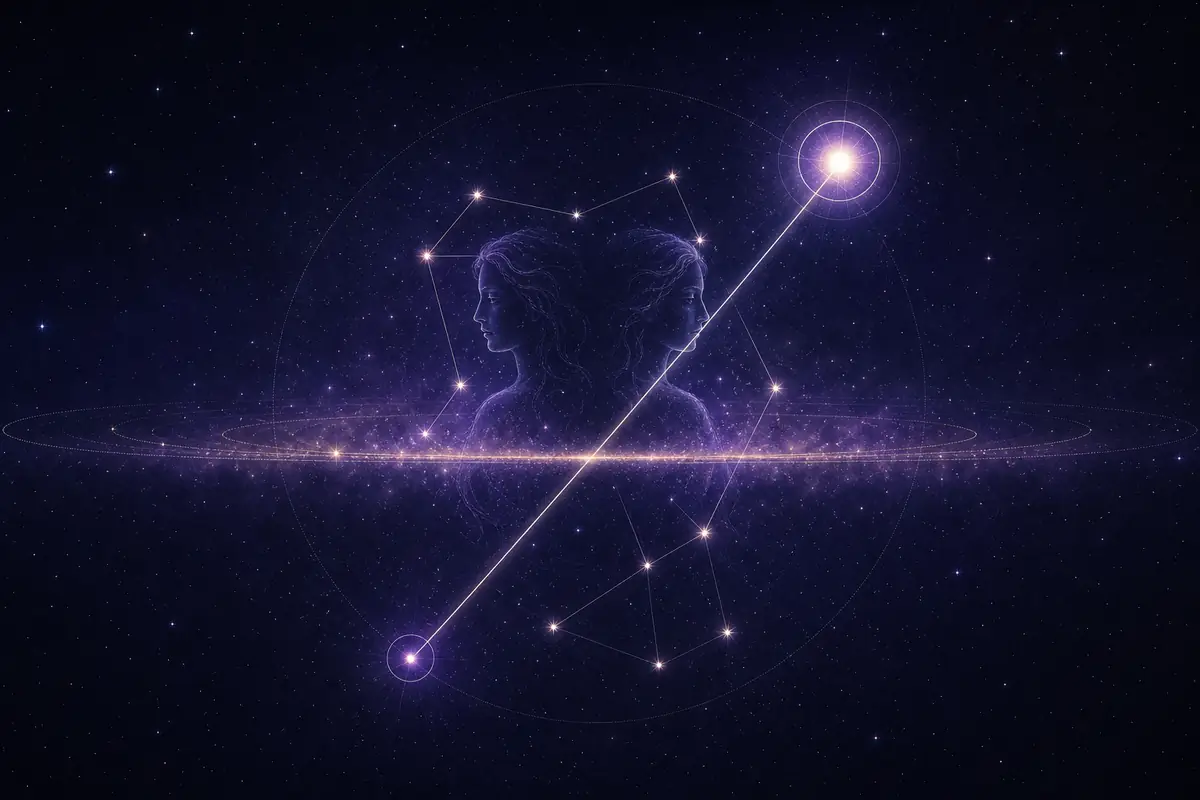
The lunar nodes are two points, not two bodies — where the Moon's orbit crosses the Sun's apparent path, always exactly opposite each other. North node in Gemini fixes south node in Sagittarius; the two are one axis, not separate placements to weigh on their own. Sagittarius is the end you already run fluently: the big picture, the belief that ties everything together, the confident verdict. Gemini is the direction the chart is asking you to grow toward, and this page follows from that single fact.
Nothing to rule, nothing to lose
Essential dignity is a system built for bodies — how a planet sits in a sign it owns, is honoured in, is exiled from, or holds no formal standing in at all. The nodes don't qualify for entry, because they aren't bodies to begin with; they mark where two orbital planes intersect, recalculated fresh for each chart. No domicile, no exaltation, no detriment, no fall, and not even peregrine, a term that at least presumes a planet capable of holding dignity. North node in Gemini has none of that. It has an axis, and the axis is Gemini–Sagittarius.
Why the case for Sagittarius always sounds finished
Reaching the conclusion before all the facts are in — synthesising, generalising, arriving at the belief that explains the pattern — is what south node in Sagittarius does well, and it can make you sound certain in rooms where certainty is scarce. Where it costs you is timing: the conclusion arrives too early, ahead of the specific case in front of you, and a sweeping claim about how things generally go quietly replaces the work of finding out how this one actually is.
Why the particular fact matters more than the verdict
Growth toward Gemini is not a demand to stop believing anything. It is slowing down before the verdict, gathering the local detail, asking the smaller question rather than reaching for the theory that already answers it. Gemini doesn't need the big picture finished by the end of the conversation. It needs the conversation itself, held a little longer than feels necessary, before any conclusion gets to stand. That patience is unfamiliar territory for a south node built on quick synthesis, which is exactly why it counts as growth rather than a step sideways.
- Reaching for the general pattern, versus staying with the one fact in front of you.
- Answering before the question is fully asked, versus asking a second question first.
- Treating a strong opinion as a finished thought, versus treating it as a starting point.
- Preferring the sweeping story, versus preferring the local, specific one.
- Mistaking conviction for accuracy.
Both mutable, but air asks and fire answers
Gemini and Sagittarius are both mutable signs, so this axis was never about whether you adapt — both ends do. The difference is what you adapt toward. Sagittarius reaches outward for the wider frame that makes sense of everything at once. Gemini reaches sideways, toward the next fact, the next conversation, the next small adjustment. Growing toward Gemini doesn't make you less mutable; it changes what the flexibility is in service of.
Eclipses only happen here
Eclipses occur only when a new or full Moon falls near the nodal axis, which means eclipse seasons literally track wherever this axis currently sits — nowhere else in the zodiac gets one at that moment. When the nodes are running through Gemini and Sagittarius, that season's eclipses fall along this exact line — the sweeping conclusion and the particular fact, lit up together, whether or not the timing feels convenient. The node also moves backwards through the zodiac, unlike every planet, spending roughly 18 months in Gemini before it moves on to Taurus.
The other half of this axis: north node in Sagittarius
The same axis, read from the opposite end, belongs to someone with north node in Sagittarius — their growth runs away from collecting information without committing to any of it, toward meaning and the long view. That page and this one are two halves of a single question, not two unrelated placements, and neither end is the more finished version of the other.
This axis carries no dignity to weigh, only a direction — Gemini asking for the particular fact where Sagittarius has spent a lifetime arriving at the general one.
What is a birth chart? Read the full guide →
Get your personal AI birth chart reading — create a free account →
Frequently Asked Questions
Mercury rules Gemini — so is this north node dignified by association?
No. The lunar nodes are calculated points, not bodies, so Mercury's rulership of Gemini has no bearing on them. North node in Gemini carries no dignity of its own — only the Gemini–Sagittarius axis it forms with its south node.
What's actually wrong with reaching a conclusion quickly, if south node in Sagittarius is so good at it?
Nothing, in principle — the trouble is timing. The conclusion tends to arrive before the specific case in front of you has been looked at, so a general belief about how things go quietly replaces the work of finding out how this one actually is. The growth work is treating conviction as a starting point rather than a finished thought.
Why do eclipses happen near the Gemini north node?
Eclipses only occur when a new or full Moon falls close to the nodal axis, so wherever the nodes currently sit determines that season's eclipses. With the axis in Gemini–Sagittarius, eclipses cluster along that exact line for as long as the node remains there.
Mutability isn't the issue on this axis — so what is?
Both Gemini and Sagittarius adapt; the difference is what they adapt toward. Sagittarius reaches outward for the wider frame that makes sense of everything at once. Gemini reaches sideways, toward the next fact, the next conversation. Growing toward Gemini doesn't make you less flexible — it changes what the flexibility is in service of.