Sun Square Moon: Aspect Meaning & Interpretation
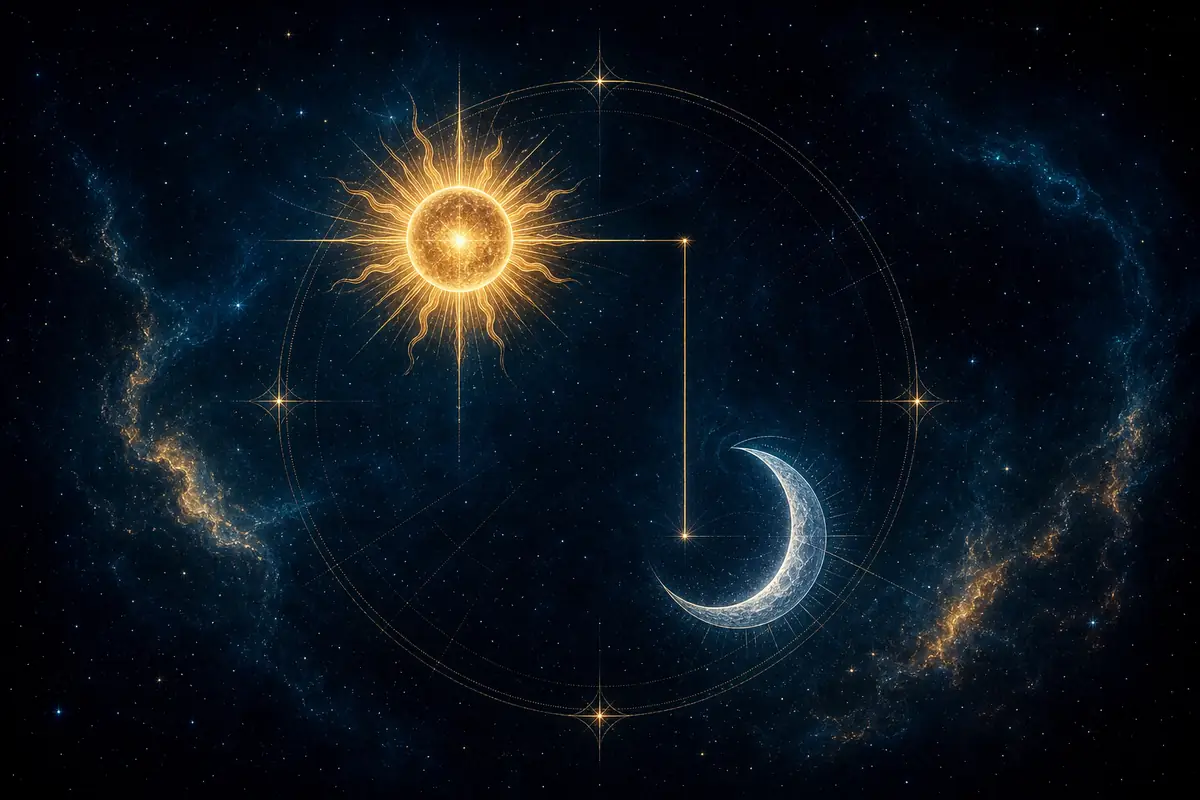
A right angle between the Sun and the Moon puts the part of you that wants to be someone and the part that needs to feel at home on different footings. The Sun carries identity, vitality and will; the Moon carries mood, habit and the body's sense of safety. At 90° the two do not melt together and they do not glide along side by side. They press on each other. Astrologers read that pressure as a restlessness that can produce action, because something always seems to need adjusting. How the pressure feels depends on orb, signs, houses and which side of the lunar cycle the birth fell on.
Friction between will and feeling
A square is a 90° aspect, one of Ptolemy's five. Squares usually join signs of the same modality, so the two lights share a style of motion (initiating, holding steady, or adapting) while differing in element and in what they want. One way to see it is as an inner negotiation: the Sun pushes towards an identity, the Moon wants familiar ground, and neither fully yields. Tension is the engine here, and the aspect can be linked with a habit of doing things in order to settle something inside.
A fire Sun against a water Moon, for example, can read as impulse running up against sensitivity, while an air Sun against an earth Moon can read as ideas pulling against a need for stability. Occasionally the square falls out of sign, crossing a sign boundary so that it is in orb without the usual modality match. That version can feel less pointed, since the signs have less in common to argue over.
First Quarter or Last Quarter
Sun-Moon aspects are the lunar phase, and the square comes in two kinds. A waxing square, with the Moon 90° ahead of the Sun, falls at the First Quarter. A waning square, with the Moon 90° behind, falls at the Last Quarter. Both are 90° apart in the sky, yet they sit on opposite sides of the cycle, and the Moon is lit on opposite sides in each.
About 9.0% of birth charts have a Sun-Moon square (using an 8° orb, waxing and waning combined), and a different orb changes the figure. By transit the Moon makes a square to the natal Sun twice each lunar month, once on each side of the cycle, so the aspect returns as a short, recurring wave of restlessness.
The waxing square: build before you are ready
Astrologers who work with phases read the waxing square as a push to build and commit: an urge to act before everything feels ready. The Moon is ahead of the Sun and the light is still growing, so the symbolism is of something half-made that has to be pushed into form. One way to see it is as a person who learns by starting, and whose discomfort eases once there is something concrete to work on.
The waning square: review and re-form
The waning square is read as a reckoning, a push to review, release and re-form what has already been built. The Moon trails the Sun and the light is shrinking, so the symbolism is of a harvest that must be sorted. Those are symbolic readings of the cycle, and no chart is bound to either. Which half of the lunar month your birth fell in is worth checking before leaning on the square at all.
Orb is the allowed distance from exact, and astrologers disagree on how much to allow. The Sun and Moon can be given wider orbs than the planets. A square within a couple of degrees can be read as constant background pressure; at the wide end, the same aspect may only surface under stress. In tradition an applying square, where the Moon is still moving towards exactness, counts as more active than a separating one.
How the Moon's side of the argument sounds
The Moon's side of the square tends to show up as mood, habit and a need for familiar routines, which are hardest to hear when the Sun's goals are loud. The Sun's side shows up as ambition and self-image. In this reading the discomfort peaks when a goal demands giving up a comfort, and it eases when the goal is built around one.
The houses set the stage for each side. Someone might feel career ambitions competing with home needs, or self-expression competing with security, depending on which areas the two lights occupy. These are examples of how the tension might be staged, not predictions.
Making use of the tension
Squares can be read as driving aspects, the ones that make a person act rather than rest. The shadow side is internal conflict that can look like moodiness. A workable approach, in this reading, is to treat the discomfort as information about a need that is not being met, and to let the Sun's goals and the Moon's needs each have a hearing before one overrules the other.
A Sun-Moon square at the First or Last Quarter does not resolve by choosing a side; it asks for a way of acting that both the lights can live with.
How aspects tie a birth chart together — read the guide →
Get your personal AI birth chart reading — create a free account →
Frequently Asked Questions
Why does a square feel different from a conjunction?
A conjunction puts two bodies together, so they act as one. A square places them a quarter of the circle apart, usually in different elements, so each pulls in its own direction. Astrologers read that as friction that can be uncomfortable but also motivating, which is why squares are linked with effort and action.
How different is a waxing square from a waning one?
The angle is the same, but the position in the lunar cycle is not. A waxing square sits at the First Quarter, with the Moon ahead of the Sun, and is read as building. A waning square sits at the Last Quarter, with the Moon behind, and is read as reviewing. Both are symbolic readings of one cycle.
When is the Moon at a square to the Sun?
Twice in each lunar month: roughly a week after the New Moon and roughly a week after the Full Moon. Those two moments are the First and Last Quarters. In a birth chart the aspect counts when the Moon sits within orb of either point, and orb conventions vary between astrologers.
Does the quarter phase change how the square is read?
In phase symbolism it does. A square at the First Quarter, with the Moon ahead of the Sun, can be read as a push to build, while one at the Last Quarter, with the Moon behind, can be read as a push to review. The angle is the same either way, so treat the distinction as a lens rather than a measurement.