Yang Metal Day Master (BaZi): Personality & Destiny
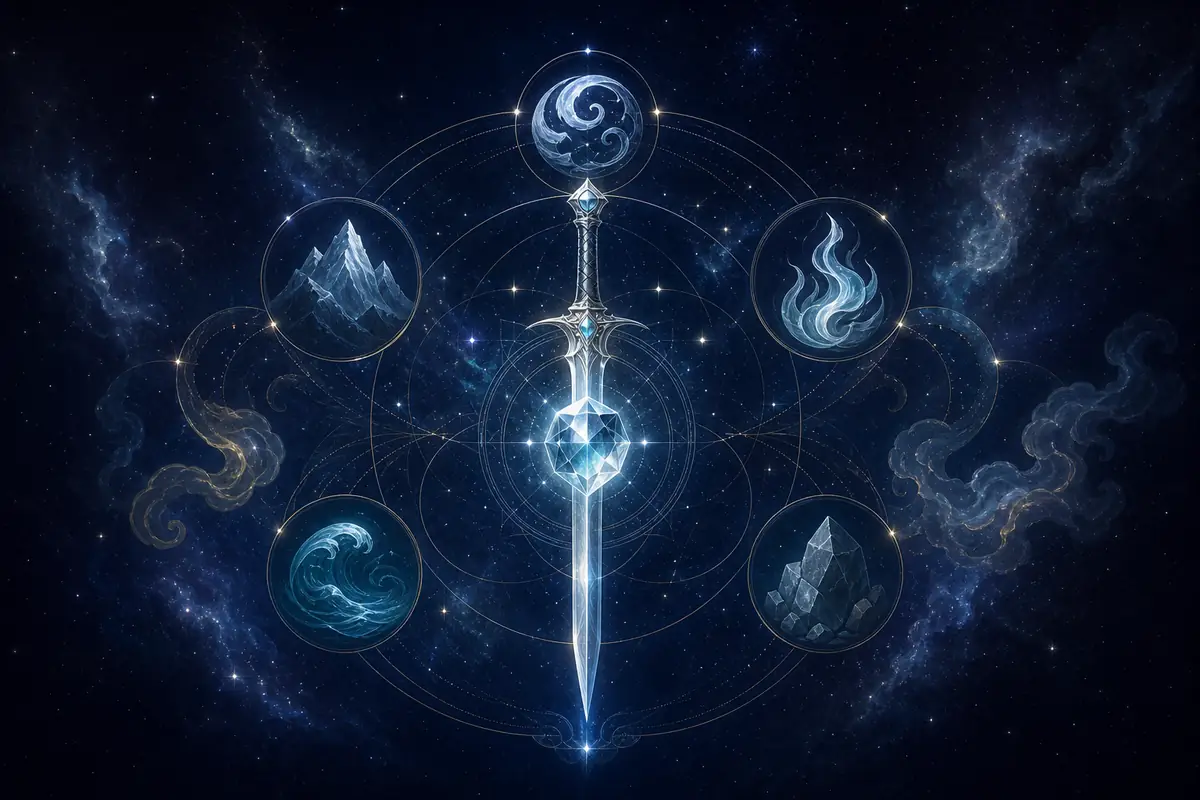
When your Day Stem is Gēng (庚), you carry Yang Metal — the axe, the sword, the raw ore that has been dug out but not yet finished. 庚 is the seventh of the ten Heavenly Stems and the assertive half of the Metal pair. What makes this Day Master unusual is that the element which attacks it is also the element that improves it: Fire controls Metal, and Fire is the forge.
庚 is the seventh stem, and metal that is still unfinished
Your Day Master is the Heavenly Stem of the Day Pillar, the point from which the rest of the chart is read. 庚 sits seventh in the sequence, on the yang side of Metal, and the classical images for it are all things that have a job to do: an axe, a blade, an ingot waiting to be worked. None of them are decorative. Yang Metal is defined by function and by potential that has not yet been realised — the material, not the finished piece.
The axe and the sword are images about use, not ornament
A tool exists to meet resistance. That is the whole point of the image: Gēng is hard, dense, and heavy, and it becomes meaningful only when something needs cutting. This is why Yang Metal people go looking for difficulty rather than avoiding it, and why an easy stretch of life often leaves them restless and slightly useless-feeling. It also explains the bluntness. An axe is not evasive. Its usefulness and its capacity to injure are the same edge, applied with more or less judgement.
Yang Metal is the axe and the ore: raw, forceful, and at its best when pressure and fire have forged it into something extraordinary.
Fire controls Yang Metal — and Fire is also the forge
In the controlling cycle, Fire controls Metal. For most Day Masters, the controlling element is simply pressure to be managed. For 庚 it is the one thing that turns raw material into a finished blade. Heat and hammering do not weaken good ore; they remove what was never useful in it. Read that way, the criticism, the demanding boss, the setback and the relationship that refuses to flatter you are not obstacles to the Gēng life path — they are the mechanism of it. Unforged Yang Metal stays strong and stays crude.
Earth is where the ore came from; Water is what the metal gives back
Earth produces Metal, so Gēng is supported by ground: stability, inheritance, institutions, and the slow accumulation that puts something solid under you. Metal in turn produces Water, and Water is the intelligence and communication that Yang Metal generates. This is the answer to the caricature of Gēng as all force and no thought. The output of a hard, decisive nature is fluidity — a mind that has been sharpened by contact with real problems and can now flow rather than only strike.
The one relationship where Yang Metal has no rival: cutting Wood
Metal controls Wood, and the axe against the tree is the most literal control relationship in the whole cycle. Wood is what Gēng shapes and takes: projects, resources, growth that would sprawl if nobody pruned it. You are unusually good at deciding what gets cut, which is a rarer skill than deciding what gets started. The same act done carelessly is clear-felling. Whether Yang Metal is a woodsman or a wrecker is decided entirely by judgement, not by strength.
What a person shaped like a tool is actually like
Gēng people are bold, decisive, and refreshingly direct. You say what you mean, you compete willingly, and you carry a strong sense of justice that turns to indignation when principles are broken.
- Decisiveness — you act quickly and confidently when others hesitate.
- Courage — you are willing to face difficulty, conflict, and challenge head-on.
- Directness — no hidden agendas; people always know where they stand with you.
- Justice — a strong moral compass and willingness to defend principles.
- Resilience — hardship strengthens rather than defeats you.
- Drive — highly competitive; you push yourself and your team to excel.
What an unsheathed edge costs
- Bluntness — directness without tact can wound people unnecessarily.
- Aggression — competitive drive can shade into combativeness or domineering behaviour.
- Inflexibility — once a course is set, changing direction feels like defeat.
- Impatience — you want to act, and process or deliberation frustrates you.
- Harshness — high standards applied to others without compassion.
庚 and 辛: the tool and the treasure
Both Metal stems are sharp; they are sharp for different reasons. 辛 is the finished jewel, valued for what it is, and rough handling ruins it. 庚 is valued for what it does, and rough handling is how it was made. That is why Fire in the chart reads so differently for the two: for the jewel it is a threat to the surface, for the axe it is the forge.
Loyalty, protection, and work that requires hard calls
In relationships, Yang Metal is loyal and protective — the partner who defends you fiercely and expects honesty in return. The challenge is gentleness: you can cut people with words the way an axe cuts wood, without intending harm. In career, Yang Metal excels wherever strength, decisiveness, and competitive drive are assets: military, law enforcement, law, surgery, engineering, competitive sports, finance, and any leadership role that requires making hard calls under pressure.
What is BaZi? Read the Four Pillars guide →
Get your free AI BaZi reading — create an account →
Frequently Asked Questions
Why is Fire said to be good for a Yang Metal Day Master?
Fire controls Metal, so it is the element that pressures Gēng — but the classic image of Yang Metal is unrefined ore, and ore is turned into a blade by heat and hammering. Pressure is what finishes the material rather than what ruins it.
Which element does a Yang Metal Day Master control?
Yang Metal controls Wood, the axe-and-tree relationship. It is produced by Earth, produces Water, and is itself controlled by Fire. Wood is what Gēng cuts and shapes; Earth is what supports it; Water is what it gives out.
Why is Yang Metal pictured as raw ore rather than a finished blade?
庚 sits on the yang side of Metal, and its classical images — the axe, the sword, unworked ore — are about a job not yet done. Its counterpart 辛 is already cut and polished; Yang Metal is material with potential that has not yet been realised. A tool exists to meet resistance, which is why Gēng people go looking for difficulty rather than avoiding it: unrefined strength needs something to shape it before its value shows.
What does a strong versus weak Yang Metal Day Master mean in a reading?
A strong Gēng — well-supported by Earth or by other Metal in the chart — leans fully into the axe's decisiveness, and can turn rigid or overbearing without enough Fire to keep tempering it. A weak Yang Metal keeps the same directness and moral clarity but has less ground behind it, and tends to need Earth before Fire does it any good — ore that has not been mined yet cannot usefully be forged.