Mars Square Saturn: Aspect Meaning & Interpretation
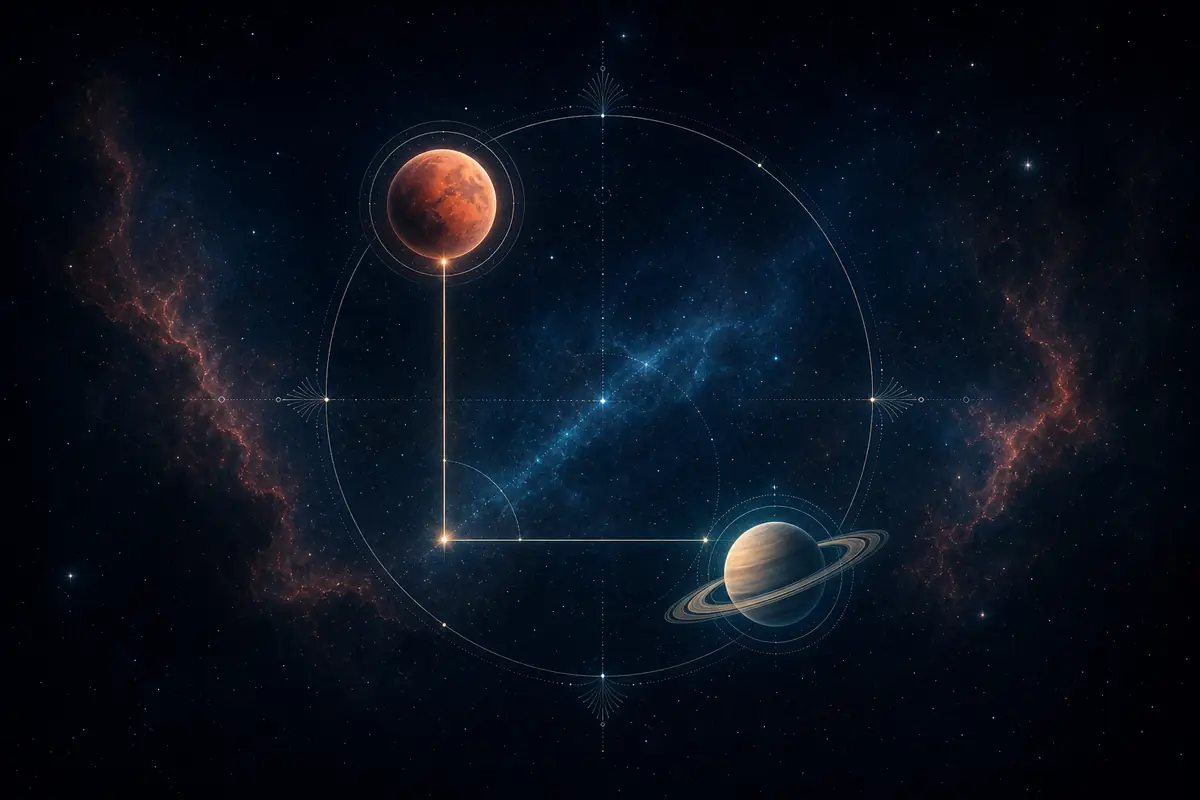
A door that is pushed hard and opens slowly is one way to picture a Mars–Saturn square. Mars, the lesser malefic, is the planet of drive, heat and initiative; Saturn, the greater malefic, is the planet of limits, patience and delay. At 90° they sit in friction, so action keeps meeting a reason to wait and caution keeps meeting an urge to move. One reading is that the square produces discipline the hard way: the person pushes, is checked, and learns a more exact use of force. The aspect can feel like obstruction when it is young and like craftsmanship once it has been practised.
Pressing on something that presses back
The square gives Mars a wall to push against, and that is both its difficulty and its use. Every initiative meets some resistance, whether from circumstances, other people or the person's own caution. What is built under that pressure can be sturdy, much like training with weights, though the aspect does not guarantee it.
The two bodies also disagree about speed. Mars wants a result today; Saturn wants it done properly over time. Neither is wrong, and the aspect keeps asking for a compromise. A person who learns to let Saturn set the plan and Mars supply the stamina often finds the two stop competing and start dividing the work.
One malefic always in sect
Sect divides the planets into a day team and a night team. Saturn, the greater malefic, belongs to the day; Mars, the lesser malefic, belongs to the night. Because the Sun is above the horizon in a day chart and below it in a night chart, one of the two is always the favoured planet and the other is out of sect. That gives the square two versions, depending on the chart.
In a day chart, Saturn is in sect, so the restraint is the steadier side of the pair, and Mars is the planet that has to find its footing. In a night chart, the roles reverse: Mars is in sect and may act with more confidence, while Saturn is the one that presses without full support. In the tradition, an out-of-sect malefic is the harder to live with, so the quality of the friction can shift between the two charts even though the angle is the same.
In a Mars–Saturn square, one malefic is always in sect and the other out of it: Saturn is favoured in a day chart and Mars in a night chart.
Frustration as raw material
The square can be linked with effort that builds slowly. Patterns that may fit include:
- Persistence in work that others would drop
- Impatience with delays, rules and slow processes
- A habit of doing things the hard way before finding the efficient one
- Anger that arrives when a plan is blocked, then settles into resolve
About 6.1% of charts hold a Mars–Saturn square, using a 6° orb, which puts it among the more common pairings for these two planets.
Authority, deadlines and the urge to push back
Saturn often stands for structures, rules and the people who enforce them. A Mars–Saturn square can make the relationship with authority a place where the friction is felt: a boss, a parent, a regulation or a deadline becomes a thing to push against. One way to see it is that the person wants independence and also respects order, and the two wants take turns being louder.
On the constructive side, the same combination can describe someone who can take charge and also do the unglamorous part of the job. Site management, engineering, endurance training and any job that pairs authority with exacting standards give the square a fair test.
Willpower with a limited supply
A square that is always being pushed against can run on willpower, and willpower is a resource that can run low. One way to see it is that Mars keeps spending effort while Saturn keeps asking for more, so planned rest belongs in the schedule rather than being earned afterwards. A demanding discipline with clear milestones lets Saturn measure progress while Mars supplies the repetitions.
Hesitation or temper: two faces of the square
The same aspect can look quite different from person to person. In one, the check from Saturn wins and the drive turns into preparation, self-criticism or a long pause before acting. In another, Mars wins and the check shows up as blunt impatience with anyone or anything slow. Either side can dominate at different times, and the sign and house of the two planets, together with how close the square is to exact, help decide which comes first. A closer orb makes the push and the check harder to separate.
Naming the point at which a delay is useful, and the point at which it is only an obstacle, keeps the brake from becoming a habit.
How aspects tie a birth chart together — read the guide →
Get your personal AI birth chart reading — create a free account →
Frequently Asked Questions
How is a day-chart Mars–Saturn square different from a night-chart one?
In a day chart Saturn is in sect and Mars is not, so restraint is the steadier side. In a night chart Mars is in sect and Saturn is not, so drive has more confidence. The tradition treats the out-of-sect malefic as the harder one, which shifts how the friction is felt.
What makes the square feel like a block?
Mars supplies a push and Saturn answers with resistance or delay, so progress can feel slow and effortful. The feeling usually eases when the goal is broken into stages, because Saturn then has something concrete to approve and Mars has a next step.
Are Mars–Saturn squares good for long-term goals?
They can be. The friction trains persistence, and Saturn gives work a sense of structure while Mars supplies stamina. One reading is that the risk is burnout from pushing too hard, so goals that allow gradual progress and planned rest suit the aspect better than sprints.
Does a Mars–Saturn square mean constant frustration?
No. The square describes friction between drive and restraint, which can be felt as impatience at times and as steady resolve at others. How often it is felt depends on the sign and house, on the orb, and on how the person has learned to pace effort. It is an interpretive tendency, not a fixed mood.