How to Read Natal Chart Basics Clearly
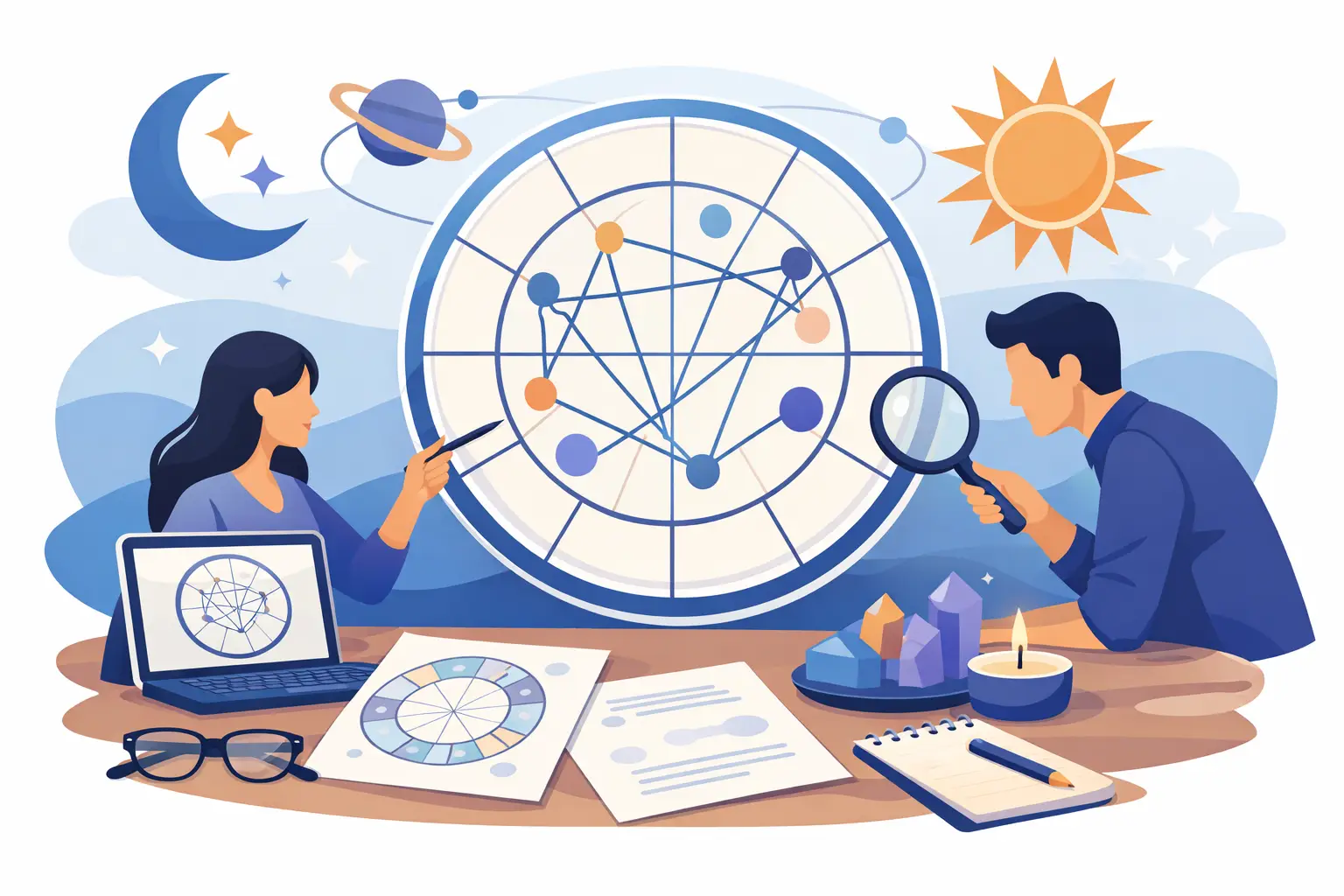
If you have ever opened a birth chart and felt like you were staring at a coded wheel of symbols, you are not missing something obvious. Learning how to read natal chart patterns is less like memorizing random astrology facts and more like learning a visual language. Once you know what each layer represents, the chart starts to feel organized, not overwhelming.
A natal chart is a snapshot of the sky at the exact moment you were born. It maps where the planets were, what signs they occupied, which houses they fell into, and how they related to one another. The real art is not reading each symbol in isolation, but understanding how those pieces work together to describe temperament, motivations, timing, and recurring life themes. If the whole idea is new, it helps to first see what a birth chart is.
Prefer to learn hands-on? Create your account and open your own Western birth chart as you read along.
How to read natal chart structure first
Start with the big four building blocks: planets, signs, houses, and aspects. If you try to interpret everything at once, the chart turns into static. If you read it in layers, it becomes much easier.
Planets show what is happening psychologically. They describe drives, needs, functions, and instincts. The Sun points to identity and vitality. The Moon reflects emotional patterns and what creates a sense of safety. Mercury describes how you think and communicate. Venus shapes affection, pleasure, and values. Mars shows action, desire, and conflict style. The outer planets add deeper generational and transformational themes.
Signs show how that planetary energy expresses itself. A Mars in Aries acts quickly and directly. A Mars in Pisces acts more intuitively, fluidly, and sometimes indirectly. Same planet, different style. This is one of the most useful shifts for beginners: the planet is the function, the sign is the tone.
Houses show where that energy plays out in life. A Venus in the tenth house may seek harmony and beauty through career, reputation, or public visibility. Venus in the fourth house brings those themes toward home, family, and inner security. The house is the life arena.
Aspects show how the planets interact with each other. They reveal whether parts of the personality work in flow, tension, or contradiction. This is where charts start to feel deeply personal, because aspects explain why someone can seem confident in one area and conflicted in another.
Begin with the big three
If you are new, do not start with every asteroid and minor point. Start with the Sun, Moon, and rising sign. This gives you a clean foundation.
The Sun represents your core identity, creative force, and conscious self. It often describes what you are becoming over time rather than what people notice first. The Moon describes your emotional body, habits, memories, and instinctive reactions. It often shows what you need when life gets loud. The rising sign, also called the Ascendant, shapes your approach to life, your first impression, and the way your chart is organized through houses.
These three can already tell a rich story. Someone with a Capricorn Sun, Cancer Moon, and Sagittarius rising may look adventurous and open on the outside, carry deep emotional sensitivity internally, and still have a serious long-term drive underneath it all. That mix matters more than any one placement alone.
Why the rising sign matters so much
The rising sign is easy to underestimate, but it sets the house system in motion. That means it determines where life themes land. Two people can have the same Sun sign and still live very different versions of that energy because their houses are different.
It also describes your style of initiation. Aries rising tends to move fast. Libra rising tends to orient through relationships and balance. Virgo rising often begins with observation, refinement, and practicality. If the Sun is your central purpose, the rising sign is the doorway through which that purpose enters the world.
Read the houses like life categories
The 12 houses divide the chart into areas of experience. A simple way to approach them is to treat each house as a category of life rather than a fixed prediction.
The first house is selfhood and how you enter the world. The second deals with money, resources, and values. The third speaks to communication and immediate environment. The fourth covers home, roots, and private life. The fifth points to creativity, romance, and pleasure. The sixth involves work, routines, and health. The seventh centers relationships and partnership. The eighth is about intimacy, shared resources, and transformation. The ninth covers belief, higher learning, and travel. The tenth speaks to career and public image. The eleventh relates to community, friendships, and future goals. The twelfth deals with the unseen, including solitude, spirituality, and subconscious patterns.
When a chart has several planets in one house, that area of life tends to become a major focus. A tenth-house emphasis may point toward ambition, visibility, or a strong relationship to achievement. A fourth-house concentration can suggest someone whose inner world and family story shape much of their life direction.
How to read natal chart aspects without overcomplicating it
Aspects can look technical, but the basic logic is simple. Some planetary relationships feel supportive. Others create friction. Both matter.
Conjunctions blend energies. If someone has Mercury conjunct Venus, their communication may be graceful, charming, or artful. Squares create tension that demands growth. A Moon square Saturn can point to emotional restraint, seriousness, or difficulty feeling fully supported, but it can also build maturity and emotional endurance. Trines create natural flow. A Sun trine Jupiter often brings confidence, generosity, or an easier relationship with possibility. Oppositions create polarity, often between two needs that both require attention.
This is where nuance matters. Easy aspects are not automatically better, and hard aspects are not automatically bad. Tension often creates movement, skill, and self-awareness. Flow can become a strength, but it can also become something so natural that it goes underused.
Look for repetition, not one-off meanings
A single placement rarely tells the whole story. If a chart repeats fire energy, first-house themes, and strong Mars aspects, then independence and action likely matter a lot. If you see water signs, twelfth-house placements, and Moon-Neptune contacts, sensitivity and intuition may be central.
Patterns are more reliable than isolated definitions. This is one reason beginners sometimes get confused. They read one placement literally and miss the larger design.
Put the chart together like a conversation
The most accurate chart reading comes from synthesis. Instead of saying, “My Venus is in Scorpio, so that means X,” ask how Venus in Scorpio interacts with the Moon, the seventh house, and any Venus aspects. A placement changes depending on its environment.
For example, Venus in Scorpio can suggest intensity, depth, loyalty, and emotional magnetism in relationships. If that Venus is trine Saturn, love may also be steady and committed. If it squares Uranus, the relationship pattern may include unpredictability, a need for freedom, or sudden shifts in attachment. Same Venus sign, very different lived experience.
This is the difference between astrology as stereotype and astrology as interpretation. Charts are layered. They describe tendencies, not scripts.
A simple order for reading any birth chart
If you want a practical sequence, use this one. First, identify the rising sign and chart ruler. Then read the Sun, Moon, and their houses. Next, look at Mercury, Venus, and Mars for thinking, relating, and action style. After that, scan for house emphasis and major aspects. Finally, notice repeating elements, modalities, and standout patterns.
That order works because it moves from the most visible structural features to the more detailed interpretive ones. It also keeps you from getting lost in detail before you understand the chart’s overall tone.
For digital-first readers, this is where a structured platform helps. A well-organized chart layout with plain-language interpretation can shorten the learning curve without flattening the complexity. Tools like Astrologer AI are useful because they let you move between raw chart data and conversational interpretation, which is exactly how most people learn best.
What beginners usually get wrong
The biggest mistake is treating one placement as destiny. The second is assuming every challenging aspect is a problem to fix. Astrology works better when you read it as a map of energies to work with, not a verdict.
Birth time accuracy also matters more than many people realize. Even a small difference can shift the rising sign and house placements, which changes the chart structure significantly. If your chart feels off, check the birth time before assuming the interpretation is wrong.
Another common issue is trying to read the chart only through personality. Natal charts also speak to relationship dynamics, work patterns, emotional regulation, values, and life timing. A good reading should feel multidimensional.
Learning how to read natal chart symbolism takes practice, but the payoff is real. You stop seeing yourself as a random collection of traits and start seeing a coherent pattern with tension, beauty, and direction. Stay with the structure long enough, and the chart begins to read you back.
Ready to practice on your own wheel? Create your account and read your natal chart step by step with guided interpretation.
Frequently Asked Questions
How do beginners start reading a natal chart?
Begin with the four building blocks: planets, signs, houses, and aspects. Read them in layers rather than all at once. The planet is the function, the sign is the tone, the house is the life arena, and the aspect shows how two planets interact. Starting with the Sun, Moon, and rising sign gives you a clean foundation before you add detail.
What are the big three in astrology?
The big three are the Sun, Moon, and rising sign. The Sun represents your core identity and conscious self, the Moon describes your emotional body and instinctive reactions, and the rising sign shapes your approach to life, your first impression, and how the houses are organized. Together they already tell a rich story before you look at anything else.
Why does the rising sign matter so much?
The rising sign sets the house system in motion, so it determines where every life theme lands. Two people with the same Sun sign can live very different versions of that energy because their houses differ. It also describes your style of initiation, which is why it is easy to underestimate and important to get right.
What is the best order to read a birth chart?
Identify the rising sign and chart ruler first, then read the Sun, Moon, and their houses. Next look at Mercury, Venus, and Mars for thinking, relating, and action style. After that, scan for house emphasis and major aspects, then notice repeating elements and standout patterns. This moves from structure to detail so you do not get lost early.