Natal Astrology Chart Explained Clearly
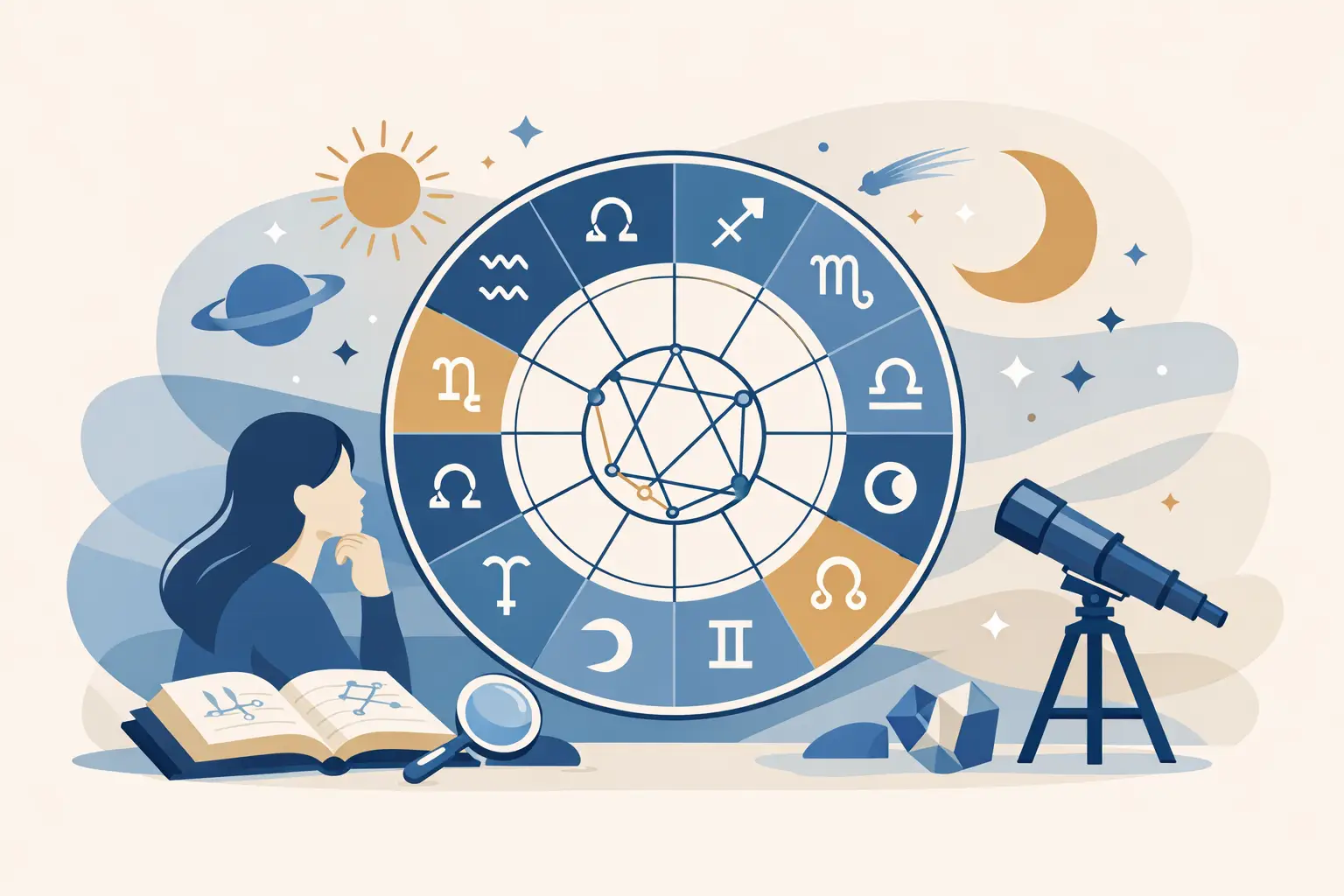
If you have ever opened your birth chart and felt like you were looking at a cosmic dashboard with no labels, you are not alone. A natal astrology chart explained well should make you feel more oriented, not more confused. At its core, your chart is a snapshot of the sky at the exact moment you were born, mapped to your time and location, then translated into patterns that astrologers use to read personality, timing, motivation, and life themes.
That sounds mystical because it is. It is also surprisingly structured. Once you know what each layer is doing, the chart stops looking like a wheel full of symbols and starts reading more like a system. You do not need to memorize every glyph to understand what matters.
Want to follow along with your own wheel? Create your account and generate your full birth chart in minutes.
Natal astrology chart explained from the inside out
Think of the natal chart as three main pieces working together: planets, signs, and houses. Then aspects show how those pieces interact. Most confusion happens when people learn these parts separately but never see how they combine. If you are brand new, it can help to first read what a birth chart actually is before layering on the detail below.
The planets are the actors. They describe functions in your psyche and life. The Sun points to identity and vitality. The Moon describes emotional needs and instinctive responses. Mercury shows how you think and communicate. Venus shapes attraction, values, and relational style. Mars speaks to drive, desire, and conflict. The outer planets add larger generational themes, but they still matter when they make strong contacts in your chart.
The signs are the style. They show how a planet behaves. Mercury in Virgo communicates differently than Mercury in Sagittarius. One tends to sort, refine, and analyze. The other tends to look for big-picture meaning and speak more broadly. Same planet, different expression.
The houses are the life areas. They show where the energy plays out. Venus in the seventh house puts relationships front and center. Venus in the second house may tie pleasure, money, and self-worth together. Again, same planet, different life arena.
This is why one placement never tells the full story. Astrology works through combinations. If you only know your Sun sign, you know something real, but not enough to understand the whole design.
Start with the big three, but do not stop there
Most people begin with the Sun, Moon, and rising sign, and that is a smart starting point. These are often called the big three because they give a fast read on your core identity, emotional landscape, and how you meet the world.
Your Sun sign describes the part of you that is becoming. It is your essential character, your will, your center of gravity. Your Moon sign is more private. It shows what helps you feel safe, how you process emotion, and what you return to under stress. Your rising sign, also called the Ascendant, shapes first impressions, your instinctive approach to life, and the layout of the houses in your chart.
The rising sign matters more than many beginners realize. It is not just about appearance or vibe. It sets the house structure, which means it changes where every planetary theme is located. Two people with the same Sun and Moon can have very different lives if their rising signs place those planets in different houses.
That said, the big three are a starting interface, not the full operating system. If your chart interpretation stops there, you miss the nuance that usually makes astrology feel personal and accurate.
What the houses actually tell you
The houses are where astrology starts feeling useful. They answer the question, where is this energy showing up?
The first house deals with selfhood, identity, and how you initiate. The second connects with money, values, and self-worth. The third rules communication, siblings, and learning. The fourth is home, roots, and private life. The fifth covers creativity, romance, and self-expression. The sixth speaks to work, habits, and health. The seventh centers relationships and partnership. The eighth goes into intimacy, shared resources, and transformation. The ninth expands into belief, travel, and higher learning. The tenth rules career, reputation, and public direction. The eleventh relates to friendship, networks, and future goals. The twelfth points to the unconscious, solitude, endings, and spiritual processing.
You do not need to force every life event into a house keyword. That is where chart reading can become flat. A strong tenth house might show career ambition, yes, but it can also show a deep need to be seen, to build legacy, or to define success on your own terms. Context matters.
Aspects are where the chart starts talking
If planets are the actors and signs are the style, aspects are the conversations happening between them. They show whether parts of your chart cooperate easily, challenge each other, or demand integration over time.
A trine often shows flow. A square shows friction and growth through tension. An opposition can create projection or polarity, especially in relationships. A conjunction blends energies together so tightly they are hard to separate. A sextile suggests opportunity, but usually one you need to engage intentionally.
This is where astrology gets more psychologically rich. Someone with Moon square Saturn may feel emotionally self-protective, highly responsible, or slow to trust vulnerability. That same person may also develop unusual emotional resilience over time. The aspect is not a sentence. It is a pattern with both pressure and potential.
This is also why oversimplified astrology content can feel off. Not every Venus placement means you are charming. Not every Mars placement means you are bold. The chart modifies itself constantly.
Why accurate birth data changes everything
A natal chart depends on your birth date, exact birth time, and birth location. If the birth time is off, even by a moderate amount, your rising sign and houses may shift. That changes the entire structure of interpretation.
For some people, the time is unknown or uncertain. You can still explore planetary signs and some broader themes, but house-based interpretation becomes less reliable. Timing techniques also get weaker without accurate birth data. So if your chart has ever felt strangely generic, the issue may not be astrology. It may be the input.
This is one reason digital tools have become so useful. A clean chart interface makes it easier to see not just what your placements are, but how they connect. Platforms like Astrologer AI also help translate technical chart data into plain-language patterns, which is especially helpful if you want depth without needing to study for years first. If you prefer to learn by doing, you can ask your chart questions as each placement comes up.
Common mistakes when reading your own chart
The biggest mistake is treating one placement like a verdict. People read Saturn in the seventh house and panic about relationships, or see Pluto in the first and assume intensity is their whole identity. A natal chart is not a list of isolated labels. It is a structured pattern.
Another mistake is reading the chart too literally. Astrology is symbolic, not mechanical. A challenging aspect does not guarantee a bad experience. It may point to a meaningful area of growth, recurring tension, or a skill you build through effort.
There is also the issue of projection. It is easy to claim the flattering parts of a chart and ignore the harder ones. Real chart work asks for honesty. The point is not to collect spiritual aesthetics. The point is to understand how your energy moves so you can work with it more consciously.
How to read your chart without getting overwhelmed
Start with the chart ruler, the planet that rules your rising sign. This often tells you a lot about your overall orientation and where life pulls your attention. Then look at your Sun, Moon, and rising. After that, notice any stelliums, which are clusters of three or more planets in one sign or house. These usually mark major concentrations of energy.
Next, find the angular houses — the first, fourth, seventh, and tenth. Planets here tend to be louder in life expression. Then look for exact aspects, especially involving the Sun, Moon, chart ruler, Venus, Mars, and Saturn. Exact aspects often describe the patterns you feel most clearly.
Finally, look for repetition. If several chart factors point to communication, relationship intensity, public visibility, or emotional sensitivity, that theme matters more than any single placement. Astrology becomes clearer when you stop chasing random facts and start noticing patterns.
What a natal chart can and cannot do
A birth chart can describe tendencies, motivations, strengths, blind spots, and recurring life themes with surprising precision. It can help you understand relationship dynamics, career orientation, and the timing of certain developmental periods. It can give language to parts of yourself you may have felt but never named.
What it cannot do is remove free will or replace discernment. Astrology is best used as a reflective tool, not a script. It helps you see the terrain. You still choose how to walk it.
That is also what makes a good interpretation feel grounding rather than fatalistic. The chart does not tell you who you have to be. It shows the pattern you were born into, so you can meet it with more awareness, skill, and compassion.
If you are learning your chart for the first time, go slowly. Let one or two patterns become clear before trying to decode everything at once. The most useful astrology is not the most dramatic reading. It is the one that helps you recognize yourself a little more clearly, then make your next decision with a steadier hand.
Ready to see it mapped out for you? Create your account and explore your Western natal chart with plain-language interpretation today.
Frequently Asked Questions
What is a natal astrology chart?
A natal chart is a snapshot of the sky at the exact moment you were born, mapped to your birth time and location. It plots the planets across signs, houses, and aspects, then astrologers read those patterns for personality, motivation, timing, and recurring life themes. It works through combinations, so no single placement tells the full story.
What are the four main parts of a natal chart?
Planets, signs, houses, and aspects. Planets are the actors that describe functions in your psyche, signs are the style each planet expresses, houses are the life areas where that energy plays out, and aspects are the conversations between planets. Reading them together, rather than separately, is what makes a chart feel accurate.
Why does my exact birth time matter?
A natal chart depends on your birth date, exact birth time, and birth location. If the time is off even moderately, your rising sign and house placements can shift, which changes the entire structure of the interpretation. Without an accurate time, you can still explore planetary signs and broader themes, but house-based and timing techniques become less reliable.
How do I read my chart without getting overwhelmed?
Start with the chart ruler and the big three (Sun, Moon, and rising), then look for stelliums, angular-house planets, and exact aspects to your key placements. Finally, notice repetition: when several factors point to the same theme, that theme matters more than any one placement. Let one or two patterns land before decoding everything at once.