Mula Nakshatra: Traits, Padas & Compatibility
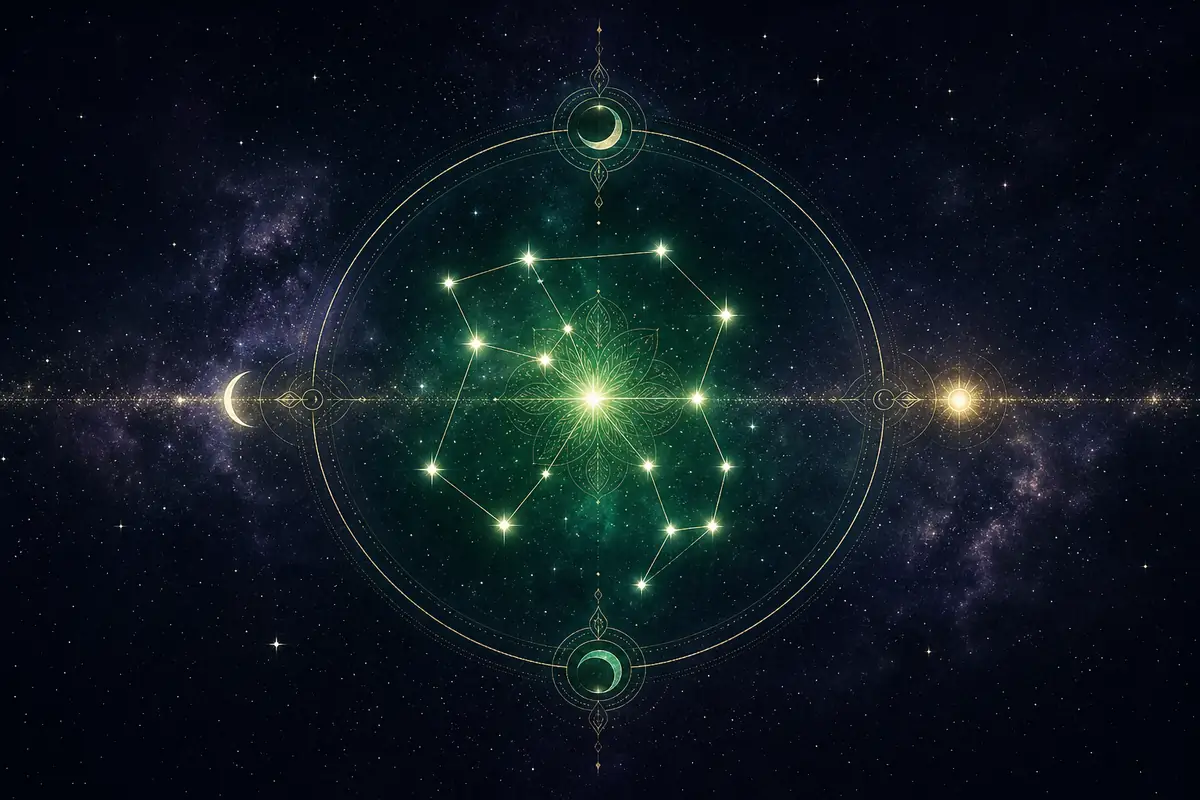
Mula Nakshatra, the nineteenth lunar mansion, is the nakshatra of uprooting, investigation, and the search for ultimate truth. Its name means 'the root', and its symbol — a tied bunch of roots — holds its central paradox: to find the foundation you must be willing to pull everything up from the ground. Presided over by Nirriti, goddess of dissolution, Mula strips away what is false so that what is real can finally be seen.
Nirriti, the goddess who presides over what falls apart
Mula spans 0°00' to 13°20' of Sagittarius (Dhanu) in the sidereal zodiac and is ruled by Ketu, the south node of the Moon. Its presiding deity is Nirriti (also spelled Nirrti), goddess of dissolution and calamity, who holds the south-western quarter and the territory of decay. She is not a deity who grants things. She takes them, and the taking is the point: what Nirriti removes was held together by attachment rather than truth. A Mula biography usually contains an episode where a career, a marriage, or a belief system came apart — and where the native can now see it had to.
Barhana shakti: the power to break a thing at the root
Mula's assigned power is barhana shakti — the power to break apart, rendered in older translations simply as the power to ruin. It is diagnostic before it is destructive: to break something at the root you first have to locate the root, which is why Mula natives ask the question a room has quietly agreed not to ask. Directed well, barhana shakti takes apart a false argument or a self-image that was never true. Directed carelessly, it takes apart a relationship that was working.
- Philosophically driven — needs to understand the ultimate nature of things.
- Investigative — cannot accept a surface explanation.
- Transformative — life unfolds through episodes of upheaval and renewal.
- Spiritually inclined, pulled by Ketu toward liberation and inner life.
- Fearless once the ego's grip has loosened.
- Intensely focused when finally committed to a path.
A bundle of roots, tied — and why they are out of the ground
The symbol is a tied bunch of roots, sometimes given as a lion's tail. Notice the two details it insists on: the roots are out of the ground, and they are bound together. Roots are the part nobody sees and the part doing the actual work, and the only way to inspect them is to destroy the plant's position. That is Mula's method — it pulls a thing up to find what was holding it, accepting that the thing may not survive being looked at. The tie matters as much as the pulling: what Mula uproots is carried to the next place, not scattered.
Born at the gandanta: the first pada and the shanti rite
Mula opens at 0° Sagittarius, where Scorpio's water gives way to fire, making its first degrees a gandanta — the knot between two elements, where nothing carries across the seam. It also begins at the Galactic Centre, the most powerful point in our galaxy. Muhurta texts treat a birth in Mula's opening pada as calling for Mula shanti, and older lore attaches cautions about the family's fortunes afterwards. The useful reading is less ominous: a gandanta Moon describes someone who starts without a framework handed down, and has to build one from scratch.
Mula's gift is the courage to let go of what was never yours — and discover, in the emptiness, what is eternal.
When uprooting stops being a passage and becomes a habit
- Destructiveness — the uprooting turns on relationships that did not need it.
- Instability — a run of crises that never allows consolidation.
- Nihilism — stripping away false foundations, ungrounded, becomes despair.
- Bluntness that wounds people who did not ask for unvarnished truth.
- Difficulty with material security — Ketu's detachment makes building feel pointless.
Work that pays for refusing the surface answer
Mula does best where the job is literally to dig: research, philosophy, archaeology, depth psychology, forensic work, frontier medicine, and any discipline that rewards challenging its own framework. Academics, mystics, surgeons, and detectives cluster here. In relationships, Mula needs someone secure enough to weather upheaval without reading it as rejection. What it wants is a connection that can be told the truth and remain standing.
Where each of Mula's four padas puts its roots down
- Pada 1 (0°00'–3°20' Sagittarius, Aries Navamsa): the gandanta pada — pioneering, courageous, prone to radical departures.
- Pada 2 (3°20'–6°40' Sagittarius, Taurus Navamsa): patient and material; grounds the searching into tangible work.
- Pada 3 (6°40'–10°00' Sagittarius, Gemini Navamsa): communicative; excels at writing, teaching, spreading ideas.
- Pada 4 (10°00'–13°20' Sagittarius, Cancer Navamsa): sensitive and devotional, with deep bonds to tradition and lineage.
Why Ardra and Ashwini can hold Mula, and Rohini cannot
Mula belongs to the Rakshasa gana — fierce, boundary-defying, driven by raw instinct. It pairs powerfully with Ardra, which sits on the same nodal axis and shares the stormy transformative quality. Ashwini, also ruled by Ketu, makes a dynamic and spiritually resonant match. Jyeshtha, on the far side of the gandanta, shares Mula's comfort with extremity. The trouble with stability-seeking nakshatras such as Rohini is not temperament but purpose: Rohini's project is to plant something and let it grow undisturbed, the one thing Mula cannot promise.
New to Vedic astrology? Read the full guide →
Get your free AI kundli reading — create an account →
Frequently Asked Questions
Why does Mula Nakshatra begin at the Galactic Centre?
Mula starts at 0° Sagittarius, where the Galactic Centre falls. Astrologers read the overlap as reinforcing the theme: it is the point the whole galaxy turns around, and Mula is the nakshatra concerned with what a thing actually turns on.
What is Mula gandanta, and why does it need a shanti rite?
Gandanta is the junction where a water sign meets a fire sign — here, the end of Scorpio meeting the start of Sagittarius. Mula's first pada sits inside it. Muhurta tradition treats births in that zone as unsupported by inheritance and prescribes Mula shanti, a propitiation to settle the transition.
Is Nirriti an evil goddess?
No. Nirriti presides over dissolution, decay, and the south-western quarter, which makes her fearsome rather than malevolent. Her function is removal, and in this nakshatra's logic what she removes was already unsound — which is why Mula natives lose things and later find the loss was structural rather than random.
What does Mula's barhana shakti actually destroy?
Barhana shakti is the power to break something apart at its root. In practice it dismantles false premises — a corrupt system, an untested argument, a self-image built on borrowed material. The risk is that an untrained version of the same power turns on things that were sound and merely nearby.