Human Design Gate 6: Friction — Meaning & Theme
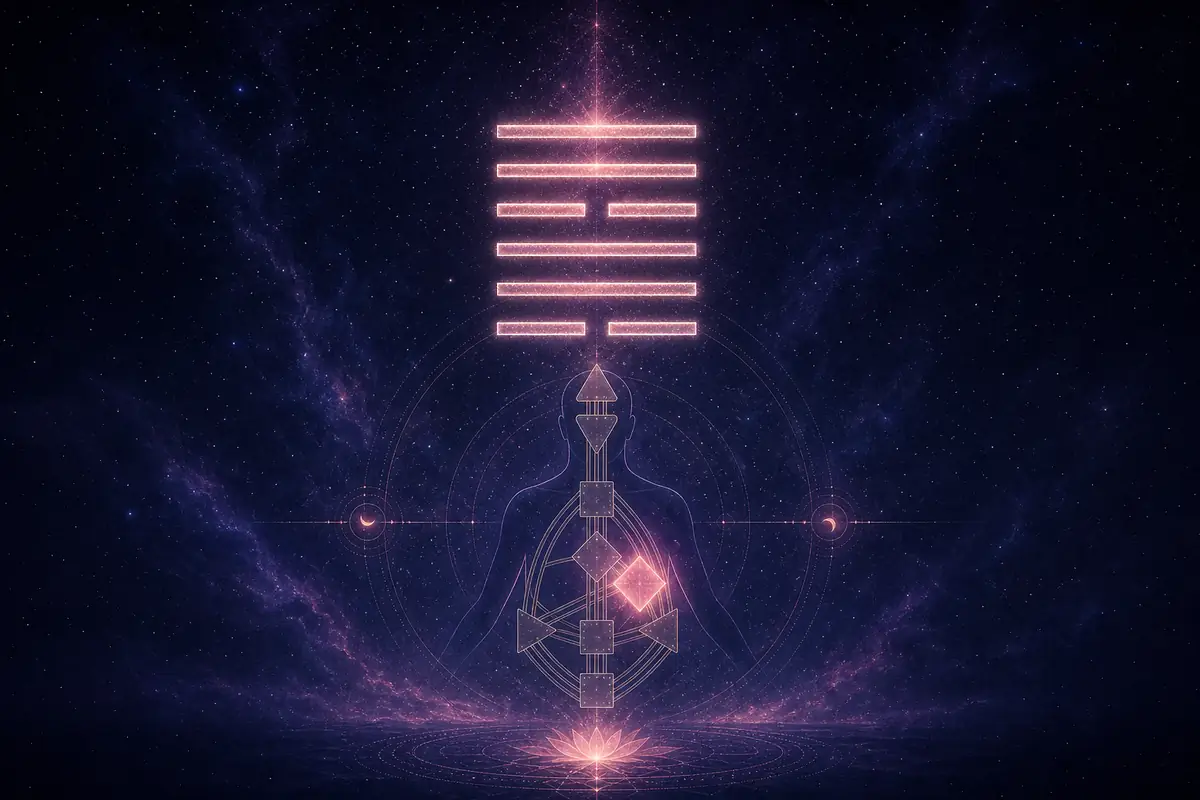
Two people can share a flat, a team or a bed and still bump into each other in small, repeated ways. Human Design names the quality behind that rubbing gate 6, Friction. Rather than treating friction as a fault, the system reads it as the contact that decides how close two people are allowed to get. The gate sits in the Solar Plexus, the emotional centre, and its hexagram is Conflict. A defined gate 6 tends to give the chart a built-in sense of when closeness is welcome and when it needs a boundary, and that sense can be uncomfortable even when it is accurate.
Friction inside an emotional centre
Gate 6 lives in the Solar Plexus, the bodygraph centre for emotional awareness and also one of its motors. That placement shapes how the gate behaves. Emotion in Human Design moves in waves, so the friction of gate 6 tends not to be a fixed opinion about a person; it rises, peaks and settles. Because the centre is a motor, the feeling can carry real pressure, which is why a single tense moment can seem larger than the facts around it. Someone with the gate defined may notice that the same remark lands differently on a calm morning and on a crowded, tiring evening. The gate spans 22°38' to 28°15' Virgo, the Sun passes through it for about a week, roughly September 15 to September 21, and the opposite gate on the wheel is 36.
Resistance as a test of closeness
The keynote suggests that friction is not only an obstacle. It can work like a screening process: a person who handles the first rub gets nearer, and one who cannot stays at a distance. Someone with this gate defined may bristle early with new acquaintances, then relax once trust has settled. That is one interpretation of the keynote, and it describes a tendency rather than a rule about how every relationship will go.
Clearing the air or leaving it
- Speaking at the height of a wave can turn mild irritation into a quarrel.
- Silence for days can leave a small snag to harden into distance.
- A calmer, short conversation after the feeling has levelled tends to resolve more than either extreme.
None of these is a prescription. They simply show why timing matters for this gate more than the choice of words.
Why a boundary can feel like rudeness
Because the gate protects the edge of closeness, the person carrying it may state a limit that sounds abrupt to someone expecting warmth. From the inside it often feels more like honesty than hostility. Gentle wording, and an explanation that the limit concerns pace and not rejection, usually helps the other person hear it correctly. Without that, a perfectly reasonable boundary can be taken as an attack. Saying what you need, and for how long, turns a refusal into information the other person can work with.
Reading a snag before answering it
Gate 6 cannot decide anything on its own, since it is only one gate. Still, a snag is information about pace before it is a verdict on a person, and the gate's theme fits Human Design's advice around emotional centres: avoid committing in the middle of a surge. Waiting until the feeling has levelled out gives you a clearer view of whether the friction is about this person, this moment or something unrelated, such as tiredness or a worry that arrived at the same time. Keeping a short note of what set the feeling off can make the pattern visible over weeks, and patterns are easier to talk about than moods. A useful question to ask afterwards is whether the snag was about the content of what was said or about how fast the closeness was growing.
Closeness with real consequences
Gate 6 pairs with gate 59 in the Sacral centre to form the channel called Reproduction. When both are defined, the emotional drive of gate 6 and the Sacral energy of gate 59 are joined, and the chart tends to treat intimacy as a matter of real consequence, with closeness bound up with bodily energy and shared life. Shared homes, shared plans and shared bodies raise the stakes of a boundary, which is why it tends to be set carefully. With only gate 6 defined, it reaches for that partner instead, and the connection to gate 59 may be felt most in the company of people who carry it.
Friction can mark the place where closeness is being negotiated. Before treating a snag as a verdict, ask what boundary or pace it is trying to set.
What Human Design is and how to read a bodygraph — read the guide →
Get your free Human Design chart and AI reading — create an account →
Frequently Asked Questions
Why is gate 6 called Friction rather than Conflict?
Conflict is the I Ching hexagram name, while Friction is the Human Design keynote. The keynote is gentler and more specific: it describes the contact between people that decides how near they get. The two labels overlap, but friction as a theme does not mean a person who is quarrelsome by nature.
Could gate 6 make someone avoid intimacy?
It can make someone careful about it. The theme is about regulating closeness, so a person may take time before letting others in. That caution is not the same as avoidance: once trust is established, the same sense of boundaries can make a relationship feel settled and safe for everyone in it.
In which centre does gate 6 sit?
It sits in the Solar Plexus, the centre for emotions and one of the bodygraph's motors. Its only channel is 6-59, called Reproduction, which links to gate 59 in the Sacral. Gate 6 is defined when a planet activates it, between 22°38' and 28°15' Virgo, on the Personality or Design side.
What changes if gate 6 is defined without gate 59?
The channel is not complete, so gate 6 is a hanging gate that reaches toward its partner. In practice, the emotional boundary-setting theme remains, but the full channel energy is borrowed from other people, or from the planets in a transit, that carry gate 59, rather than being a permanent part of your own chart.