Sun Square Saturn: Aspect Meaning & Interpretation
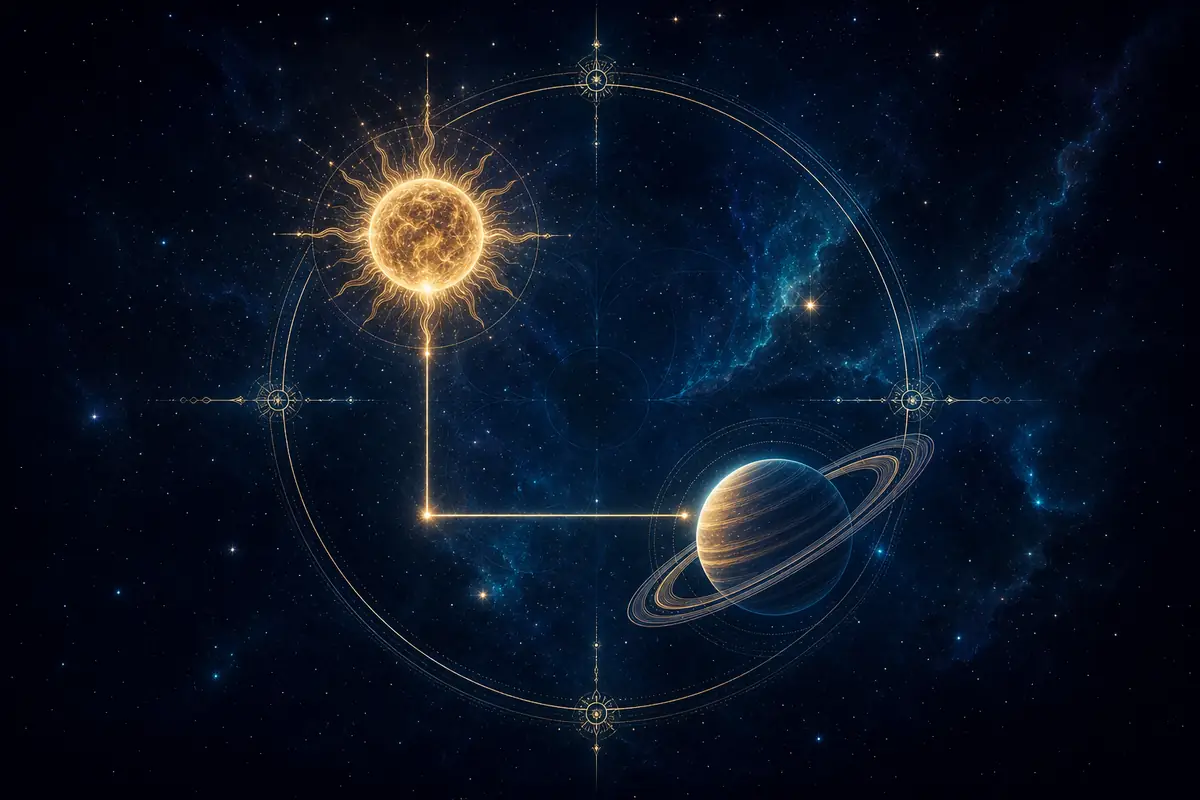
Pressure has a direction, and in a Sun square Saturn it comes from a right angle. The Sun, the planet of identity, vitality and will, stands 90° from Saturn, the planet of limits, time and structure, and neither can look straight at the other. Astrologers read the square as the aspect of friction and action: it describes a self that meets resistance, and learns what it is made of by pushing back. Which side of Saturn the Sun stands on changes the character of that pressure, and the transiting Sun forms a square to natal Saturn twice a year. The sections below take these in turn.
Identity keeps meeting a limit
The Sun wants to express itself and Saturn wants to test whether the expression can hold. At a square the two do not blend and do not cooperate; they interrupt each other. One reading is a sense that effort is required before anything is allowed, with high standards for the self and a habit of measuring achievement against an inner ruler.
Friction that turns into action
Squares are the aspects that make things happen, because the friction cannot be ignored. With Saturn, the action tends to take the form of building: setting a task, finishing it and meeting the cost of doing it properly. This is interpretation, not a prediction, and it describes a pressure to act rather than a particular result. Squares usually join signs of the same modality, so the two planets often share a style of acting even while they disagree about what to do, and a tight square is commonly read as more insistent than a wide one.
Sun ahead of Saturn, or Sun behind it
Squares come in two kinds. In a waxing square the faster body, here the Sun, is 90° ahead of Saturn in their cycle; in a waning square it is 90° behind. The two feel different, and a chart report will show which you have.
- Waxing: the Sun is ahead, so the pressure can read as a drive to build and prove, with the lesson arriving through the work itself
- Waning: the Sun is behind, so the pressure can read as a call to review and refine what was already built before moving on
These are interpretive readings, and neither kind is the harder one. About 8.9% of birth charts carry a Sun–Saturn square of either kind (using an 8° orb), and a different orb changes that figure.
Where the two squares fall in a cycle
The Sun and Saturn meet about every 378 days, and the two squares are the points a quarter and three quarters of the way round that cycle. As rough arithmetic, the waxing square falls about 95 days after a conjunction, and the waning square about 285 days after it, or roughly 95 days before the next conjunction. Those figures are approximate, because the bodies do not move at a perfectly even pace.
One way to use the picture is to see a waxing square as a young cycle, with Saturn's work still to be done, and a waning square as a cycle already well along, with the work to be assessed. Both are metaphors for how the pressure may feel. Neither claims that the person's life follows a calendar.
A greater malefic in the Sun's own camp
Tradition calls Saturn the greater malefic, a label for its austere nature and not a forecast of misfortune. In the Hellenistic scheme Saturn also belongs to the day sect, like the Sun. A square between two day-sect planets can be read as a disagreement within one team: both want the person to endure and to be taken seriously, and the quarrel concerns how much proof the self owes and how soon.
The square that comes round again
The natal square is a fixed pattern, but the Sun revisits it. Each year the transiting Sun passes the point 90° ahead of natal Saturn and later the point 90° behind it, so it forms a square to natal Saturn twice a year. The passage is brief, since the Sun moves quickly. When transiting Saturn later forms a square to your natal Sun, the contact is a much longer episode, and it can be read as a test of long-term commitments.
Whether the Sun stands ahead of Saturn or behind it decides if the right angle pushes you to build or to revise.
Choosing the standards you keep
The task here is selection. High standards can serve you, but only if you picked them. Useful practices include breaking big aims into finished stages, noting what has already been completed and separating a standard that guides from one that only accuses. The square describes a relationship with pressure, not a limit on what you can do.
How aspects tie a birth chart together — read the guide →
Get your personal AI birth chart reading — create a free account →
Frequently Asked Questions
How does it feel to have the Sun square Saturn?
One reading is a persistent sense of being measured against a standard, with effort felt before ease. It is an interpretation, not a universal experience, and the sign, house and orb shape how it shows. The chart cannot say which way it goes for any one person.
What happens if the square is waning instead of waxing?
The Sun sits 90° behind Saturn rather than ahead of it. One way to read it is as pressure to review and refine what has already been built, where the waxing square pushes towards building. The two are different flavours of friction, and neither is harder.
Do all Sun square Saturn charts feel the same?
No. Waxing or waning, the signs and their modality, the house, the orb and the rest of the chart all change the expression. The aspect gives the outline of a relationship between identity and limits, and personal factors fill in the detail.
How visible is the square from the outside?
Astrology does not say it has to be visible. The tension may show as conscientiousness, or stay inward as self-criticism. The placement describes an inner dynamic more than a public manner, and how it appears depends on the sign, house and the rest of the chart.