Snake Chinese Zodiac: Personality, Traits & Years
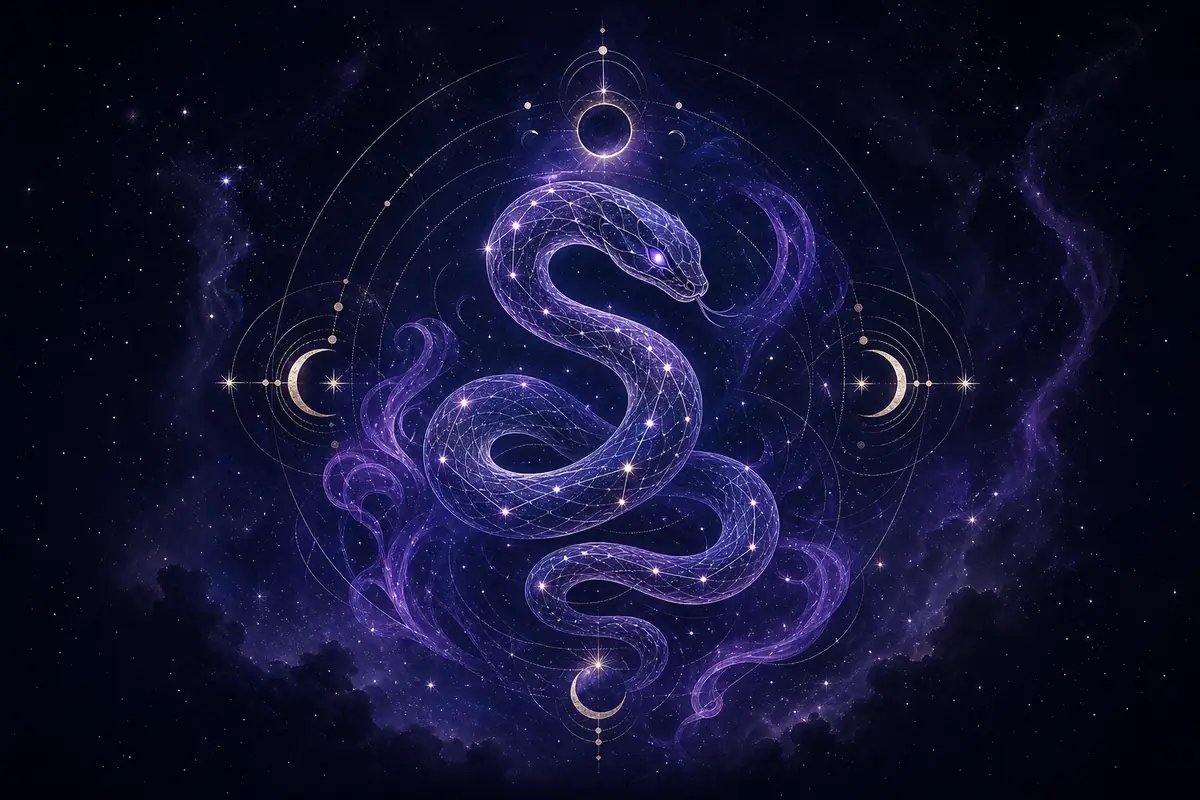
Wise, enigmatic, and quietly formidable — the Snake is the philosopher of the Chinese zodiac, and the sign most often misread by Western readers. In Chinese tradition the snake is not a tempter or a threat but a creature of hidden knowledge, healing, and renewal. People born in a Year of the Snake move through the world with deliberate grace, processing far more than they reveal, and trusting intuition as much as evidence.
Why Chinese tradition calls the Snake the little dragon
In Chinese the Snake is commonly nicknamed 小龙 (xiǎo lóng), the "little dragon", and the name is a compliment rather than a diminutive. The Dragon is the only mythical animal in the cycle, and the Snake is the real creature it most resembles — sinuous, water-associated, and credited with knowledge ordinary animals lack. The two sit side by side, Dragon fifth and Snake sixth, and the pairing is instructive: the Dragon holds power in public and the Snake holds the same power in private. A Snake rarely announces its strength; it simply turns out to have been the best-informed person in the room.
The serpent of Genesis is not the animal this sign describes
English carries a heavy inheritance around snakes — the deceiver in the garden, the snake in the grass, snake oil. None of it belongs to the Chinese sign, and importing it distorts the reading badly. Chinese mythology places the serpent at the origin of humanity rather than at its fall: the creator goddess Nüwa is conventionally depicted with a human head and a serpent's body, as is her counterpart Fuxi. Snakes here are linked to fertility, medicine, longevity, and secret wisdom. If you were told a Snake year is unlucky to be born in, you were given a Western association wearing Chinese clothing.
Shedding the skin: renewal as the sign's organising idea
The behaviour that defines the animal in Chinese symbolism is moulting. A snake outgrows its skin, sheds it whole, and continues as the same creature in a new surface — transformation without loss of identity. Snake natives live in that rhythm. They stay with a career, a city, or a relationship long past the point where anyone expects them to move, then reinvent completely and without much explanation. The quietness is part of the pattern: shedding is private work, and a Snake does not want an audience for the vulnerable interval in between.
The Snake understands what most miss: that real power lies not in noise, but in knowing when to be still.
What Snakes are like once you get past the reserve
Snakes observe before acting, gather information quietly, and rarely tip their hand until ready to move. Their inner life is rich and complicated, though little of it surfaces.
- Intuitive — trust gut feeling and are rarely wrong about people.
- Strategic — plan several moves ahead before acting.
- Elegant — drawn to quality, beauty, and refinement.
- Determined — pursue a chosen goal with quiet relentlessness.
- Private — guard their inner world and share selectively.
The shadow grows from the same soil. Guardedness curdles into secretiveness, perceptiveness into suspicion, patience into a long memory for slights. A threatened Snake does not confront you; it quietly rearranges the situation to its own advantage, which is why the sign carries a reputation for jealousy alongside its reputation for wisdom.
The Si hour and the Snake's yin fire
The Snake governs the earthly branch 巳 (Sì) and the double-hour from 9 am to 11 am — mid-morning, when the day is under way but has not reached its glare. Its fixed element is Fire and its polarity is yin, a combination describing heat kept under control: a banked flame rather than a bonfire. Its lucky numbers are 2, 8, and 9, and its lucky colours are black, red, and yellow.
Every Year of the Snake since 1953, element by element
The twelve animals combine with the five elements across sixty years, so no two Snake years are alike:
- Water Snake — 1953: the most perceptive and persuasive.
- Wood Snake — 1965: more sociable than the type suggests.
- Fire Snake — 1977: openly ambitious, with visible charisma.
- Earth Snake — 1989: steady, patient, unusually reliable.
- Metal Snake — 2001: single-minded and hard to deflect.
- Water Snake — 2013: intuitive, adaptable, diplomatic.
- Wood Snake — 2025: the most recent Snake year.
- The next Year of the Snake falls in 2037.
The Chinese year begins at the lunar new year, so a January or early-February birthday needs checking against that year's date first.
Work that pays a Snake for waiting
Snakes work best where the reward arrives late and depends on having read the situation correctly.
- Psychology, psychiatry, and counselling
- Research, philosophy, and academia
- Law, investigation, and intelligence work
- Finance, hedge funds, and investment strategy
- Art, literature, and creative direction
Why the Pig is the Snake's hardest match
The Snake belongs to the second Triangle of Affinity with the Ox and the Rooster — three disciplined signs that share a drive for excellence and prefer depth to breadth, which makes those pairings stable and quietly powerful. The Snake's opposite on the wheel is the Pig, and the friction is structural rather than personal: the Pig trusts openly and says what it thinks, while the Snake withholds until certain. Each reads the other's honest behaviour as a fault — the Pig finds the Snake evasive, the Snake finds the Pig naive — and the trust neither can do without never forms.
Read the Chinese zodiac 2026 guide →
Get your free AI BaZi reading — create an account →
Frequently Asked Questions
Why is the Snake called the little dragon in Chinese?
小龙 (xiǎo lóng), or "little dragon", is a common affectionate name for the Snake. The Dragon is the only mythical animal in the zodiac and the Snake is the real animal closest to it, so the nickname credits the Snake with the Dragon's qualities in a quieter register.
Is the Snake a bad or unlucky sign in Chinese astrology?
No. The negative reputation comes from Western and biblical associations with serpents, not from Chinese tradition, where the snake is linked to wisdom, healing, longevity, and renewal, and the creator goddess Nüwa is depicted with a serpent's body.
What does shedding skin symbolise for the Snake sign?
Moulting is the Snake's central symbol: the animal outgrows its skin, sheds it whole, and continues unchanged underneath. For the sign it means periodic reinvention — Snake natives stay in a role far longer than expected, then transform completely without warning.
Why is the Pig the Snake's hardest match?
The Pig sits directly opposite the Snake on the zodiac wheel, and the friction is structural rather than personal: the Pig says what it thinks and expects the same openness back, while the Snake shares only when it judges the moment right. Each reads the other's ordinary behaviour as a flaw — the Pig finds the Snake evasive, the Snake finds the Pig naive. The Snake's natural allies are the Ox and the Rooster, its Triangle of Affinity partners, whose discipline and depth suit its own.