Sun Square Jupiter: Aspect Meaning & Interpretation
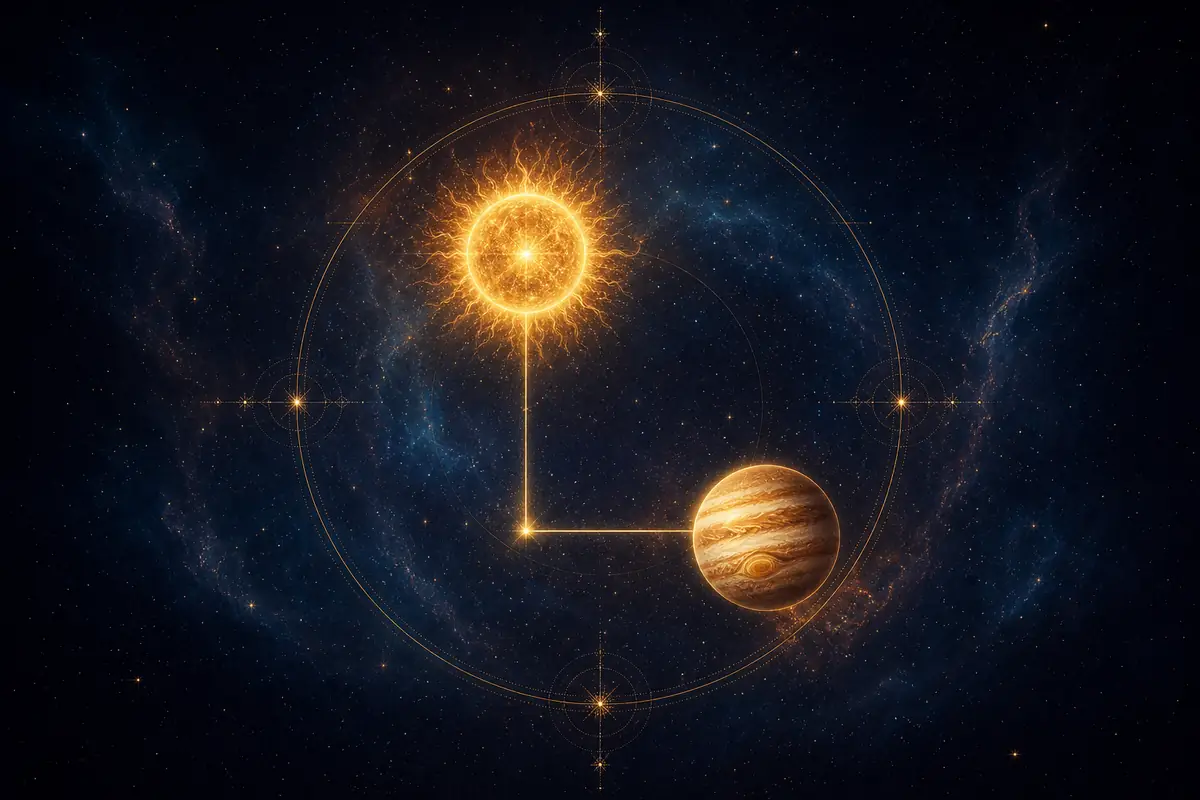
It would be natural to expect the Sun and Jupiter to get along. One is the symbol of identity and vitality, the other the planet of growth, belief and abundance, and tradition places both among the planets of the day. A square at ninety degrees complicates that picture. The aspect is read as friction, so the generosity and optimism that Jupiter offers collide with the Sun's wish to define itself, and the result may be bigger than either planet would produce alone. It can look like ambition that keeps raising its own bar, or confidence that runs slightly ahead of the facts. The tension is real, but it is of a kind that tends to produce movement.
Growth under friction
A square is the aspect that produces effort. Two bodies that are close enough to interact and different enough to disagree set up a pressure that a conjunction lacks and a trine does not need. With Jupiter on one side of the angle, the pressure tends to take the form of wanting more: more scope, more meaning, more room. The Sun's task is to decide how much of that wanting actually belongs to the person, and the square keeps asking the question.
Two members of the day sect at odds
In the Hellenistic scheme the Sun, Jupiter and Saturn belong to the day sect, while the Moon, Venus and Mars belong to the night sect. A Sun–Jupiter square therefore places two planets of the same sect in conflict. One way to see it: neither planet is a stranger to the other, so the friction is more like a disagreement within a team than a clash between opponents. Both want the person to do well and may disagree sharply about how.
Compare that with a square between planets of opposite sects, where the two natures themselves differ. Here the nature is shared and the quarrel is about proportion: how big, how fast and how soon. That is an interpretation of the sect idea and not a measured effect.
A benefic that overshoots
Jupiter is the greater benefic, which adds an edge. The benefic's generosity is not hostile, yet at ninety degrees it can overshoot, offering more than the Sun can digest. This is a traditional interpretation and should be held lightly, since a chart is never read from one aspect alone.
Excess dressed as optimism
Overreach is the recurring theme of this aspect. In practice it can look like these patterns:
- Taking on more than a schedule or budget allows
- Promising generously and delivering late
- Reading a good start as a finished result
- Beliefs held with more certainty than the evidence supports
Squares usually join signs of the same modality, which can intensify the habit: two cardinal planets both want to launch, two fixed ones both refuse to scale back, two mutable ones both keep expanding the plan. The sign sets the style and the house sets where it appears, so the same square can surface as an overstretched career, an overfull calendar or an over-large belief, depending on where the planets sit. About 8.9 percent of birth charts hold a Sun–Jupiter square at an 8-degree orb, and a different orb changes that figure.
Jupiter at ninety degrees to the Sun rarely lacks generosity of spirit. What it tends to lack is a sense of scale.
What the stretch can build
The same restlessness has a productive side. A person who cannot settle for a small version of their ambitions may end up building something larger than they planned, and the friction can supply the stamina to keep going. The square may also produce a habit of questioning received beliefs, since neither confidence nor doubt is allowed to settle quietly.
Tradition reads a tighter square as more insistent, and an applying one as more active than a separating one, so the effect depends on the details of the chart. A wide, separating square may show up mostly as a taste for large ideas, while a tight one can press for action on them.
Learning proportion
Practical approaches usually focus on scale. Setting a limit on commitments before taking them on, checking promises against the calendar, and keeping a record of past estimates can bring the Sun's judgement into the conversation. It can help to treat enthusiasm as information about what matters, and not as evidence about what is feasible.
When transiting Jupiter later forms a square to the natal Sun, a period of overextension risk and large plans can be read, which is a reason to commit in stages and to let the first stage prove itself before the second begins.
How aspects tie a birth chart together — read the guide →
Get your personal AI birth chart reading — create a free account →
Frequently Asked Questions
Where is overreach most likely to show up?
In the areas of life tied to the houses the two planets occupy, and in the style their signs suggest. Commitments, money, beliefs and ambitions are the usual candidates in interpretation. A tighter square tends to be read as more insistent. It is a pull to watch, not a pattern that plays out the same way in every chart, and awareness is usually the first adjustment.
Could shared sect soften this clash?
One way to see shared sect is as a kinship between the two planets, so the friction may feel more like a quarrel over scale than a fight between strangers. It remains a square, however, and the tension tends to show as disagreement over pace. That is an interpretation, not a measurement, and one lens among several.
When should Jupiter's benefic label count as literal?
Treat it as a traditional category, not a guarantee. Jupiter is the greater benefic because its signification is growth and generosity, but a square can turn those qualities into excess. The label describes the planet's nature, and the aspect describes how that nature meets the Sun in a particular chart.
What exactly counts as overreach under this aspect?
In astrological terms, overreach is expansion outrunning capacity: commitments, beliefs or ambitions that grow faster than the resources or evidence behind them. It is a description of a tendency, and the same energy can also appear as courageous growth. Only the person can judge which side of that line a particular choice falls on.