Human Design Gate 61: Inner Truth — Meaning & Theme
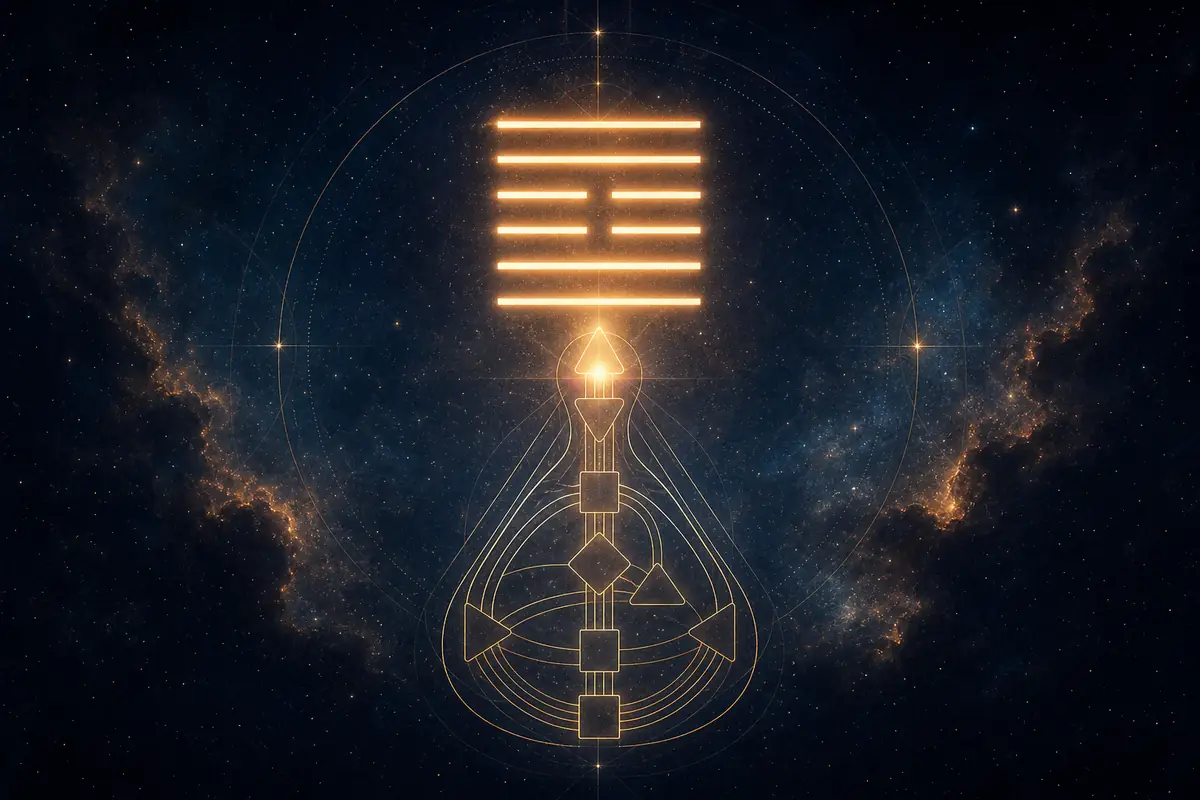
Inner Truth is both the Human Design name of gate 61 and the name of its hexagram, so a single phrase does double duty here. The gate belongs to the Head centre, the pressure centre at the top of the bodygraph, where Human Design places the urge to wonder and to ask. Gate 61 aims that pressure at what cannot easily be checked: the feeling that something underneath ought to be understood. A planet in the gate, on either the Personality or Design side, defines the gate and nothing more. It sets a theme for how curiosity feels, not a measure of wisdom, and it promises no answers.
A question that has no tidy answer
Most curiosity can be settled by looking something up. The keynote of gate 61 points elsewhere, toward the kind of question that stays unresolved however much information is gathered: what something is really about, why it matters, what sits behind the surface of an event. A person with the gate may recognise a long-running preoccupation with a mystery they could not describe in a single sentence. Human Design treats this as the gate's theme, a pressure to know, and it does not say the person will ever find out.
Inner Truth, twice over: the name and the keynote
Most gates carry an HD keynote that differs from the name of their hexagram. Here the two coincide: hexagram 61 in the I Ching is called Inner Truth, and the Human Design keynote uses the same words. That leaves no gap to bridge between the two names, so the work of reading is different. It lies in deciding what the phrase is being asked to carry.
One way to see it is that the repeated name stresses the inward direction of the theme. The truth in question is not a fact to be looked up outside; it is a sense of something held within that wants to be understood. That is an interpretive reading, offered as one lens, and nothing in the gate fixes what the inner truth of any particular person would be.
Why an explanation satisfies it only for a while
Because the pressure is aimed at something that does not fully resolve, a good explanation may calm it briefly before it returns in a new form. A person with gate 61 may notice that each answer opens the next question rather than closing the subject. That can be tiring when it is read as failure to reach a conclusion. It can also be read as the gate working as described: the point of the pressure is to keep the question alive, not to retire it.
The asking carries on after the explanations have run out.
Keeping a hunch without announcing it
A sense of what lies beneath often arrives without evidence, which makes it awkward to share. Saying it aloud can invite demands for proof that the person cannot yet give. One option is to hold a hunch privately for a while, jotting it down and returning to it, rather than defending it before it has taken shape. A hunch that is still interesting a few weeks later may deserve more attention than one that faded.
A question with nowhere to land
Gate 61 forms the 24-61 channel, Awareness, with gate 24 in the Ajna centre, the centre where Human Design places conceptualising. A channel exists only when both gates are active, and only a full channel defines the two centres it joins. A single gate never defines the Head centre. With gate 61 alone, the pressure is an activation that can come and go, and in that case the question may press without a reliable place to land. Where both gates are active and the centres are defined, one reading is that the pressure has a steadier route into thought.
The gate on the opposite side of the wheel is gate 62, Detail, in the Throat. When the Sun is in gate 61, which happens in about the week of January 10 to January 16 and spans 20°45' to 26°22' Capricorn, the Earth sits in gate 62 in a Personality chart. The pairing can be read as a contrast between a mystery with no edges and a practical gate that attends to small, nameable facts.
Telling an unanswered question from an unanswerable one
A theme built on unanswered questions can feel unsettling in settings that reward quick conclusions. It can help to separate two things: a question that has not been answered yet, and a question that cannot be answered. The gate does not say which one is in front of a person. It suggests that living comfortably with an open question is its own kind of skill, and that other people, who may approach the same subject from a different direction, can be a useful test of whether the mystery is shared. Type, authority and the rest of the bodygraph decide how any of this plays out.
What Human Design is and how to read a bodygraph — read the guide →
Get your free Human Design chart and AI reading — create an account →
Frequently Asked Questions
What does the matching name add to the Inner Truth reading?
Because the hexagram and the HD keynote share the name Inner Truth, no translation between the two is needed. One reading is that the repetition stresses an inward direction: the theme concerns a truth held within rather than a fact found outside. It is an interpretation, not a rule, and it says nothing specific about any individual.
What separates gate 61 from ordinary curiosity?
Ordinary curiosity can be settled by looking something up. The keynote of gate 61 points to questions that stay open however much is gathered, such as what something is really about. That is a description of a theme in the Head centre, and it says nothing about how well anyone thinks or what they will find.
Should a hunch from gate 61 be acted on straight away?
The gate does not say. A reasonable approach is to treat a hunch as a question rather than a conclusion: write it down, test it against whatever evidence exists and discuss it with someone who sees things differently. That keeps the theme useful without leaning on a feeling that cannot yet be checked.
Why does each answer seem to open another question?
The point of this gate's pressure may be to keep the question alive, so a good explanation calms it briefly before it returns in a new form. That can be tiring if it feels like failing to reach a conclusion. Whether the pressure is steady depends on the rest of the chart.