What Is Human Design? Your Bodygraph, Type & Strategy Explained
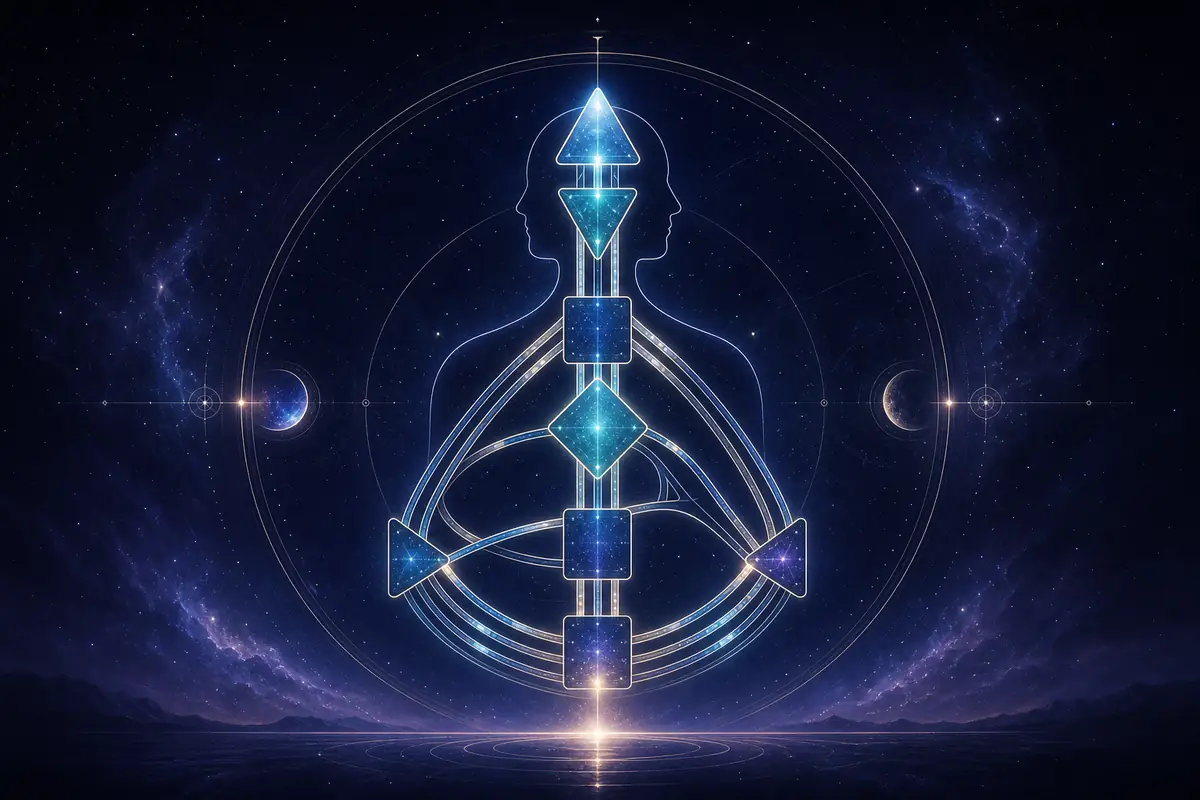
Human design is a system that asks a deceptively simple question: how are you actually wired to make decisions, spend energy, and move through life? The answer is encoded in your bodygraph — a chart calculated from your exact birth data that maps your energy anatomy in a way no single tradition could achieve alone. If you have ever wondered “what is my human design?” or felt that astrology alone only scratched the surface, this guide walks you through everything: what the system is, what the chart shows, how the five human design types differ, and how an AI Human Design reading on Astrologer AI can decode yours in minutes.
Ready to see your chart right now? Create your account and generate your bodygraph — then come back and the rest of this article will land much more concretely.
Where Human Design Comes From
Human Design was synthesized in 1987 by Ra Uru Hu (born Alan Robert Krakower) following what he described as a mystical experience in Ibiza. The system draws on four ancient and modern traditions:
- Western astrology — the positions of the planets at your birth and 88 days before it provide the raw data that activates your chart.
- The I Ching — the 64 hexagrams of the Chinese Book of Changes map directly onto the 64 gates of the bodygraph, each gate carrying a specific archetypal theme.
- Kabbalistic Tree of Life — the nine energy centers of the bodygraph are arranged in a structure analogous to the Sephirot, reflecting different aspects of consciousness and biology.
- Hindu-Brahmin chakra system — the centers correspond to the body's energy zones: head, ajna, throat, heart, sacral, root, spleen, solar plexus, and self/identity.
The synthesis is what makes human design distinctive. No single tradition gives you all the layers; the bodygraph brings them together into one unified map.
Anatomy of the Bodygraph
Your human design chart — the bodygraph — is a diagram of nine geometric centers connected by 36 channels. Each channel is made up of two gates. When a planet activates a gate at birth, that gate becomes defined and colors the channel. When both gates of a channel are activated, the entire channel is defined and the two centers it connects become defined as well.
Defined vs. Undefined Centers
A defined center (colored in your chart) operates consistently and independently. It is a fixed, reliable aspect of who you are — energy you generate and radiate outward. An undefined center (white or open) takes in and amplifies the energy of others. That is not a weakness; it is where you are most flexible and where you learn the most — but it is also where you are most susceptible to conditioning and pressure from the outside world.
The ratio and pattern of your defined and undefined centers is what determines your human design type, which is the most foundational layer of the system.
Gates, Channels, and the I Ching Connection
The 64 gates of the bodygraph correspond to the 64 hexagrams of the I Ching. Every gate carries a specific theme — for example, Gate 1 is the Gate of Self-Expression, Gate 57 is the Gate of Intuition. When planetary positions at your birth (and design date) fall in those gates, they bring those themes into your chart and personality. The human design chart is therefore simultaneously an astrological calculation and an I Ching reading, rendered as a single visual.
The Five Human Design Types
Type is the entry point into human design. It describes your overall energy mechanics and defines the strategy — the mode of engagement — that works best for you. A deeper look at each type will come in a dedicated article; here is the essential overview.
Generator (approx. 37% of the population)
Generators have a defined Sacral center — the body's powerhouse of life-force energy. They are the builders of the world, with sustainable energy for work they love. Their strategy is to wait to respond: instead of initiating, they wait for something in life to trigger their gut response, then follow the “uh-huh” or “uh-uh” signal. When Generators respond authentically, energy flows and satisfaction follows.
Manifesting Generator (approx. 33%)
Manifesting Generators share the Generator's Sacral definition but also have a motor connected to the Throat center, giving them bursts of manifesting capacity. They are multi-passionate, fast-moving, and non-linear. Their strategy is also to wait to respond, then inform before acting. When they try to do things sequentially, frustration sets in; their path is naturally skipping steps.
Projector (approx. 20%)
Projectors do not have a defined Sacral center. Rather than generating energy, they are designed to guide and manage others' energy. Their strategy is to wait for the invitation — for recognition and an invitation before sharing their gifts. When invited, Projectors can offer penetrating insight; when they push uninvited, they meet resistance and bitterness.
Manifestor (approx. 9%)
Manifestors are the only type truly built to initiate. They have a motor connected directly to the Throat and no defined Sacral. Their strategy is to inform others before acting — not to ask permission, but to reduce the resistance their impact naturally generates. When Manifestors follow their strategy, anger dissipates and peace replaces it.
Reflector (approx. 1%)
Reflectors have no defined centers at all. They are completely open, sampling and reflecting the health and energy of those around them. Their strategy is to wait a full lunar cycle (28 days) before making major decisions, allowing the moon's transit through all 64 gates to bring clarity. When Reflectors are in the right environment and community, they experience a rare and beautiful sense of surprise and delight.
Strategy and Authority: Your Decision-Making Blueprint
Knowing your type gives you your strategy — the outer approach to life. But human design goes further with authority, which is the body-based inner signal you use to make decisions. Authority is what distinguishes human design from purely mental self-help frameworks: it insists that the mind is not designed to be the decision-maker.
The most common authorities include:
- Sacral authority (Generators and Manifesting Generators) — a visceral gut response, often literally a sound or sensation in the belly area: a rising “mm-hmm” for yes, a flat “uh-uh” for no.
- Emotional authority — a defined Solar Plexus means emotions move in waves; clarity only comes after riding the wave, never in the heat of the moment.
- Splenic authority — a spontaneous intuitive hit in the now, often quiet and easy to override. The Spleen only speaks once.
- Ego/Heart authority — what the heart or will genuinely wants, expressed through speaking it out loud.
- Self-Projected authority — clarity emerges by talking through a decision with trusted others (without needing their input, just the sounding board).
- Lunar authority (Reflectors only) — waiting the full 28-day lunar cycle and noticing how a decision feels across different days and environments.
Understanding your authority is often the most immediately practical thing you can take from your human design chart. It is a concrete instruction: when facing a decision, use this inner signal, not mental analysis.
Profile: Your Life's Role and Theme
Beyond type and authority, your human design profile describes the costume you wear and the role you play in this lifetime. There are 12 profiles, each a combination of two lines drawn from the I Ching hexagram structure (lines 1 through 6). For example, a 3/5 profile is the “Martyr/Heretic” — someone who learns through trial and error (line 3) and is seen by others as a practical problem-solver (line 5). A 1/3 is the “Investigator/Martyr,” always needing a solid foundation of knowledge before feeling secure.
Profile adds nuance that type alone cannot provide: two Generators with identical type and strategy can have very different life themes and relational dynamics depending on their profile.
How an AI Human Design Reading Works
Traditionally, learning your human design chart meant either buying an expensive reading from a certified analyst or spending hundreds of hours studying the system. Astrologer AI changes that equation. Enter your birth date, time, and place, and the app calculates your complete bodygraph — type, strategy, authority, profile, defined and undefined centers, gates, channels, and more — with the same astronomical precision a professional uses.
The AI then reads that chart conversationally. You can ask: “What does my open Sacral center mean for work?” or “How does my 2/4 profile show up in relationships?” or “I'm a Projector — how do I handle an environment where everyone expects me to push?” The human design AI grounds every answer in your actual chart data, not a generic template.
Because Astrologer AI holds your complete birth profile, you can also compare lenses — ask how your Human Design type intersects with your Western natal chart or your numerology life path. Each system illuminates a different dimension of the same person.
Human design doesn't tell you what to do — it shows you how you are wired so you can stop fighting your own nature.
Using Human Design Day to Day
The practical application of my human design chart usually starts with three experiments:
- Follow your strategy for 30 days. If you are a Generator or Manifesting Generator, practice responding rather than initiating. If you are a Projector, notice what happens when you wait for an invitation vs. pushing in. The feedback loop is often surprisingly quick.
- Honor your authority on one real decision. If you have Sacral authority, drop into your gut before your head on something that matters. If you have Emotional authority, give yourself time before committing. Notice the quality of the outcome.
- Study your undefined centers. Where you are open is where conditioning from others sneaks in. Awareness of your open centers reduces the “not-self” patterns — the Generator's frustration, the Projector's bitterness, the Manifestor's anger, the Reflector's disappointment.
The goal of human design is not to box you in but to give you a framework that reduces the noise — the conditioning, the pressure, the expectations of others — so what remains is genuinely you. An AI reading is particularly useful here because you can return to the conversation whenever a new life situation calls for a fresh perspective on your chart.
Human Design and Astrology: Sister Systems
Human design is rooted in astrology — it literally uses planetary positions as its input data — but it asks different questions. Western astrology focuses on personality archetypes, timing, and the story of the psyche through signs and houses. Human design focuses on energy mechanics: how your body is designed to move through the world, make decisions, and interact with others' energy fields.
Using both together gives you a fuller picture. Your natal chart might show a strong Scorpio stellium that explains your intensity; your bodygraph might show an undefined Will center that explains why you sometimes say yes when you mean no. Neither system is complete alone — but side by side, they are remarkably complementary.
On Astrologer AI, your bodygraph and natal chart live in the same app, so you can explore them together or ask the AI to bridge the two. Create your account to generate your complete human design chart and start the conversation.
Frequently Asked Questions
What is Human Design?
Human Design is a synthesis system that combines Western astrology, the I Ching, Kabbalistic Tree of Life, and the Hindu-Brahmin chakra system into a single chart called a bodygraph. Created in 1987 by Ra Uru Hu, it maps your energy type, decision-making authority, life strategy, and profile — a kind of blueprint for how you are designed to operate in the world.
How do I find my Human Design type?
Your Human Design type is calculated from the positions of the planets at two moments: your birth date, time, and place, and exactly 88 days before your birth (your 'design' calculation). Enter your birth data into a Human Design calculator — such as the one inside Astrologer AI — and the system determines which of the five types you are: Generator, Manifesting Generator, Projector, Manifestor, or Reflector.
What is a bodygraph?
A bodygraph is the core chart of Human Design. It is a diagram of nine energy centers (similar to chakras) connected by 36 channels. Channels that are activated by planetary gates become 'defined' (colored in), while unactivated ones remain 'undefined' (open). The pattern of defined and undefined centers determines your type, reveals consistent personality traits, and shows where you are open to outside influence.
Is Human Design real or accurate?
Human Design is not a scientifically validated system, but many people find its descriptions of their type, strategy, and authority highly accurate and practically useful. It draws on ancient wisdom traditions (I Ching, astrology, Kabbalah, chakras) and modern genetics. Like astrology, its value lies in the self-awareness and decision-making framework it offers rather than in empirical proof. An AI Human Design reading can make those insights immediately accessible without requiring years of study.
What are the five Human Design types?
The five types are: Generators (about 37% of the population) — builders with sustainable energy who thrive by responding; Manifesting Generators (about 33%) — multi-passionate responders with a faster, non-linear path; Projectors (about 20%) — guides designed to manage and direct others' energy; Manifestors (about 9%) — initiators built to act and inform; and Reflectors (about 1%) — mirrors of community health who need a full lunar cycle before major decisions.
What is Human Design authority?
Your Human Design authority is your inner decision-making compass — the body-based signal that tells you when a choice is correct for you. Authorities include Sacral (a gut yes/no response), Emotional (waiting for emotional clarity), Splenic (spontaneous intuitive hits), Ego/Heart, Self-Projected, Mental Projector, and Lunar (for Reflectors). Honoring your authority, rather than relying purely on the mind, is central to the Human Design strategy.