Shatabhisha Nakshatra: Traits, Padas & Compatibility
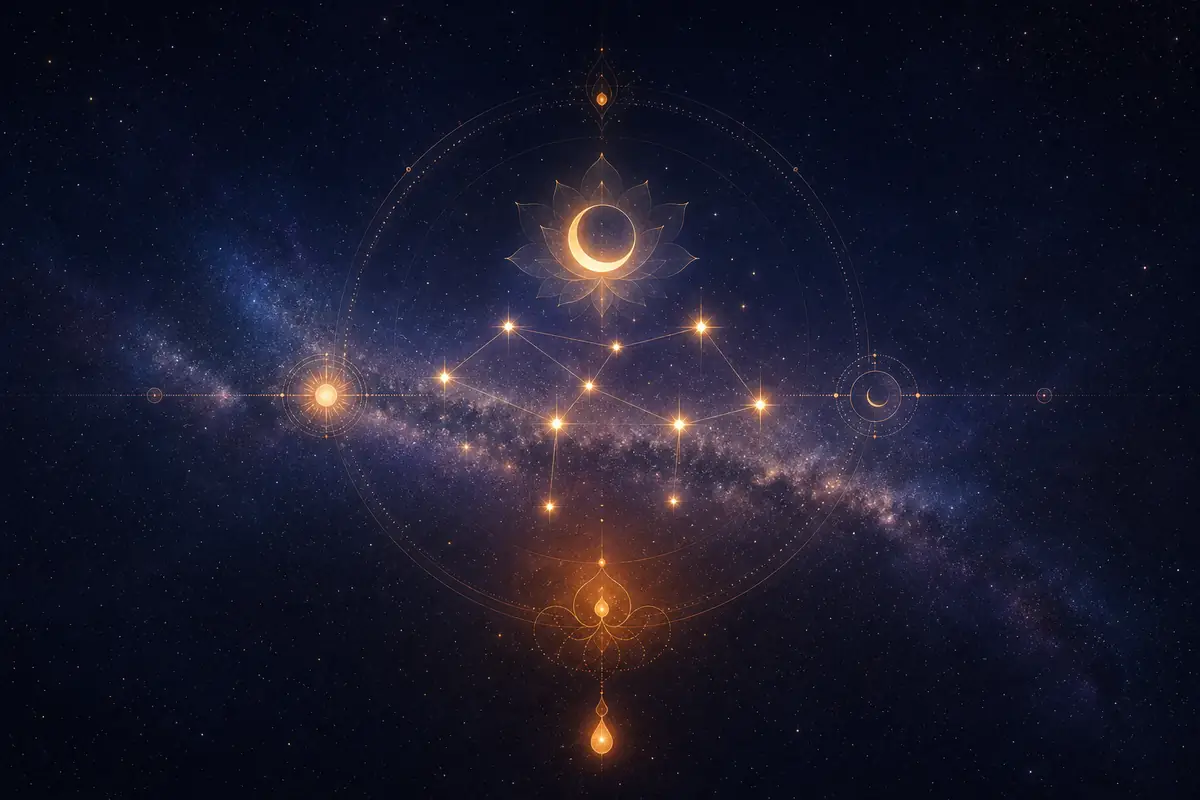
Shatabhisha Nakshatra, the twenty-fourth lunar mansion, is the nakshatra of the healer, the mystic, and the lone seeker of cosmic truth. Its name means 'a hundred physicians' or 'a hundred stars', and its symbol — an empty circle or a circle of a hundred stars — captures both its healing power and its profound solitude. Presided over by Varuna, the lord of cosmic law, the night sky, and the ocean of existence, Shatabhisha carries an oceanic depth that few other nakshatras can match.
Varuna's noose, and why a hundred physicians are needed
Shatabhisha spans 6°40' to 20°00' of Aquarius (Kumbha) in the sidereal zodiac. Its presiding deity is Varuna, the ancient Vedic god of rita — cosmic order — who governs the night sky, the waters, and everything hidden. Varuna is the god who binds: he carries a noose, and in the Vedic hymns he throws it over those who violate truth, which is why he is invoked both as the cause of certain afflictions and as the one who releases them. The nakshatra's name follows directly from that double role. When the illness is Varuna's, a hundred physicians may be required — and the shakti classically assigned to Shatabhisha, bheshaja shakti, is simply the power to heal.
The only nakshatra symbol that depicts nothing
Every other lunar mansion is pictured by an object — a bow, a throne, a cot, a pot. Shatabhisha's is an empty circle. Nothing is drawn inside it, and that absence is the point. A boundary is asserted; what it encloses is left undefined and is nobody else's business. It is the most accurate image in the system for a person whose inner life is enormous and almost entirely undisclosed. The variant reading, a circle containing a hundred stars, says the same thing from the other side: from outside, an unlit void; from inside, a sky.
Rahu in Aquarius and the appetite for what is off-limits
Shatabhisha's ruling planet is Rahu, the north lunar node, the classical significator of boundary-crossing, obsession, and knowledge acquired outside sanctioned channels. Placed in Aquarius, that hunger becomes systematic rather than chaotic — Rahu here investigates. The combination with Varuna is unusual and productive: Rahu wants the forbidden answer, Varuna insists that the answer must be true. Natives therefore tend toward research that respectable opinion has not yet endorsed, held to a standard of evidence stricter than the mainstream applies to itself. It is also why Shatabhisha is frequently found in the charts of astrologers, medical researchers, and technologists working ahead of consensus.
The habits of someone who researches alone
- Deeply independent — values private time above almost everything else.
- Scientifically and philosophically inclined — a natural investigator of hidden truths.
- Unconventional — Rahu ensures Shatabhisha walks paths others have not mapped.
- Secretive — shares selectively, carefully, and rarely on request.
- Compassionately service-oriented — behind the solitude is a genuine wish to heal.
- Mystically attuned — a real connection to cosmic law and the nature of reality.
When chosen aloneness quietly becomes confinement
Shatabhisha's solitude is a working condition, not a wound — but the boundary between the two is thinner than natives usually admit. The circle drawn to protect concentration keeps functioning after the work is done, and the same discipline that makes the mind rigorous makes positions hard to revise once adopted. Melancholy follows, along with a habit of withholding information other people genuinely need. The correction is not more socialising. It is noticing when the circle has stopped being a boundary and started being a wall.
The empty circle of Shatabhisha is not emptiness — it is infinite space, the kind of vastness that holds a hundred stars and the potential for a hundred more.
Fields where an unsupervised investigator is worth more
Medicine, astrology, astronomy, research science, philosophy, psychology, and technology all reward the same profile: long unsupervised investigation ending in a result nobody else reached. The healing instinct suits conventional medicine and energy-based practice equally. In relationships, Shatabhisha needs a partner who reads solitude as a working state rather than a rejection.
The four padas of Shatabhisha, from Sagittarian quest to Piscean surrender
- Pada 1 (6°40'–10°00' Aquarius, Sagittarius Navamsa): philosophically expansive and idealistic; driven by a quest for universal truth and higher wisdom.
- Pada 2 (10°00'–13°20' Aquarius, Capricorn Navamsa): disciplined and scientifically rigorous; the most practically accomplished pada in research and healing.
- Pada 3 (13°20'–16°40' Aquarius, Aquarius Navamsa): the most Aquarian pada — fiercely independent, innovative, and socially reformist.
- Pada 4 (16°40'–20°00' Aquarius, Pisces Navamsa): the most intuitive and spiritually sensitive pada; bridges the cosmic law of Varuna with deep compassion.
Partners who can leave Shatabhisha alone without leaving
Shatabhisha belongs to the Rakshasa gana, reflecting its fierce independence, and to the chara or movable group, which is why its attention travels. Swati shares Rahu's rulership and the same investigative freedom. Dhanishta shares the Aquarian ground and brings energy that enlivens the solitude. Purva Bhadrapada, also touching Aquarius, matches its philosophical intensity. Emotionally demanding or highly social nakshatras struggle here, because absence is not withdrawal of affection.
New to Vedic astrology? Read the full guide →
Get your free AI kundli reading — create an account →
Frequently Asked Questions
Why is Shatabhisha called 'a hundred physicians'?
The name points to its deity Varuna, who both binds with his noose and releases from it. An affliction that comes from cosmic law is not cured casually — a hundred healers may be needed. Shatabhisha's classical power, bheshaja shakti, is the power to heal.
What does the empty circle of Shatabhisha mean?
It is the only nakshatra symbol that depicts no object at all. The circle asserts a boundary while leaving its contents undefined, which mirrors natives whose inner world is vast and deliberately undisclosed. The alternative image, a circle of a hundred stars, describes the same space seen from inside.
Is Shatabhisha a good nakshatra for a medical career?
It is one of the strongest healing nakshatras in the system, and it favours research, diagnosis, and alternative or energy-based practice as much as clinical work. Rahu's rulership tends to draw natives toward the unexplained case rather than routine treatment.
Why do Shatabhisha natives prefer to be alone?
Solitude is the condition their work requires, not a symptom. The difficulty is that the same protective circle keeps operating after the work ends, so aloneness can harden into isolation and positions can become difficult to revise.