Birth Chart Compatibility & Synastry: How Astrology Reads Relationships
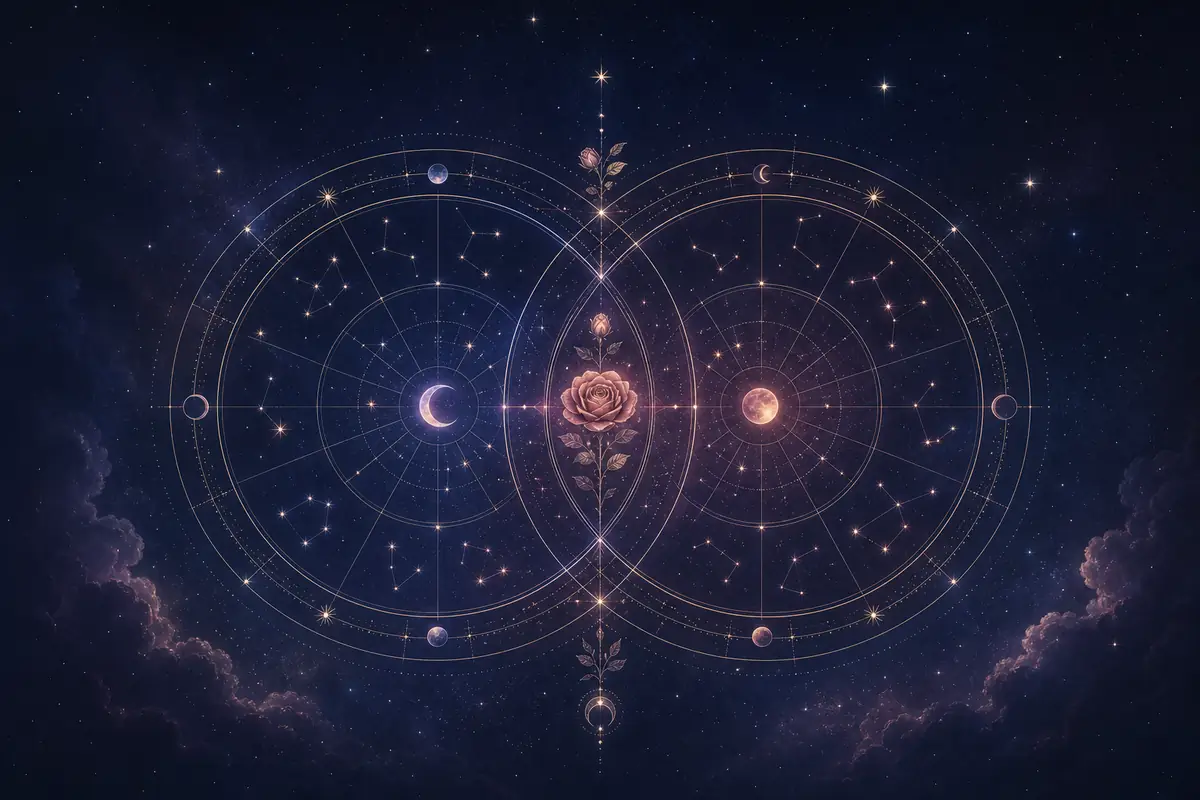
“Are we compatible?” is one of the oldest questions people bring to astrology. The shallow answer — “you're both Scorpios, so yes” — has almost nothing to do with what astrology can actually reveal. The real answer lives in synastry: the technique that places two complete birth charts side by side and reads the angular relationships between every planet in both charts. Astrologer AI brings this depth to anyone with two birth dates — and an AI that can walk you through what it all means. Create your account to get a full birth chart compatibility reading now.
Sun-Sign Matching vs. Real Synastry
Pop astrology collapses zodiac compatibility down to twelve Sun signs. The problem: your Sun sign is one data point out of roughly thirty in a natal chart. It says nothing about your emotional needs (the Moon), your love language (Venus), your drive and desire (Mars), your communication style (Mercury), or the houses — the life areas — you actually inhabit. Matching two Sun signs is like judging a book by its first word.
Relationship astrology takes a different approach. A synastry chart overlays both natal charts and computes every inter-chart aspect: the angular distances between, say, your Venus and your partner's Mars, your Moon and their Saturn, your Sun and their Moon. Those angles — conjunctions, trines, squares, oppositions, sextiles — describe the actual dynamics at play between two specific people, not two Sun-sign archetypes.
The result is a reading that can feel uncannily accurate precisely because it is built from real chart data. Two Leos can have wildly different synastry with the same Aquarius partner depending on where their Moons, Venuses, and Saturns fall. Generic zodiac compatibility cannot capture that. A full synastry reading can.
The Inter-Chart Aspects That Actually Matter
When astrologers analyze birth chart compatibility, they focus first on contacts between the personal planets: Sun, Moon, Mercury, Venus, and Mars. These planets are fast-moving and personal, which means their inter-chart aspects describe everyday relating — how you communicate, how you feel around each other, whether there is spark and warmth.
Sun – Moon Contacts
A Sun-Moon conjunction or trine between two charts is the classic indicator of emotional attunement. The Moon person feels seen and nurtured by the Sun person; the Sun person feels energized and supported. In long-term relationships, strong Sun-Moon contacts are often found in couples who describe feeling “at home” with each other. A square or opposition is more challenging: there is still a magnetic pull, but the Sun person's core identity can feel threatening to the Moon person's emotional security, generating recurring friction.
Venus – Mars Aspects
Venus-Mars contacts are the signature of romantic chemistry and physical attraction in relationship astrology. A conjunction, trine, or sextile between one person's Venus and the other's Mars creates natural desire and complementarity — each person tends to express exactly what the other is drawn to. Squares and oppositions can produce intense attraction too, but with an edge of competitiveness or frustration that needs conscious navigation. Same-sign or opposite-sign Venus-Mars contacts in the charts of two people frequently accompany descriptions of “instant chemistry.”
Moon – Moon and Moon – Venus
The Moon in synastry governs emotional resonance, domestic life, and nurturing. A Moon-Moon trine or conjunction suggests that two people feel emotionally comfortable and understood without having to explain themselves. Moon-Venus contacts add affection, warmth, and a quality of genuinely enjoying each other's company. These aspects are particularly important in long-term relationships where daily emotional comfort matters as much as initial attraction.
Saturn Aspects: The Glue and the Grind
Saturn contacts are double-edged in any synastry chart. Saturn conjunct a partner's Sun, Moon, or Venus can feel steadying and committed on a good day, and restricting or critical on a harder one. Many enduring long-term relationships carry Saturn contacts — they provide structure and seriousness — but they also tend to surface issues around control, responsibility, and self-worth. They are not “bad” aspects so much as aspects that ask both people to grow.
Conjunctions, Trines, Squares, and Oppositions
In practical terms: conjunctions (0°) blend two planets' energies — powerfully, for better or worse. Trines (120°) and sextiles (60°) create ease and natural flow; they are the aspects that make a relationship feel effortless. Squares (90°) generate friction and tension that can be creatively productive or exhausting. Oppositions (180°) create polarity — a strong pull toward and against simultaneously, often experienced as “we are so different, yet we can't stay away.” Most synastries contain all of these. The question is which patterns are strongest and how consciously the people involved work with them.
House Overlays: Where Your Planets Land in Their Life
Aspects between planets tell you how two people interact. House overlays tell you where. When one person's planets fall in a specific house of the other's chart, they activate that house's themes in the other person's life.
For example: if your Venus falls in your partner's 7th house (the house of partnership), you naturally occupy the role of the ideal partner in their inner world. If their Saturn falls in your 10th house (career and public life), they may feel like a demanding mentor figure — inspiring but also pressure-generating — around your ambitions. If someone's Jupiter falls in your 4th house, they expand and brighten your sense of home and family.
House overlays require knowing both people's exact birth times, which is why a serious birth chart compatibility reading always starts with accurate birth data on both sides. When that data is available, the full synastry picture — aspects plus house overlays — is considerably richer than aspects alone.
Synastry Beyond Romance: Friendships and Work
Relationship astrology is not only for couples. The same synastry techniques that reveal romantic dynamics apply to any significant relationship: a long-term friendship, a business partnership, a creative collaboration, a parent-child bond, or a difficult dynamic with a colleague.
The planets being activated change the reading's emphasis. In a friendship, Moon-Moon and Mercury contacts tend to be more descriptive than Venus-Mars. In a business partnership, Saturn contacts (who plays the disciplinarian?), Jupiter contacts (who brings optimism and expansion?), and Sun-Sun aspects (whose identity leads?) become central. In a parent-child dynamic, Saturn, Moon, and the 4th house carry extra weight.
Knowing the synastry chart for a working relationship can clarify why a team collaboration feels energized or stuck, or why one person instinctively defers to another. It does not assign blame — it maps the energetic terrain so both parties can navigate it more consciously.
Composite Charts: The Relationship as Its Own Entity
Alongside synastry, many astrologers use the composite chart — a single chart created by finding the midpoints between both people's planets. Where a synastry chart describes how two individuals interact, the composite describes the relationship itself as a third entity with its own character, purpose, and challenges.
A composite Sun in the 7th house, for instance, suggests a relationship whose central purpose is partnership and mutual growth. A composite Moon in the 12th suggests an emotionally private bond, one that may feel fated or carry unspoken undercurrents. Composite Saturn conjunct the Sun describes a relationship built on serious commitment and shared responsibility. Together, synastry and the composite chart give the fullest picture of both how two people relate and what they are building together.
How an AI Compatibility Reading Works
Traditional synastry analysis requires a skilled astrologer to calculate both charts, identify the key aspects, weigh them relative to each other, and synthesize a coherent narrative. That process is time-consuming, expensive, and — critically — hard to ask follow-up questions about. An AI synastry reading on Astrologer AI changes all three of those constraints.
You enter both birth profiles (date, time, and place for each person). The calculation engine computes the full synastry grid — every inter-chart aspect, every house overlay — with astronomical precision. The AI then interprets those specific patterns in plain language: not “Venus trine Mars is good for romance” in the abstract, but “your Venus at 14° Taurus trines their Mars at 16° Virgo — here is what that tends to create between two people.” Then you can ask: “What does it mean that their Saturn is on my Moon?” or “Is this a good partnership for a business?” — and the AI answers from your actual charts.
This is where an AI birth chart compatibility reading differs from a static report. It is a conversation. You bring your questions, your context, and your specific relationship dynamics, and the AI grounds its answers in the real chart data rather than generic archetypes. Explore the Western astrology chart tool to get started with your own chart first, then bring a second profile for synastry.
What Synastry Cannot Tell You
Honest relationship astrology acknowledges its limits. Synastry describes the energetic field between two people; it does not dictate behavior, choices, or outcomes. Two charts with a challenging Saturn square can describe a relationship that becomes deeply transformative and committed — or one that never quite works because neither person addresses the underlying tension.
Synastry also cannot account for timing in isolation. A relationship may become available only at a certain life stage, or the moment of meeting may shape how the same aspects are experienced. For timing, transits and progressions to both natal charts add another layer of context.
What synastry can do is give you a vocabulary for what you feel. When a relationship has inexplicable intensity, a Saturn square to your Sun in the other person's chart names it. When a friendship feels effortless, a Moon-Jupiter trine shows you why. That vocabulary is not a script — it is a map. The choices remain yours.
Getting Started With Birth Chart Compatibility
You need three things for a meaningful synastry reading:
- Both people's birth data — date, time, and place of birth for each person. Exact birth time matters most for accurate house placements and the Ascendant.
- Both natal charts calculated — not just Sun signs, but the full planetary picture.
- A way to read the inter-chart aspects — which is where Astrologer AI's AI makes the process accessible, even if you have never studied astrology.
If you are curious about a relationship — romantic, professional, or otherwise — start with your own chart on the Western astrology page, then bring the other person's birth data to run a full synastry chart comparison. Create your account to get your first compatibility reading and discover what your charts reveal about the relationships that matter most.
Frequently Asked Questions
What is synastry?
Synastry is the branch of relationship astrology that compares two people's birth charts side by side. Each planet in one chart is measured against every planet in the other to find inter-chart aspects — conjunctions, trines, squares, and more — that describe how the two individuals interact, attract, challenge, and support each other.
How does birth chart compatibility work?
Birth chart compatibility works by overlaying two natal charts and calculating the angular relationships (aspects) between their planets. Key pairings include Sun-Moon, Venus-Mars, and Moon-Moon contacts. House overlays — where one person's planets land in the other's chart — show which areas of life each person activates for the other. Together these patterns reveal emotional resonance, attraction, friction, and long-term potential.
What aspects matter most for compatibility?
The most significant aspects for compatibility are conjunctions (0°), trines (120°), and sextiles (60°) between personal planets, which tend to create ease and attraction. Squares (90°) and oppositions (180°) create tension that can generate passion or conflict. Sun-Moon conjunctions and trines indicate deep emotional attunement. Venus-Mars aspects drive romantic chemistry. Moon-Moon and Moon-Venus contacts shape emotional comfort and nurturing between partners.
Is zodiac compatibility based on Sun signs accurate?
Sun-sign zodiac compatibility — the kind that says 'Leos and Aries match well' — is a very rough shorthand. It uses only 1 of the 10+ planets in a chart and ignores house placements, aspects, the Moon, rising sign, Venus, and Mars entirely. A full synastry reading compares both complete birth charts and is far more specific and meaningful than Sun-sign matching.
Can synastry predict relationship success?
Synastry reveals the energetic landscape of a relationship — its strengths, its growth edges, and its recurring tensions — but it does not determine outcomes. Two charts with many squares can describe a passionate, transformative relationship; a chart full of trines can still describe a relationship that stagnates. Synastry is a map, not a verdict.
Does synastry work for friendships and work relationships?
Yes. Synastry applies to any two people — romantic partners, close friends, business partners, parent and child, or colleagues. The planets and aspects read differently in each context: Venus-Mars contacts are more relevant for romance, Sun-Jupiter for mentorship, Saturn contacts for professional structure. The chart overlay describes the dynamic regardless of relationship type.