Chinese Zodiac Compatibility: Best & Worst Matches
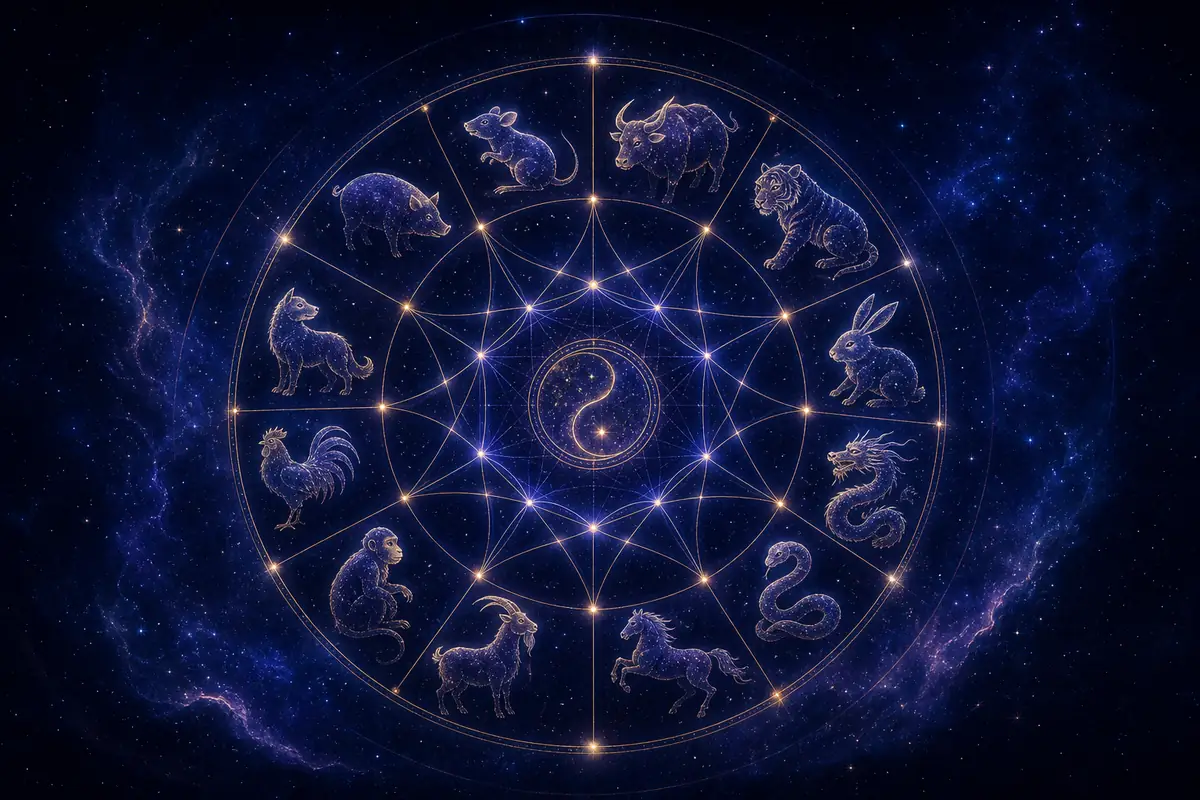
Chinese zodiac compatibility is one of the most practical and enduring tools in traditional Chinese astrology. For centuries, families consulted astrologers before marriages, business partnerships, and even friendships to understand whether two people's animal signs would support or undermine each other. The system is built on clear structural logic: twelve signs, arranged in a cycle, grouped into natural allies and natural antagonists. Once you understand the underlying framework, the compatibility of any two signs becomes readable at a glance.
How Chinese zodiac compatibility works
The twelve Chinese zodiac animals are not randomly ordered — they are arranged in a wheel that encodes relationships between signs. The most important structures in that wheel are the four Triangles of Affinity (groups of three highly compatible signs) and the Six Clashes (pairs of signs that sit opposite each other and naturally generate friction). Secondary structures include the Six Combinations (pairs that are particularly harmonious) and the Three Penalties, though the triangles and clashes are the most widely used in everyday compatibility readings.
The four triangles of affinity
Each Triangle of Affinity groups three signs that share a fundamental temperament, energy, and approach to life. Signs within the same triangle understand each other instinctively, make natural allies, and tend to create productive, lasting relationships — whether romantic, professional, or platonic.
- First Triangle — Rat, Dragon, Monkey: the ambitious, resourceful, and intellectually driven trio. These three signs are competitive, forward-moving, and energised by ideas and opportunity.
- Second Triangle — Ox, Snake, Rooster: the disciplined, methodical, and excellence-driven trio. These three signs are patient, precise, and motivated by mastery and long-term achievement.
- Third Triangle — Tiger, Horse, Dog: the passionate, freedom-loving, and principled trio. These three signs are action-oriented, fiercely loyal, and guided by a strong moral compass.
- Fourth Triangle — Rabbit, Goat, Pig: the gentle, creative, and emotionally expressive trio. These three signs are empathetic, peace-seeking, and drawn to beauty and deep human connection.
The six clashes: most challenging pairings
The Six Clashes identify pairs of signs that sit directly opposite each other on the zodiac wheel and carry fundamentally incompatible energies. Clashing signs are not necessarily doomed — many successful relationships exist between clash pairs — but they require conscious effort, compromise, and mutual understanding to navigate the inherent tension.
- Rat and Horse clash — the Rat's cautious strategy versus the Horse's impulsive optimism.
- Ox and Goat clash — the Ox's rigid structure versus the Goat's free-spirited creativity.
- Tiger and Monkey clash — the Tiger's proud authority versus the Monkey's irreverent cleverness.
- Rabbit and Rooster clash — the Rabbit's sensitive diplomacy versus the Rooster's blunt candour.
- Dragon and Dog clash — the Dragon's grand idealism versus the Dog's grounded pragmatism.
- Snake and Pig clash — the Snake's guarded complexity versus the Pig's open-hearted trust.
A clash does not mean failure — it means two people must work harder to bridge a genuine difference in how they see the world. Many of history's most dynamic partnerships have been clash pairs.
How compatibility is used in relationships
In traditional Chinese culture, zodiac compatibility was consulted for marriage, business partnerships, and even the timing of important meetings. In practice, compatibility readings consider three layers: the birth year animal (the most commonly referenced), the birth month animal (the inner animal, reflecting emotional nature), and the birth hour animal (the secret animal, reflecting the unconscious self). A thorough BaZi reading — Chinese Four Pillars astrology — maps all three alongside the Five Elements to give a nuanced picture of two people's dynamic.
For everyday use, the triangle and clash framework provides a reliable starting point. If two people share a triangle, they are likely to find each other naturally easy and energising. If they are a clash pair, they may experience recurring friction around specific themes — communication style, approach to risk, or values around security and freedom. Neither outcome is fixed: self-awareness and willingness to understand a different worldview can bridge any gap.
Read the Chinese zodiac 2026 guide →
Get your free AI BaZi reading — create an account →
Frequently Asked Questions
Which Chinese zodiac signs are most compatible?
Signs within the same Triangle of Affinity are most compatible: Rat-Dragon-Monkey, Ox-Snake-Rooster, Tiger-Horse-Dog, and Rabbit-Goat-Pig. Within each triangle, the three signs share a fundamental temperament and tend to support each other naturally in relationships and partnerships.
Which Chinese zodiac signs clash?
The Six Clashes are: Rat-Horse, Ox-Goat, Tiger-Monkey, Rabbit-Rooster, Dragon-Dog, and Snake-Pig. These pairs sit opposite each other on the zodiac wheel and carry contrasting energies. Clash relationships are not impossible, but they typically require more conscious effort and mutual understanding.
Is Chinese zodiac compatibility accurate for romantic relationships?
The animal year sign is one layer of a much richer system. A complete Chinese astrology compatibility reading also examines the month pillar (emotional nature), hour pillar (deeper self), and the interplay of the Five Elements across all four pillars. Year-sign compatibility is a useful starting point, but a full BaZi reading gives a far more accurate picture.
Can clash zodiac pairs have successful relationships?
Yes. A clash indicates natural tension between two temperaments — not an insurmountable obstacle. Many successful marriages and business partnerships exist between clash pairs. Awareness of the specific friction points (communication style, approach to risk, values around freedom versus security) allows both people to navigate their differences consciously rather than being surprised by recurring conflicts.