Mars in Capricorn: Drive, Anger & How You Act
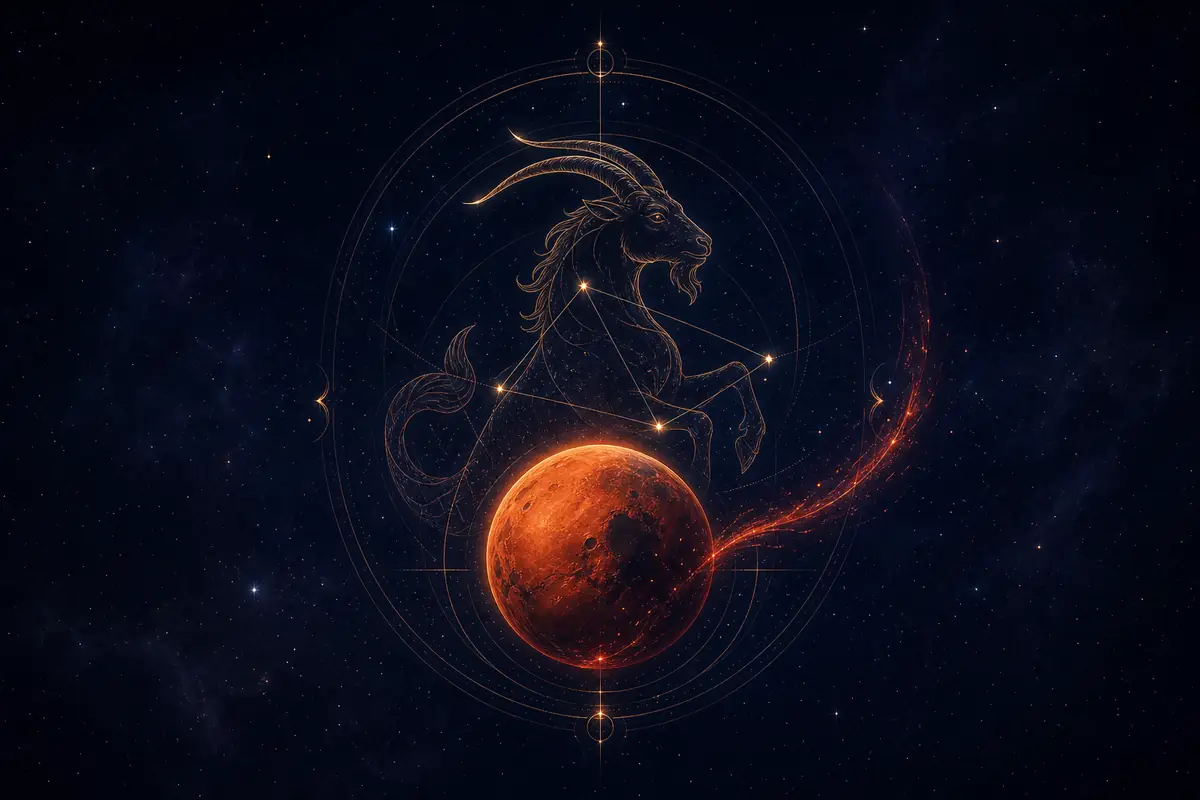
Exaltation is the dignity of an honoured guest, raised above its ordinary station — different from domicile, which is ownership. Mars is exalted in Capricorn, exact at 28°, and what Saturn's sign gives it is not more force but the one quality Mars does not supply on its own: patience. Cardinal earth still initiates — Capricorn is a cardinal sign — but the initiation is aimed at a structure that will still be standing years later, not at whatever happens to be directly in front of it.
Exaltation, exact at 28°: an honoured guest, not an owner
Exaltation and domicile are often run together, and Capricorn is the placement where the difference matters most for Mars. Domicile — Mars's own condition in Aries or Scorpio — means the planet owns the territory and needs no help operating there. Exaltation is more specific: Mars is a guest in Saturn's sign, honoured and raised above its usual station, but still working by rules that belong to its host. Capricorn's exaltation is exact at 28°, the far end of the sign, the last degree before it gives way to Aquarius.
What Saturn adds that Mars doesn't carry on its own
Mars, left to its own devices, wants a target and a fast route to it. Saturn's rule runs the other way: consolidate, wait, build the structure that survives contact. Put Mars in Saturn's sign and the planet keeps its capacity for direct action but loses its impatience — the single trade that accounts for nearly everything distinctive about this placement. The drive is not quieter. It has learned to wait for the right moment rather than the first one.
Cardinal earth: still first to move, but only once the ground is tested
Capricorn is cardinal, so this placement initiates as readily as Aries or Libra does — it does not sit back and let events happen to it. What differs is the threshold before action starts. Earth signs test footing before committing weight, and Capricorn does this more than any other sign: the ground gets checked, the plan gets a timeline, the risk gets priced, and only then does the cardinal instinct to begin actually fire. To an outside observer the caution can look like reluctance. It is closer to a refusal to move before the move will hold.
Its opposite sign, Cancer, is where Mars falls instead
Capricorn's opposite sign is Cancer, where Mars is in its only fall — force that turns sideways rather than forward, protection standing in for a direct hit. The axis sets two responses to threat against each other. Capricorn Mars answers by building a structure sturdy enough that the threat cannot recur; Cancer Mars answers by shielding whatever is already exposed. Both are more indirect than Aries's straight strike, but only one of them is built to last for years.
- Sets goals in years, not days, and does not need an early win to stay motivated
- Treats status and long-term position as legitimate reasons to act, not vanity
- Rarely announces intentions before the structure to support them already exists
- Can be mistaken for low drive by anyone expecting Mars to look like urgency
Other Mars placements ask what you want right now. This one asks what you will still want to have built in ten years, and moves accordingly.
Strategy aimed at a result years out
Because the horizon is long, the day-to-day expression of this Mars can look understated — effort spent on groundwork nobody outside the plan can see, milestones that matter to the strategy but not to any observer. That patience is the real advantage. Where a faster placement burns out chasing a result that should have taken longer, exalted Mars in Capricorn is still working the plan on schedule, because the schedule was realistic from the start.
The cost of a dignity built on delay
The trade Saturn offers is not free. A Mars that has learned to wait can also learn to wait indefinitely — postponing the reward past the point of use, treating every want as premature until circumstances are perfect, which they never quite are. The corrective is not to abandon the long view. It is to schedule the payoff as deliberately as the plan itself, so patience stays a strategy rather than quietly becoming permanent deferral.
Western chart analysis explained — read the guide →
Get your personal AI birth chart reading — create a free account →
Frequently Asked Questions
What does it mean that Mars is exalted in Capricorn?
Exaltation means Mars is honoured in Capricorn without owning it outright, the way it does in Aries or Scorpio. The dignity is exact at 28° Capricorn. Saturn's sign gives Mars patience and staying power, so it expresses through discipline and long-range planning rather than raw impulse.
Is Mars stronger in Capricorn than in Aries or Scorpio?
Not stronger — differently expressed. Aries and Scorpio are Mars's own signs, where it needs no help operating. Capricorn is exaltation, a guest status that channels Mars through Saturn's patience and structure, producing sustained, strategic effort rather than the immediate drive of a domicile.
Why is Mars in Capricorn described as ambitious?
Capricorn is cardinal earth, so this placement initiates readily, but only after testing the ground — pricing the risk, setting a realistic timeline. Combined with Saturn's long horizon, that produces goals measured in years and a willingness to treat status as a legitimate, unembarrassed objective.
Does Mars in Capricorn struggle to know when to stop?
It can. The same patience that makes this Mars effective can tip into indefinite deferral — treating every reward as premature until conditions are perfect. The fix is scheduling the payoff as deliberately as the plan, so waiting remains a strategy rather than a permanent postponement.