Relationship Compatibility Birth Chart Basics
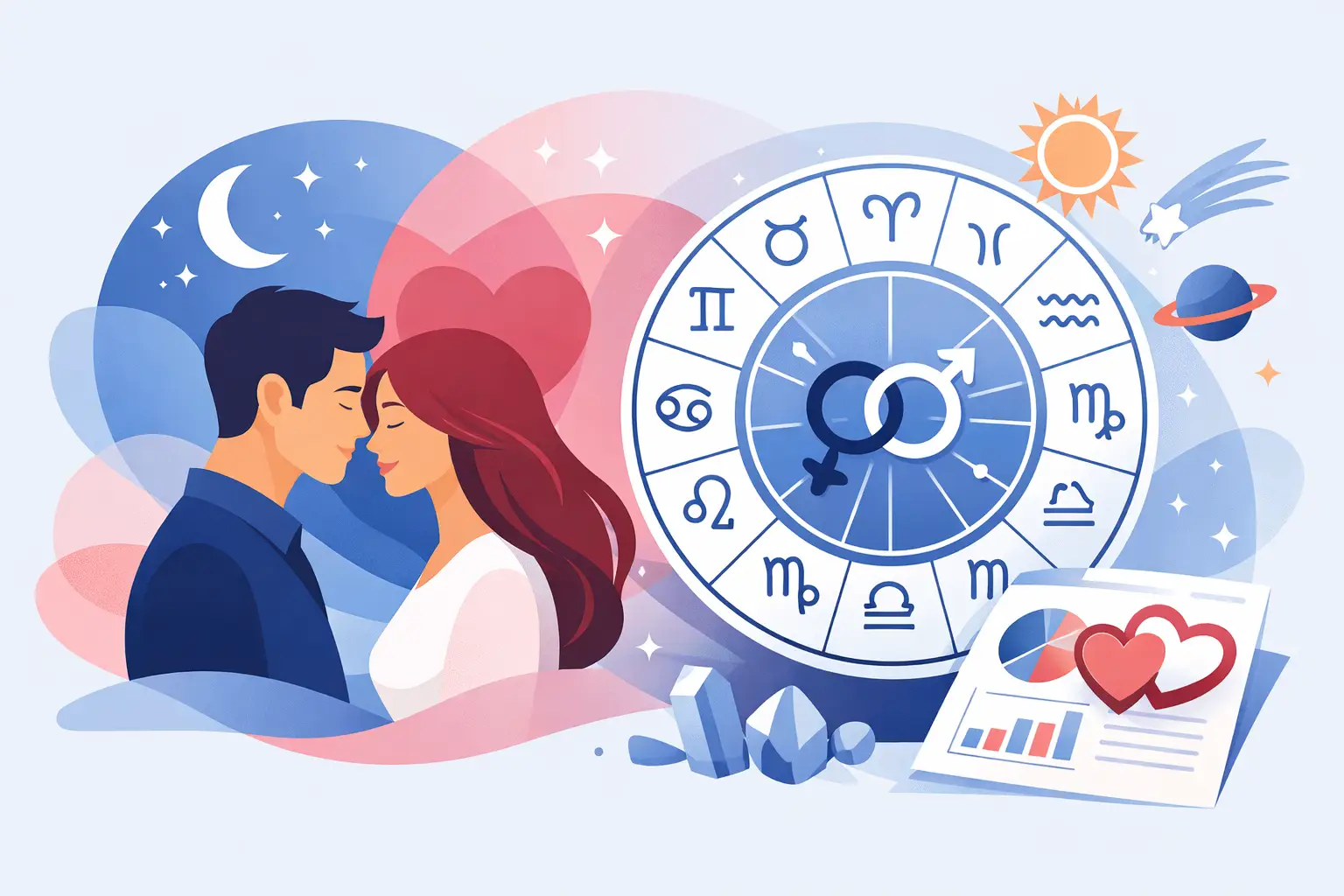
You can have instant chemistry with someone and still hit the same argument every two weeks. You can also meet a person who feels calm, steady, and almost strangely familiar without the usual fireworks. A relationship compatibility birth chart helps explain why. It looks beyond Sun sign shorthand and into the actual interaction between two full charts — emotions, communication style, attachment patterns, timing, and the parts of each person that naturally support or challenge the other.
That matters because compatibility in astrology is rarely a simple yes or no. Most relationships are a mix of ease and tension. The useful question is not, are we meant to be? It is, what happens when your chart meets mine, and what can we do with that information?
Want to compare two charts directly? Create your account and run a full synastry comparison in minutes.
What a relationship compatibility birth chart actually shows
In astrology, relationship analysis usually starts with synastry. Synastry compares two natal charts to see how one person’s planets interact with the other person’s planets, angles, and houses. This is where astrologers look for attraction, emotional resonance, friction, shared values, and recurring misunderstandings.
For example, one person’s Venus might connect beautifully with the other person’s Moon, which can create warmth and emotional affection. But if that same pairing also includes Mercury square Saturn, the relationship may struggle when feelings need to become words. You might care deeply for each other and still feel chronically unheard.
A compatibility chart can also show house overlays. That means one person’s planets fall into specific life areas in the other person’s chart. If someone’s Sun lands in your seventh house, you may experience them as especially relationship-oriented or significant. If their Mars lands in your fourth house, they might energize your home life — or bring conflict into private space. It depends on the rest of the chart.
This is one reason astrology feels more accurate when it moves past generic sign matches. Two Tauruses can have very different emotional needs. Two people with “bad” sign compatibility can have excellent long-term potential if other chart factors create trust, mutual respect, and growth. If the underlying wheel is still new to you, a primer on what a birth chart is makes the comparison easier to follow.
The placements that matter most in compatibility
The Sun gets the attention, but it is rarely the whole story. In a relationship compatibility birth chart, the Moon often tells you more about daily closeness. The Moon reflects emotional habits, comfort, sensitivity, and how each person responds under stress. If Moon connections are supportive, the relationship often feels easier to live inside.
Mercury matters just as much, especially after the early attraction phase. Strong Mercury contacts can make conversation feel natural, curious, and clarifying. Hard Mercury aspects are not always dealbreakers, but they can create a pattern where one person feels dismissed, rushed, or misunderstood.
Venus and Mars shape desire, affection, and relational rhythm. Venus shows how someone gives and receives love, what they value, and what feels sweet or beautiful to them. Mars shows drive, pursuit, sexuality, anger, and how someone takes action. When Venus and Mars connect well, attraction tends to move with less friction. When they clash, chemistry may still be strong, but the pace, style, or expectation around intimacy can feel off.
Saturn deserves special attention. People often worry when they see Saturn in relationship astrology, but Saturn is not automatically bad. It can indicate commitment, staying power, responsibility, and long-term influence. It can also feel heavy, critical, or restrictive if the bond lacks enough warmth and flexibility. Saturn is often where a relationship gets serious — or where it starts to feel like work.
Outer planets matter too, but context is everything. Pluto can intensify connection and bring obsession, transformation, or power struggles. Uranus can create excitement, unpredictability, and a need for freedom. Neptune can feel spiritual, romantic, and deeply idealized, but also blurry. These placements do not ruin or guarantee anything. They simply describe the atmosphere people step into together.
Why synastry is only half the picture
A lot of people stop at synastry, but that is only one layer. The other major tool is the composite chart, which blends two natal charts into a single chart for the relationship itself. Synastry shows interaction. A composite chart shows the identity of the bond.
This distinction matters. You may have easy synastry and still create a relationship that drifts, avoids conflict, or lacks direction. Or you may have challenging synastry with a composite chart that suggests deep purpose and resilience. In real life, some relationships feel complicated person-to-person but become meaningful because the bond itself has structure.
A composite Sun shows the core style of the relationship. A composite Moon reveals its emotional tone. Composite Saturn can show responsibility and weight. Composite Venus describes how affection flows in the bond. If you want a fuller view, you need both charts.
This is where digital astrology tools become especially useful. Reading two natal charts, synastry aspects, house overlays, and a composite chart at once can get technical fast. A well-designed interface helps you move from raw placements to something more usable: what feels natural here, what creates tension, and where growth is likely required.
What compatibility cannot tell you
Astrology can describe a relationship pattern with surprising precision, but it cannot make choices for either person. A strong chart connection does not guarantee emotional maturity. A difficult chart comparison does not mean a relationship is doomed.
This is the part people often skip. Compatibility is not just chemistry. It is chemistry plus self-awareness, timing, communication skills, willingness, and the life circumstances surrounding the relationship. A chart may show intense attraction, but if one person is avoidant and the other wants immediate commitment, the lived reality will still be difficult.
There is also a difference between karmic feeling and healthy partnership. Some chart contacts feel fated because they activate old material, deep desire, or unresolved emotional patterns. That can be transformative, but it is not always peaceful. Sometimes the chart explains why you cannot stop thinking about someone. It does not automatically mean they are the best person to build a life with.
How to read a compatibility chart without oversimplifying it
Start with the emotional layer. Look at Moon contacts, fourth house activity, and any Venus-Moon aspects. Ask whether the relationship feels emotionally safe, not just exciting.
Then look at communication. Mercury aspects can tell you whether the two of you process information similarly, argue productively, or repeatedly miss each other’s meaning. This area becomes more important over time, not less.
After that, check attraction and momentum through Venus and Mars. This gives shape to chemistry, flirtation, desire, and relational pacing. Then examine Saturn and the outer planets to understand seriousness, volatility, fantasy, transformation, and long-term pressure points.
Finally, look at the whole pattern. One difficult aspect rarely defines a relationship. What matters is repetition. If multiple placements point to emotional distance, control issues, or unstable timing, pay attention. If several placements support affection, honesty, and mutual grounding, that matters too.
The best interpretations balance precision with humility. Astrology can name the pattern, but the pattern still needs to be lived.
Relationship compatibility birth chart tools and real use
For most people, the goal is not to become a professional astrologer. The goal is to understand what is happening with more clarity. A relationship compatibility birth chart becomes genuinely helpful when it translates technical data into real-world questions.
Do you soothe each other or trigger each other? Do you speak the same emotional language? Is the attraction mutual but unstable? Does the bond support commitment, or does it thrive on uncertainty? These are the questions that matter when you are deciding whether to lean in, slow down, repair, or let go.
That is why modern chart platforms are so effective when they do more than generate placements. They can organize the comparison, surface the strongest aspects, and explain the difference between romantic intensity and relational stability. Astrologer AI, for example, fits this approach well because it combines chart structure with interpretation, which makes deeper compatibility analysis more approachable for both beginners and experienced astrology users. You can even ask follow-up questions about your chart as the relationship evolves.
A good tool should help you see layers rather than force a verdict. It should show where connection flows, where it catches, and what might shift with timing or maturity.
When compatibility is strong but the timing is wrong
One of the hardest truths in astrology is that a promising match can still arrive at the wrong time. Transits, life cycles, and personal readiness all affect how a relationship unfolds. If someone is in a major Saturn period, they may be focused on rebuilding structure. If another person is moving through a Neptune-heavy phase, they may be more idealistic, porous, or uncertain. Understanding what planetary transits mean adds real nuance here.
That does not erase compatibility. It simply changes how available each person is to meet it. This is where timing-based astrology adds nuance. Sometimes the chart says yes, but not easily. Sometimes it says the lesson is real even if the relationship is brief. Mapping each person’s life cycles can show whether the season supports building something lasting.
A compatibility chart is best used as a mirror, not a verdict. It can show why the connection feels magnetic, why certain conflicts repeat, and where the relationship asks each person to grow. If you read it with honesty, it becomes less about chasing a perfect match and more about recognizing the kind of connection you are actually in — and what it is asking of you next.
Ready to see how two charts fit together? Create your account and explore your western astrology charts side by side today.
Frequently Asked Questions
What is a relationship compatibility birth chart?
A relationship compatibility birth chart looks beyond Sun sign shorthand at the actual interaction between two full charts, including emotions, communication style, attachment patterns, and timing. It usually starts with synastry, which compares two natal charts to see how one person's planets interact with the other person's planets, angles, and houses. It describes a pattern rather than a simple yes or no verdict.
Which placements matter most for compatibility?
The Sun gets attention, but the Moon often tells you more about daily closeness and emotional habits. Mercury shapes communication, Venus and Mars shape affection and desire, and Saturn indicates commitment and staying power. Outer planets like Pluto, Uranus, and Neptune describe the atmosphere two people step into together. What matters most is the repeating pattern, not any single aspect.
What is the difference between synastry and a composite chart?
Synastry shows the interaction between two people, while a composite chart blends two natal charts into a single chart for the relationship itself. Synastry describes how you affect each other, and the composite describes the identity of the bond. You may have easy synastry with a directionless composite, or challenging synastry with a composite that suggests deep purpose, so a full view uses both.
Can a birth chart predict if a relationship will last?
Astrology can describe a relationship pattern with surprising precision, but it cannot make choices for either person. A strong connection does not guarantee emotional maturity, and a difficult comparison does not mean a relationship is doomed. Compatibility is chemistry plus self-awareness, timing, communication, and willingness, so the chart is best used as a mirror rather than a verdict.