The G (Identity) Center in Human Design: Defined vs Undefined
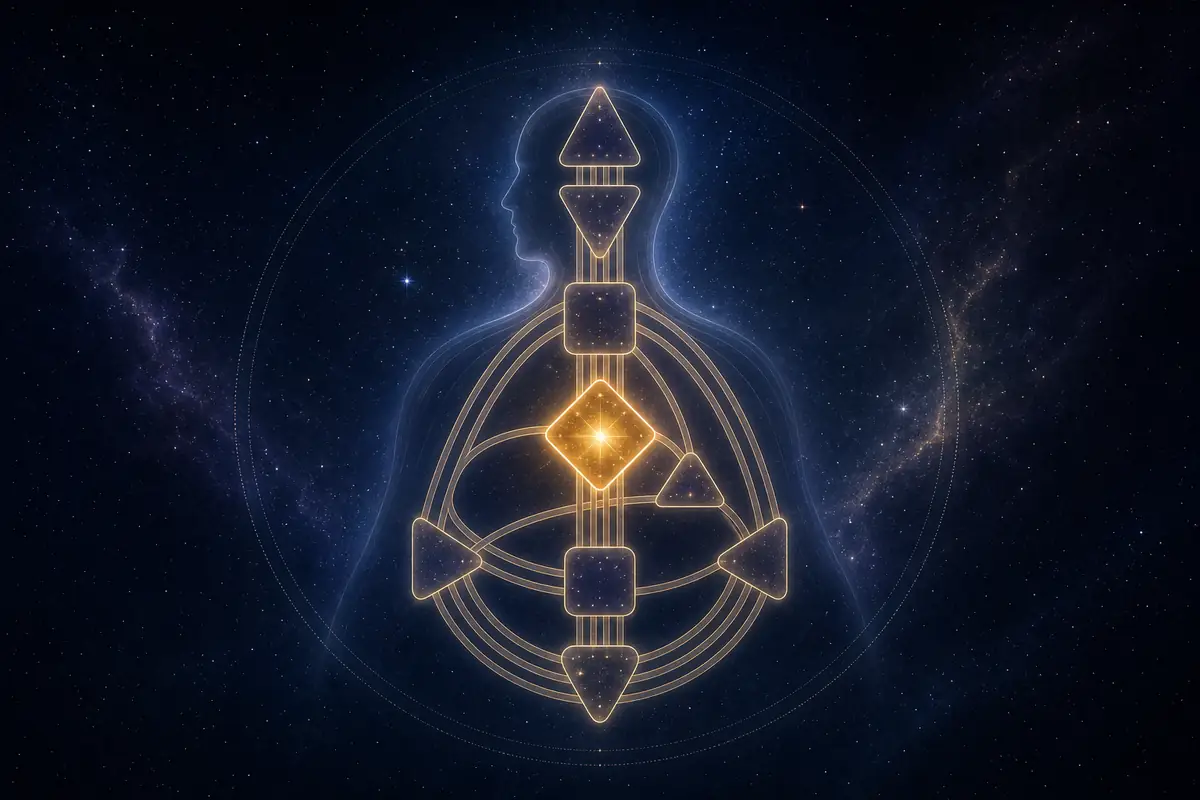
The G Center behaves like a magnetic monopole sitting at the geometric heart of the bodygraph — a single pole with no opposite, pulling the right people, places, and circumstances toward it rather than balancing between two forces. It carries identity, direction, and love together, which sounds abstract until you notice the one detail that makes the G Center different from every other center in the chart: when it's undefined, the question it raises isn't answered by who you're with. It's answered by where you are.
One pole, not two
A magnet with two poles balances attraction against repulsion. A monopole only pulls. That's the physical metaphor Human Design uses for the G Center's love: it isn't the negotiated give-and-take of the Heart Center's tribal exchange, and it isn't the emotional wave of the Solar Plexus. It's a constant, one-directional pull that draws the right circumstances toward you simply because of what's active in this center — not because of anything you do to attract them.
A pole that stays fixed no matter the coordinates
When your G Center is defined, your magnetic pole is fixed — it doesn't relocate depending on which room you walk into. Identity and direction stay stable across completely different environments, which means you can drop into an unfamiliar city, job, or social circle and still recognize yourself. The specific gates defined in your G Center set the character of that pull, but the fact of a fixed pole itself is the constant: you carry your own coordinates with you.
- Your magnetic pole doesn't move — the same pull operates whether you're at home or somewhere entirely new.
- Because the pole is fixed, you don't need the right location to feel like yourself; you bring the fix with you.
- Others can navigate by your fixed pole, which is why people often feel oriented simply standing near you.
- The risk is mistaking a fixed pole for a static one — direction can still deepen and evolve without ever relocating.
Where you are, before who you are
An undefined G Center has no fixed pole of its own, so its identity doesn't stabilize around a person the way it might seem to — it stabilizes around a place. This is the detail that separates the G Center from the other identity-adjacent centers: the undefined G isn't primarily conditioned by people overwriting who you are, it's shaped by the coordinates you're standing in. The right room, city, or piece of land can make you feel more like yourself than any conversation could; the wrong one can erase you regardless of who else is present.
The not-self question for an undefined G Center is: 'Do I love myself?' But the correct diagnostic question to ask first is a geographic one — 'Am I in the right place?' — because for this center, place answers the identity question before people do.
Reading your own coordinates
For a defined G, the practice is trusting the pole you already carry rather than second-guessing it based on unfamiliar surroundings — your magnetism works the same everywhere, so let it operate instead of forcing direction. For an undefined G, the practice is treating physical location as diagnostic data: pay attention to which rooms, cities, and landscapes leave you feeling like yourself, and which ones quietly erase you, and let that geography — not persuasion from other people — decide where you spend sustained time.
- Defined G: your pole is fixed regardless of geography — trust it rather than waiting for the 'right' place to feel like you.
- Undefined G: track your felt sense across different physical locations, not just different relationships, before deciding where to stay.
- Both: the G Center's love is a one-directional pull, not the negotiated exchange that runs through the Heart Center.
- Use your Strategy and Authority as the mechanism for actually moving toward the right coordinates, not willpower alone.
New to Human Design? Read the full guide →
Generate your free AI Human Design bodygraph →
Frequently Asked Questions
What does it mean that the G Center is a magnetic monopole?
A magnetic monopole only pulls — it has no opposing pole to balance against. The G Center's love works the same way: a constant, one-directional pull that draws the right people, places, and circumstances toward you, rather than the negotiated give-and-take found in the Heart Center's tribal exchange.
Why does location matter so much for an undefined G Center?
Because the undefined G Center has no fixed pole of its own, its sense of identity stabilizes around place rather than around any single relationship. The right physical environment can restore a felt sense of self that persuasion from other people cannot — which is why Human Design puts unusual weight on geography for this center specifically.
What does 'direction' actually mean in the G Center, separate from having a goal or a plan?
A plan is a mentally constructed route toward a known destination, decided in advance. G Center direction is closer to a magnetic pull toward what's correct next, without necessarily knowing where it leads — you can trust it without having mapped the destination first. That's why direction from this center is often only obvious in hindsight: the right steps show up one at a time, and the shape of where they were going only becomes visible after the fact, not before.
Can a defined G Center's identity still change over time?
Yes. A fixed pole isn't a static one — the direction it points can deepen, mature, and shift emphasis across a lifetime even though the pole itself doesn't relocate. What stays constant for a defined G is the presence of a fixed pole, not a frozen personality.